Tuesday, December 27, 2016

Lord of the Rings / Phases of the Moon II

In his fantasy masterpiece Lord of the Rings author J.R.R. Tolkein was in general consistent with real world astronomy when mentioning the phases of the moon. In a previous post A Peculiar Moon in Lord of the Rings I noted a couple of exceptions. Alas, I'm in the middle of rereading it for the zillionth time and found another glitch, this time in volume I, Fellowship of the Ring. This webpage Moon Phases in The Lord of the Rings kindly reproduces the offending passage and also sets out the relevant facts about the phases of the moon, but did not point out the inconsistency.
Above him was a black starry sky. Suddenly a pale light appeared over the crown of Weathertop behind him. The waxing moon was climbing slowly above the hill that overshadowed them, and the stars above the hill-top faded. ... ‘Look!’ said Merry. ‘The Moon is rising: it must be getting late.’
However, a waxing moon rises during the daylight hours, not at night!
Oddly enough, just a few pages earlier, while describing events taking place two nights previously, Tolkein mentioned the phase of moon accurately. “The moon was waxing, and in the early night-hours a cold grey light lay on the land.” That is correct: a waxing moon rises during the daylight hours and in the early night-hours it is still above the horizon.

Here's a speculative attempt to figure out in some detail the state of the moon the day of the incident at Weathertop - October 6 S.R. 1418. In appendix D, it says the our New Year's Day corresponds more or less to the Shire January 9. That means that the full moon - which they saw on January 8th S.R. 1419 when the Company reached Hollin - would correspond to our December 31st. There was a full moon in London on Dec 31, 1933, which can be used as a reference point. https://www.timeanddate.com/moon/phases/uk/london?year=1933

Also our 26th of September is probably a good approximation for October 6 S.R. - the date of the incident at Weathertop.

On September 26, 1933 the moon was half full and waxing https://www.timeanddate.com/moon/uk/london?month=9&year=1933.

6:52 sunrise 26th September
15:39 moonrise
18:51 sunset
22:25 moonset
6:54 sunrise 27th September, the next morning
16:23 moonrise the next afternoon

Daylight savings time was in effect during September in 1933 in England - not sure about Middle Earth on the corresponding date - but the intervals between sunrise/sunset/moonrise/moonset would not be effected.

So by that rationale, the moon would have never been above the horizon during the night of the incident at Weathertop.

Friday, December 19, 2014

Dark Matters

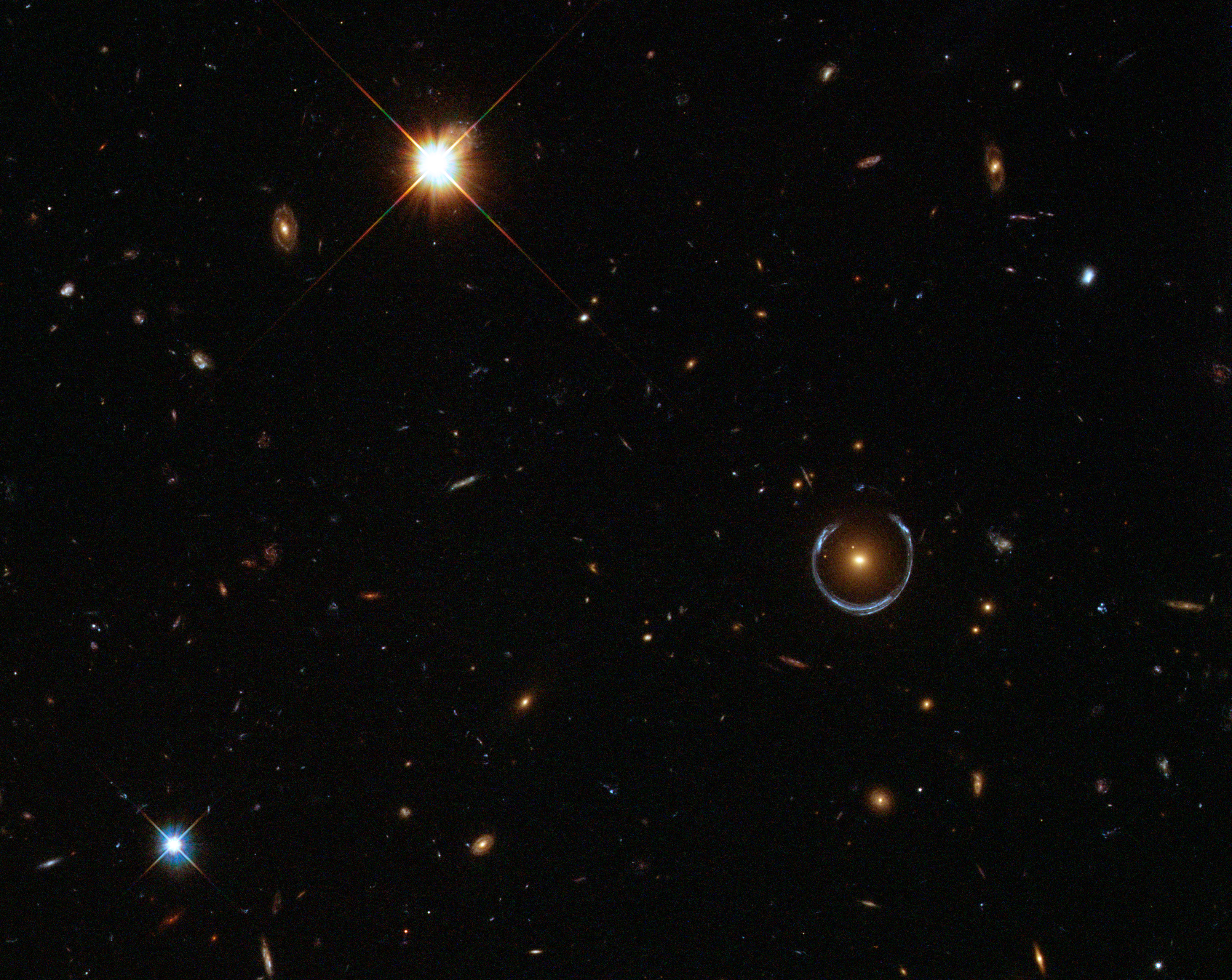
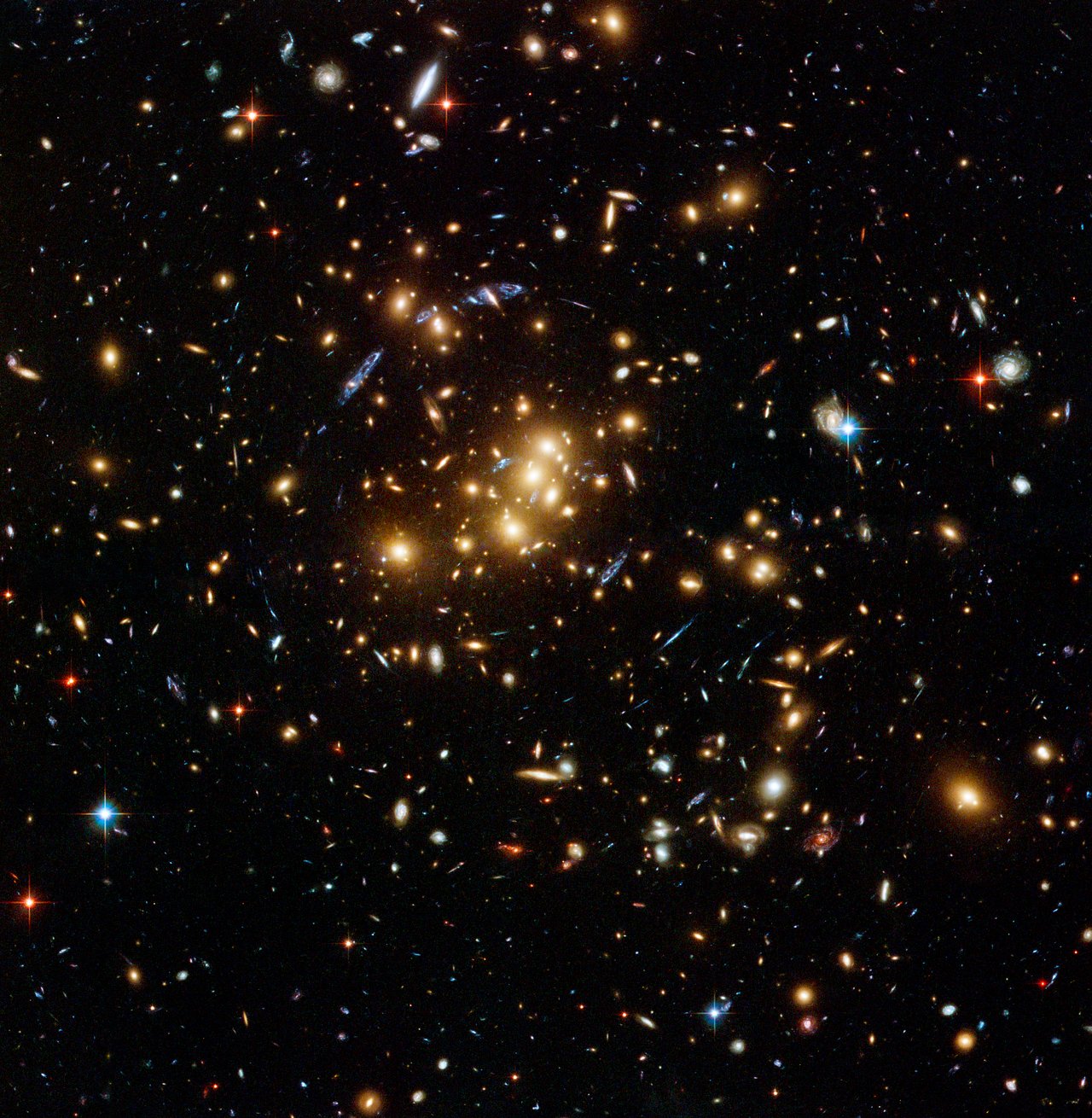
Recently I've been reading about proposals to explain the "Dark Matter" phenomenon by modifying the law of gravity, as opposed to invoking some unseen form of matter. The original proposal along those lines was MOND: Modified Newtonian Dynamics, invented by Israeli physicist Mordehai Milgrom. Modified Newtonian Dynamics: A Review is an excellent summary of the observational evidence and theories as of late 2011. It mentioned some mind-blowing gravitational lensing phenomena some of which have resulted in spectacular images.

Einstein Cross

Einstein Ring


Cluster CL0024+17 
The blue streaks near the center of CL0024+17 are not part of the cluster itself, they are images of galaxies much further way which have been magnified and distorted by the gravitational lensing effects of this massive cluster.

Saturday, September 20, 2014

Hong Kong Elementary School Admissions Test


How long did it take you to solve it? I'll tell you how I did in the comment section to avoid spoiling it for you.

Supernatural Horror in Literature by H. P. Lovecraft

Supernatural Horror in Literature (1927) by H. P. Lovecraft is a fantastic review, both for its breadth of coverage and the creepy way in which it is written. Here's the first paragraph:
The oldest and strongest emotion of mankind is fear, and the oldest and strongest kind of fear is fear of the unknown. These facts few psychologists will dispute, and their admitted truth must establish for all time the genuineness and dignity of the weirdly horrible tale as a literary form. Against it are discharged all the shafts of a materialistic sophistication which clings to frequently felt emotions and external events, and of a naively insipid idealism which deprecates the aesthetic motive and calls for a didactic literature to uplift the reader toward a suitable degree of smirking optimism. But in spite of all this opposition the weird tale has survived, developed, and attained remarkable heights of perfection; founded as it is on a profound and elementary principle whose appeal, if not always universal, must necessarily be poignant and permanent to minds of the requisite sensitiveness.
I've already acquired several of the classics he mentioned and will read them whenever I next feel the need to be weirded out. His only work of fiction that I recall reading was The Dunwhich Horror which was so creepy that I was never able to bring myself to read anything else by the author, despite my appreciation for the quality of his writing.

Lovecraft in 1934

Richard III

I just finished rereading Alison Weir's great book "The Wars of the Roses". Coincidentally, the article Perimortem trauma in King Richard III: a skeletal analysis recently appeared in the journal The Lancet. In 2012 a skeleton identified as Richard III's was discovered in Leicester, England and exhumed.  I also recommend a chilling 1995 film version of Shakespeare's play starring Ian McKellen set in an imaginary fascist 1930's Britain.

Digital photograph; arrow shows the penetrating injury to the maxilla
Richard III in Better Days

Movie Poster

Saturday, April 12, 2014

OSA EARS

The Osa Peninsula is a remote, biodiverse region of Costa Rica, home to Corcovado National Park. It's the site of the OSA EARS listening station, an audio streaming project in the Costa Rican rainforest where you'll soon be able to listen to the sounds of the jungle in real-time. The project's web site is not quite ready, but there's an introductory video at Vimeo. The program director is the SETI Institute's first Artist in Residence and Guggenheim Fellow Charles Lindsay. You can email the project team at info@osa-ears.org. Very cool!

Thursday, January 09, 2014

Beautiful Wind Map

There's a beautiful moving map of the wind for the United States at http://hint.fm/wind/. This is the moving wind map during Hurricane Sandy on October 30, 2012.

Monday, October 07, 2013

Turtles are more closely related to Crocodiles than Lizards!


CREDIT: G. GRULLÓN/SCIENCE
The orange line shows where turtles actually belong in this part of the tree of life, the dashed lines indicate previous suggestions.
New DNA techniques have recently been developed to more easily determine where species belong in the tree of life. See Large-Scale Gene Comparisons Boost Tree of Life Studies in Science. As you may have heard, birds and dinosaurs are closely related. Moving further up the tree, Archosaurs are a group that contain birds, dinosaurs and crocodiles as well as the extinct flying reptiles, the Pterosaurs. Thanks to this new research, turtles are now known to be the sister group to the archosaurs. https://upload.wikimedia.org/wikipedia/commons/e/e8/Turle124.jpg
A red-eared slider.

Sunday, September 15, 2013

Harriet Dark Art

Harriet Dark is an art student here in Boston. You can see more of her haunting work at Harriet Dark Art.


Monday, August 12, 2013

Scientism

Steven Pinker, a linguistics professor at Harvard and prolific author, has a provocative article at The New Republic web site, Science Is Not Your Enemy An impassioned plea to neglected novelists, embattled professors, and tenure-less historians (August 2013). Pinker says that science is now encroaching on matters traditionally in the realm of the humanities, for example human emotion and human values, and that has generated a backlash in various quarters: the humanities, religion and public policy. Scientism is a term - new to me - used by critics who believe that science is often misapplied when it address some of the traditional concerns of the humanities, religion and public policy. I have found many other things Pinker has written very interesting, especially when they are focused on his specialty, linguistics. However, this article seems to me yet another example of someone who knows a lot of science and feels like their scientific knowledge supports some of their other values and opinions, but their attempt to make their case unfortunately comes off very weak. I suspect that Pinker's article will often have the exact opposite effect of what he says he intends. Instead of reassuring people who think science overreaches, it will just seem like yet another attempt that misuses science to support someone's personal opinions. See The Scientism of Steven Pinker by Ross Douthat in the New York Times, for someone who didn't find Pinker at all convincing.
Faulty 'scientific' results have, of course, repeatedly been used to support personal biases, The Mismeasure of Man, by Steven Jay Gould is a collection of interesting historical examples. In some cases the errors and misinterpretations were really rather subtle, but invariably the errors somehow ended up supporting the preconceived notions of the investigators.

Tuesday, August 06, 2013

Bunker Hill

Bunker Hill: A City, a Siege, a Revolution is a 2013 book by Nathaniel Philbrick. It focuses heavily on Joseph Warren, a physician, politician and patriot general killed during the 1775 battle of Bunker Hill. The detailed accounts of the years leading up to and following the battle were quite interesting, especially since I've been a resident of the Boston area for most of my life. The Bunker Hill monument is easily visible from my windows. My favorite quotes from the book were from the loyalist pastor Mather Byles. When asked how he could be a "brainless Tory", Byles replied, "Tell me, which is better, to be ruled by one tyrant 3,000 miles away, or by 3,000 tyrants not a mile away?" He called the sentry stationed outside his house his "Observe-a-Tory". The Death of General Warren at the Battle of Bunker's Hill, June 17,1775 by John Trumbull

A Quantum Critique

Many reputable thinkers have had issues with quantum mechanics, notably Einstein, who said "God does not play dice with the universe", referring to the probabilistic outcomes predicted by standard quantum theory. The EPR Paradox (the 'E' stands for Einstein) and Bell's Theorem are two well-known examples of the somewhat peculiar predictions of quantum mechanics. John Bell is quoted saying about quantum mechanics
I did not dare to think that it was false, but I knew it was rotten!
The Fate of the Quantum by Nobel prize winner Gerard 't Hooft is a sophisticated critique of quantum mechanics which also touches upon philosophical issues such as Free Will. The standard interpretations of quantum theory often invoke the free will of experimenters to make independent decisions at the last second. 't Hooft complains that alternative interpretations are sometimes dismissed, on grounds more philosophical than scientific:
This explanation is usually also dismissed. It is called a ‘conspiracy theory’, and that is considered to be disgusting. But are ‘disgusting’, or ‘ridiculous’, valid arguments in a mathematical proof? We have reasons to doubt that.
More concretely the paper mentions the concept of Superdeterminism, which probably eliminates the possibility of free will and also evades the assumptions behind Bell's Theorem.
For what it's worth - probably not that much haha - I'm with 't Hooft on this one. Over the years I've bored my friends and even written an outline of a paper along these lines, but haven't polished my arguments into publishable form, so it's nice to see that someone as distinguished as 't Hooft has basically saved me the trouble. 't Hooft doesn't, at the moment, have a completely fleshed out proposal to compete with quantum mechanics and, alas I don't either. He finds Quantum cellular automata interesting in this context and so did I at one point, but he also mentions the same problem that caused me to give up on that - issues of compatibility with relativity.

Friday, August 02, 2013

The Invisible Gorilla Strikes Again!

This video is a test of selective attention, count how many times the players in white pass the basketball.

Casual observers may miss the gorilla, but what about expert observers? The following study tested radiologists looking for lung nodules in CT scans. A picture of a gorilla was inserted into some of the images. A majority of the radiologists did not notice! See The invisible gorilla strikes again: Sustained attentional blindness in expert observers by Trafton Drew, Melissa Võ, Jeremy Wolfe for a poster and here for a link to the full paper.

Wednesday, July 17, 2013

Cosmography of the Local Universe

At Cosmography of the Local Universe there is a video showing the distribution and motion of the galaxies in our neighborhood. There is also an accompanying paper by Courtois, Pomar, Tully, Hoffman and Courtois. In the video "distances" are represented by velocities in km/s. It's difficult to figure out distances to galaxies directly, what we can actually measure is the "redshift" of spectral lines, which can be interpreted as a velocity, which is then assumed to also indicate distances, due to the fairly uniform expansion of our local universe. Another term appearing in the video is the 'Zone of Avoidance' or ZOA. Our own galaxy, the Milky Way, blocks our view of the galaxies, due to the the dust and stars of the Milky Way being concentrated around the plane of the Milky Way's disk. So we really don't have much information about the galaxies laying in those directions.
One of the characteristic features of the distribution of galaxies is the presence of voids: huge, roughly spherical regions in which galaxies are very sparse. I have a collection of interesting links to the literature about voids here.

Friday, July 05, 2013

“On the quantum theory of radiation” by Albert Einstein

In Einstein's 1917 paper “On the quantum theory of radiation” he introduced the concepts of stimulated and spontaneous emission of radiation, the effects that make possible lasers and many other fascinating devices. He accomplished this in masterful fashion by starting with the simplest of assumptions, all but one of which were traditional classical physics. Using just one basic quantum notion - Bohr's idea of quantized molecular energy levels - his amazing powers of deduction led him to hypothesize new observable physical phenomenon as well as rederiving Planck's radiation law in a very neat way. This was apparently also the first time that anyone realized that photons should carry momentum as well as energy. This English translation of the original paper is beautifully written. Here are two nice retrospectives: Einstein as armchair detective: The case of stimulated radiation by Vasant Natarajan; Rereading Einstein on Radiation by Daniel Kleppner.
A dim recollection of freshman physics is probably enough to follow much of Einstein's train of logic.
"A Theory Should be as Simple as Possible - but not Simpler"

Saturday, June 15, 2013

I would have liked to have written a shorter title, but I did not have the time

I would have written a shorter letter, but I did not have the time. Blaise Pascal in Provincial Letters: Letter XVI; similar statements have been attributed to Mark Twain, T.S. Eliot, Cicero, and others besides. From Simplicity - Wikiquote.

Wednesday, May 22, 2013

Richard Holmes at the Radcliffe Institute

I attended a talk by biographer Richard Holmes at the Radcliffe Institute here in Cambridge yesterday (5/22/2013): The Scientist Within: Scientific Biography and The Creative Moment. I had read his book, The Age of Wonder: How the Romantic Generation Discovered the Beauty and Terror of Science which I found fascinating. I've found attending talks by authors of favorite books to be highly uneven, sometimes they are great and sometimes they are very disappointing. Sometimes the author is just how you pictured them, sometimes they are not all what you expected. In this case, happily, I was smiling appreciatively throughout his talk. In one gem from the talk, Holmes read a passage from Byron's Don Juan, Canto the tenth:
When Newton saw an apple fall, he found
In that slight startle from his contemplation --
'T is said (for I'll not answer above ground
For any sage's creed or calculation) --
A mode of proving that the earth turn'd round
In a most natural whirl, called "gravitation;"
And this is the sole mortal who could grapple,
Since Adam, with a fall or with an apple.
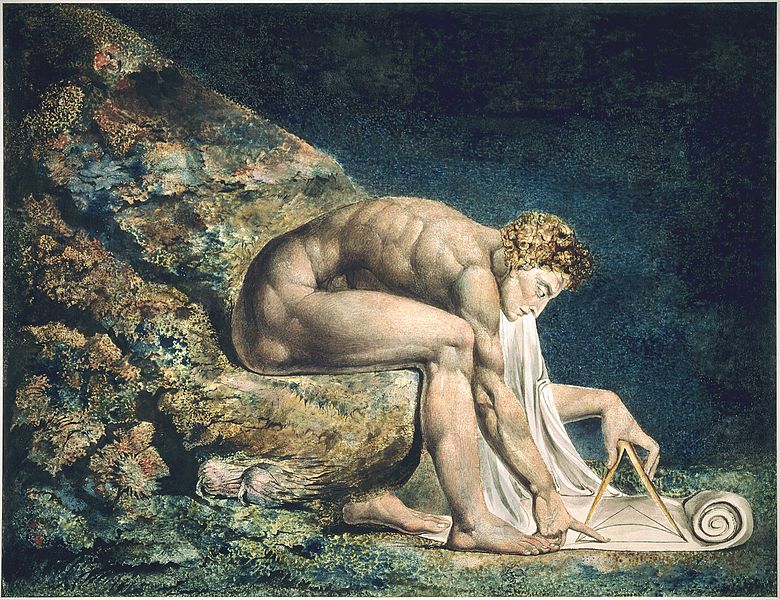
In contrast, William Blake found Newton's work deeply offensive. I had of course seen reproductions of the Blake monotype many times and had always thought of it as a rather heroic depiction, until Holmes pointed out Blake's actual opinion of Newton. He showed a slide of Blake's image along with a photo of the Eduardo Paolozzi bronze at the British museum. https://upload.wikimedia.org/wikipedia/commons/thumb/0/0e/Newton-WilliamBlake.jpg/780px-Newton-WilliamBlake.jpg

Tuesday, April 23, 2013

Alternative History

I recently read A Palette of Particles, another fine book by the writer and physicist Jeremy Bernstein about the history of particle physics up to the Higgs boson. Bernstein mentions one chilling near miss in physics. In Rome in 1934 an Italian team led by Enrico Fermi actually observed nuclear fission. But they misinterpreted what they saw. Bernstein asks us to imagine how world history might have been different if fission was discovered in Fascist Italy in 1934 instead of four years later in Berlin 1938. Even though fission was discovered in Germany, by that time, the fascist powers were rapidly becoming very isolated from the rest of the scientific community. Lack of scientific knowledge might have been only part of the reason the Nazis weren't able to build a bomb, but it was probably a factor. After WWII several distinguished German scientists were held together by the Allies in England (Operation Epsilon) and their conversations were secretly recorded. Several of them, including Heisenberg, seemed surprised when they learned of the atomic bomb and may have mistakenly believed that an explosion would require tons of uranium, not kilograms.