Steven Pinker, a linguistics professor at Harvard and prolific author, has a provocative article at The New Republic web site, Science Is Not Your Enemy An impassioned plea to neglected novelists, embattled professors, and tenure-less historians (August 2013).
Pinker says that science is now encroaching on matters traditionally in the realm of the humanities, for example human emotion and human values, and that has generated a backlash in various quarters: the humanities, religion and public policy. Scientism is a term - new to me - used by critics who believe that science is often misapplied when it address some of the traditional concerns of the humanities, religion and public policy.
I have found many other things Pinker has written very interesting, especially when they are focused on his specialty, linguistics. However, this article seems to me yet another example of someone who knows a lot of science and feels like their scientific knowledge supports some of their other values and opinions, but their attempt to make their case unfortunately comes off very weak.
I suspect that Pinker's article will often have the exact opposite effect of what he says he intends. Instead of reassuring people who think science overreaches, it will just seem like yet another attempt that misuses science to support someone's personal opinions. See The Scientism of Steven Pinker by Ross Douthat in the New York Times, for someone who didn't find Pinker at all convincing.
Faulty 'scientific' results have, of course, repeatedly been used to support personal biases, The Mismeasure of Man, by Steven Jay Gould is a collection of interesting historical examples. In some cases the errors and misinterpretations were really rather subtle, but invariably the errors somehow ended up supporting the preconceived notions of the investigators.
Showing posts with label Science. Show all posts
Showing posts with label Science. Show all posts
Monday, August 12, 2013

Wednesday, May 22, 2013
Richard Holmes at the Radcliffe Institute
I attended a talk by biographer Richard Holmes at the Radcliffe Institute here in Cambridge yesterday (5/22/2013): The Scientist Within: Scientific Biography and The Creative Moment. I had read his book, The Age of Wonder: How the Romantic Generation Discovered the Beauty and Terror of Science which I found fascinating. I've found attending talks by authors of favorite books to be highly uneven, sometimes they are great and sometimes they are very disappointing. Sometimes the author is just how you pictured them, sometimes they are not all what you expected. In this case, happily, I was smiling appreciatively throughout his talk.
In one gem from the talk, Holmes read a passage from Byron's Don Juan, Canto the tenth:
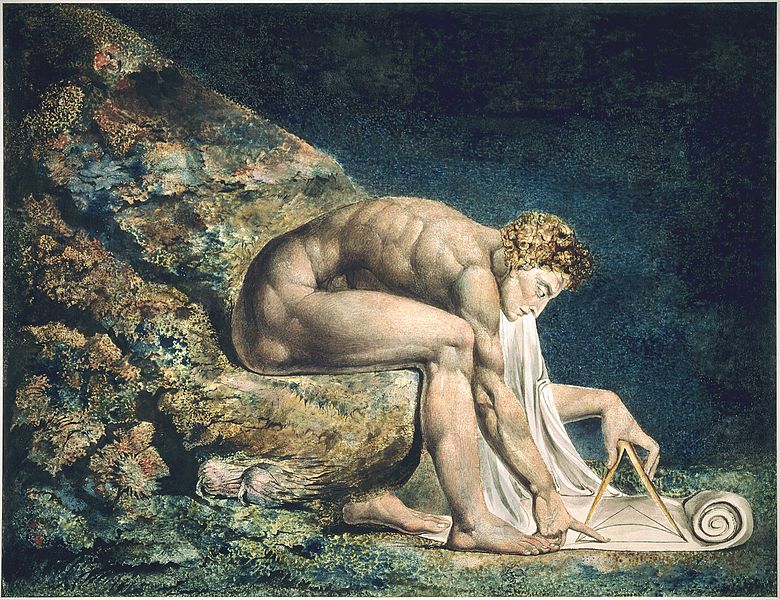

When Newton saw an apple fall, he foundIn contrast, William Blake found Newton's work deeply offensive. I had of course seen reproductions of the Blake monotype many times and had always thought of it as a rather heroic depiction, until Holmes pointed out Blake's actual opinion of Newton. He showed a slide of Blake's image along with a photo of the Eduardo Paolozzi bronze at the British museum.
In that slight startle from his contemplation --
'T is said (for I'll not answer above ground
For any sage's creed or calculation) --
A mode of proving that the earth turn'd round
In a most natural whirl, called "gravitation;"
And this is the sole mortal who could grapple,
Since Adam, with a fall or with an apple.
Sunday, February 26, 2012
Supercontinent formation and True Polar Wander
There have been several periods in the history of this planet when all the continents have united in a single supercontinent. The most recent occasion was the supercontinent Pangaea, which began to break up 175 million years ago with the formation of the proto-Atlantic Ocean.
 Map of Pangaea
Not only do the continents move around relative to one another, the entire solid earth may shift with respect to the earth's axis of rotation: True Polar Wander (TPW). The article Absolute plate motions and true polar wander in the absence of hotspot tracks in Nature (2008) discusses the evidence for TPW at the time of the formation of Pangaea, 300 million years ago.
Supercontinent cycles and the calculation of absolute palaeolongitude in deep time, also in Nature(2012), outlines a far-reaching theory that tries to explain where and how a new supercontinent forms in relation to the previous supercontinent in the cycle. The next supercontinent is conjectured to be Amasia which may form due to the closing of the Arctic and Caribbean seas.
 Map of Pangaea
Not only do the continents move around relative to one another, the entire solid earth may shift with respect to the earth's axis of rotation: True Polar Wander (TPW). The article Absolute plate motions and true polar wander in the absence of hotspot tracks in Nature (2008) discusses the evidence for TPW at the time of the formation of Pangaea, 300 million years ago.
Supercontinent cycles and the calculation of absolute palaeolongitude in deep time, also in Nature(2012), outlines a far-reaching theory that tries to explain where and how a new supercontinent forms in relation to the previous supercontinent in the cycle. The next supercontinent is conjectured to be Amasia which may form due to the closing of the Arctic and Caribbean seas.
Saturday, December 10, 2011
Magma
Magma is melted rock, when it reaches the surface it's called lava. Magma comes from deep underground where it's much hotter, so the rock down there is melted, isn't it? Well not really. Beneath the earth's crust is the mantle and it's by and large solid too. The difference between the crust and the mantle is mainly chemical, they are both solid.
So then, where does magma come from, how does all that rock melt and create such appalling displays at volcanic eruptions?

As it turns out, magma forms by decompression melting. Not only is the temperature higher deep underground in the mantle, the pressure is also terrifically greater. We usually think of solids melting when the temperature rises, but they can also melt when the pressure decreases. Peridotite the mantle rock, is solid at the high pressures and temperatures found down in the mantle, but it will melt when the pressure is released by an opening to the surface - a volcano.
So then, where does magma come from, how does all that rock melt and create such appalling displays at volcanic eruptions?
As it turns out, magma forms by decompression melting. Not only is the temperature higher deep underground in the mantle, the pressure is also terrifically greater. We usually think of solids melting when the temperature rises, but they can also melt when the pressure decreases. Peridotite the mantle rock, is solid at the high pressures and temperatures found down in the mantle, but it will melt when the pressure is released by an opening to the surface - a volcano.
Thursday, November 10, 2011
Einstein and controversy in Weimar Germany
Einstein's theory of general relativity was astonishingly controversial around 1920, even at the level of the general public. Einstein was caught up in the politics and anti-semitism rampant in Germany at the time. See the preprint Reactionaries and Einstein's Fame: "German Scientists for the Preservation of Pure Science," Relativity, and the Bad Nauheim Meeting
 Cut with a kitchen knife, Dada through the last Weimar beer belly culture of Germany, 1919/1920 - Hannah Höch
Cut with a kitchen knife, Dada through the last Weimar beer belly culture of Germany, 1919/1920 - Hannah Höch
Wednesday, December 29, 2010
Replication Fall Offs
The replication of experimental results is a fundamental part of the scientific process. If you get some interesting results, someone else should try it too, to make sure what you got wasn't just a fluke. The Truth Wears Off: Is there something wrong with the scientific method? in the New Yorker documents many examples of scientific research in which there was an initial report of significance, followed by a sequence of replication attempts which yielded poor confirmation. Many of these cases were in medicine and psychology, fields in which experimental trials are extremely difficult and expensive.
This really isn't surprising at all. Scientific research is now a major industry. Thousands upon thousands of people are out there racking their brains to come up with new results. Each individual may try and discard dozens or hundreds of ideas before stumbling across something interesting and apparently significant. Now let's imagine a million people around the world are flipping coins every day. On some days, some of the flippers will get a very skewed outcome. A tiny number of people might even get a skewed result several days in a row. But if they keep trying to "replicate" their results, they will eventually find that the significance falls off due to a regression toward the mean. Alas, despite all the training and talent that goes into science, most of the novel ideas researchers try out will not end up being significant. But when thousands of insignificant ideas are tested, a small percentage will end up looking good - initially. Researchers are paid to get results, they will keep trying new ideas until they get a skewed result. But was that result truly significant, or was it just a statistical fluke? There are billions of circuit elements following Ohm's law in the computer I'm typing this with - that's not a statistical fluke. Some scientific results have been tested and replicated an astronomical number of times, especially when they prove useful in technology. But it shouldn't be surprising if difficult experiments - especially involving complicated living organisms - often prove to be disappointing despite some initial promise.
The Journal of Irreproducible Results collects science humor. Some of the examples in the New Yorker article aren't too funny however, especially in the medical field.
This really isn't surprising at all. Scientific research is now a major industry. Thousands upon thousands of people are out there racking their brains to come up with new results. Each individual may try and discard dozens or hundreds of ideas before stumbling across something interesting and apparently significant. Now let's imagine a million people around the world are flipping coins every day. On some days, some of the flippers will get a very skewed outcome. A tiny number of people might even get a skewed result several days in a row. But if they keep trying to "replicate" their results, they will eventually find that the significance falls off due to a regression toward the mean. Alas, despite all the training and talent that goes into science, most of the novel ideas researchers try out will not end up being significant. But when thousands of insignificant ideas are tested, a small percentage will end up looking good - initially. Researchers are paid to get results, they will keep trying new ideas until they get a skewed result. But was that result truly significant, or was it just a statistical fluke? There are billions of circuit elements following Ohm's law in the computer I'm typing this with - that's not a statistical fluke. Some scientific results have been tested and replicated an astronomical number of times, especially when they prove useful in technology. But it shouldn't be surprising if difficult experiments - especially involving complicated living organisms - often prove to be disappointing despite some initial promise.
The Journal of Irreproducible Results collects science humor. Some of the examples in the New Yorker article aren't too funny however, especially in the medical field.
Tuesday, November 02, 2010
Why Medical Studies are Often Wrong
Lies, Damned Lies, and Medical Science in the Atlantic Magazine.
Much of what medical researchers conclude in their studies is misleading, exaggerated, or flat-out wrong. So why are doctors—to a striking extent—still drawing upon misinformation in their everyday practice? Dr. John Ioannidis has spent his career challenging his peers by exposing their bad science.
Much of what medical researchers conclude in their studies is misleading, exaggerated, or flat-out wrong. So why are doctors—to a striking extent—still drawing upon misinformation in their everyday practice? Dr. John Ioannidis has spent his career challenging his peers by exposing their bad science.
Saturday, August 14, 2010
The Earth's Inner Core
Earth's Moving, Melting Core in Science.
Strange forces are at work 5000 kilometers below Earth's surface. The inner core is acting in ways that scientists can't explain. Theoretically, the core should be drawing iron from its molten surroundings and crystallizing it into solid metal. But that alone doesn't account for a number of odd observations—unless, as a few scientists speculate, the core is also melting.
Thursday, May 13, 2010
The Inner Core
Hemispherical anisotropic patterns of the Earth’s inner core in PNAS.
It has been shown that the Earth’s inner core has an axisymmetric anisotropic structure with seismic waves traveling ∼3% faster along polar paths than along equatorial directions. Hemispherical anisotropic patterns of the solid Earth’s core are rather complex, and the commonly used hexagonal-close-packed iron phase might be insufficient to account for seismological observations. We show that the data we collected are in good agreement with the presence of two anisotropically specular east and west core hemispheres. The detected travel-time anomalies can only be disclosed by a lattice-preferred orientation of a body-centered-cubic iron aggregate, having a fraction of their [111] crystal axes parallel to the Earth’s rotation axis. This is compelling evidence for the presence of a body-centered-cubic Fe phase at the top of the Earth’s inner core
Sunday, August 02, 2009
Pathological Science
Pathological Science is when investigators trick themselves into believing false results. There was a classic talk PATHOLOGICAL SCIENCE given by Irving Langmuir in 1953.
Tuesday, November 11, 2008
Galaxies appear simpler than expected
preprint
Galaxies are complex systems the evolution of which apparently results from the interplay of dynamics, star formation, chemical enrichment, and feedback from supernova explosions and supermassive black holes. The hierarchical theory of galaxy formation holds that galaxies are assembled from smaller pieces, through numerous mergers of cold dark matter. The properties of an individual galaxy should be controlled by six independent parameters including mass, angular-momentum, baryon-fraction, age and size, as well as by the accidents of its recent haphazard merger history. Here we report that a sample of galaxies that were first detected through their neutral hydrogen radio-frequency emission, and are thus free of optical selection effects, shows five independent correlations among six independent observables, despite having a wide range of properties. This implies that the structure of these galaxies must be controlled by a single parameter, although we cannot identify this parameter from our dataset. Such a degree of organisation appears to be at odds with hierarchical galaxy formation, a central tenet of the cold dark matter paradigm in cosmology.
Wednesday, August 06, 2008
More Weird Quantum Behaviour
Paradoxical Reflection in Quantum Mechanics
This article concerns a phenomenon of elementary quantum mechanics that is quite counter-intuitive, very non-classical, and apparently not widely known: a quantum particle can get reflected at a potential step downwards. In contrast, classical particles get reflected only at upward steps. As a consequence, a quantum particle can be trapped for a long time (though not forever) in a region surrounded by downward potential steps, that is, on a plateau. Said succinctly, a quantum particle tends not to fall off a table. The conditions for this effect are that the wave length is much greater than the width of the potential step and the kinetic energy of the particle is much smaller than the depth of the potential step. We point out how the topic is accessible with elementary methods, but also with mathematical rigor and numerically.
An Exceptionally Simple Theory of Everything
This preprint by Garrett Lisi has been getting a lot of press in the popular media, in part because the author is a "surfer dude". Here's an article at the New Yorker: Surfing the Universe An academic dropout and the search for a Theory of Everything. Here's the discussion (some of it heated) at the backreaction physics blog and also at Woit's Not Even Wrong blog. Lisi himself comes off as an unassuming, pleasant, amiable fellow, much in contrast to many of the other commenters.
How can a "Theory of Everything" be "Exceptionally Simple"? Sorry, it's a pun, 'Exceptional' and 'Simple' are technical terms from mathematical Group Theory, the new theory relies on very advanced mathematics and theoretical physics.
Here's a pretty graphical illustration of the theory, but don't expect to watch it and actually understand anything.
How can a "Theory of Everything" be "Exceptionally Simple"? Sorry, it's a pun, 'Exceptional' and 'Simple' are technical terms from mathematical Group Theory, the new theory relies on very advanced mathematics and theoretical physics.
Here's a pretty graphical illustration of the theory, but don't expect to watch it and actually understand anything.
Wednesday, April 16, 2008
The Early Universe
Let there be Light: the Emergence of Structure out of the Dark Ages in the Early Universe
The initial conditions of our Universe can be summarized on a single sheet of paper. Yet the Universe is full of complex structures today, such as stars, galaxies and groups of galaxies. In this review I describe the standard theoretical model for how complexity emerged from the simple initial state of the Universe at early cosmic times through the action of gravity. In order to test and inform the related theoretical calculations, large-aperture telescopes and arrays of radio antennae are currently being designed and constructed. The actual transition from simplicity to complexity has not been observed as of yet. The simple initial conditions were already traced in maps of the microwave background radiation, but the challenge of detecting the first generation of galaxies defines one of the exciting frontiers in the future of cosmology. Once at hand, the missing images of the infant Universe might potentially surprise us and revise our current ideas.
Monday, April 14, 2008
John A. Wheeler Dies
John A. Wheeler, Physicist Who Coined the Term ‘Black Hole,’ Is Dead at 96 article in the New York Times.
Gecko Acrobatics
Active tails enhance arboreal acrobatics in geckos in PNAS.
Geckos are nature's elite climbers. Their remarkable climbing feats have been attributed to specialized feet with hairy toes that uncurl and peel in milliseconds. Here, we report that the secret to the gecko's arboreal acrobatics includes an active tail. We examine the tail's role during rapid climbing, aerial descent, and gliding. We show that a gecko's tail functions as an emergency fifth leg to prevent falling during rapid climbing. A response initiated by slipping causes the tail tip to push against the vertical surface, thereby preventing pitch-back of the head and upper body. When pitch-back cannot be prevented, geckos avoid falling by placing their tail in a posture similar to a bicycle's kickstand. Should a gecko fall with its back to the ground, a swing of its tail induces the most rapid, zero-angular momentum air-righting response yet measured. Once righted to a sprawled gliding posture, circular tail movements control yaw and pitch as the gecko descends. Our results suggest that large, active tails can function as effective control appendages. These results have provided biological inspiration for the design of an active tail on a climbing robot, and we anticipate their use in small, unmanned gliding vehicles and multisegment spacecraft.
Is the Solar System Stable?
On the Dynamical Stability of the Solar System
The experiments yielded one evolution in which Mercury falls onto the Sun at ~1.261Gyr from now, and another in which Mercury and Venus collide in ~862Myr. In the latter solution, as a result of Mercury's unstable behavior, Mars was ejected from the Solar System at ~822Myr. We have performed a number of numerical tests that confirm these results, and indicate that they are not numerical artifacts.
What is a Galaxy?
What is a galaxy? How Cold is Cold Dark Matter? Recent progress in Near Field Cosmology
These data show that there is a bimodal distribution in half-light radii, with stable star clusters always being smaller than 35pc, while stable galaxies are always larger than 120pc. We extend the previously known observational relationships and interpret them in terms of a more fundamental pair of intrinsic properties of dark matter itself: dark matter forms cored mass distributions, with a core scale length of greater than about 100pc, and always has a maximum central mass density with a narrow range.
...
Galaxies are embedded in dark matter halos with these properties; smaller systems containing dark matter are not observed
SS433
SS433 a strange object in our own Galaxy. Aligned Molecular Clouds towards SS433 and L=348.5 degrees; Possible Evidence for Galactic "Vapor Trail" Created by Relativistic Jet
Subscribe to:
Posts (Atom)


