Friday, May 20, 2005

Microsocopic Images

at The Micropolitan Museum of microscopic art forms.


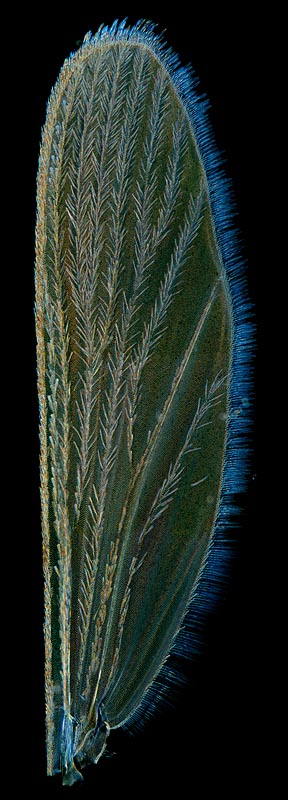
The fragile wing of a mosquito. If you smash a mosquito very carefully you can enjoy the beauty of its wings!


Bell animalcules are common in fresh water but can also be found in the sea. These colonial Ciliates live attached to a stalk. Find out more about their fresh water relatives on the smallest page on the web

Monday, May 16, 2005

The Poggendorff Illusion


Fig. 1. The Poggendorff illusion and its behavior. (A) When an obliquely oriented straight line is interrupted by a vertical occluder, the line segment on the right appears to be shifted downward with respect to the line segment on the left. (B) A similar effect occurs when the orientation of the interrupted line is reversed. In this case, the collinear extension on the right appears to be shifted upward. (C) When an oblique line is interrupted by parallel horizontal lines, the oblique line segments appear to be shifted horizontally with respect to each other. (D) The magnitude of the effect increases as the interrupted line is made more vertical. (E) The magnitude also increases as the width of the interruption increases. (F) The illusion is largely abolished when only the acute components of the stimulus are presented, but the effect is maintained when only the obtuse components are shown. (G) The illusion is diminished when the standard configuration is rotated so that the interrupted line is horizontal.


A new explanation for this illusion has just been published.

The Poggendorff illusion explained by natural scene geometry by Catherine Q. Howe, Zhiyong Yang, and Dale Purves in Proc. Natl. Acad. Sci. USA.
One of the most intriguing of the many discrepancies between perceived spatial relationships and the physical structure of visual stimuli is the Poggendorff illusion, when an obliquely oriented line that is interrupted no longer appears collinear. Although many different theories have been proposed to explain this effect, there has been no consensus about its cause. Here, we use a database of range images (i.e., images that include the distance from the image plane of every pixel in the scene) to show that the probability distribution of the possible locations of line segments across an interval in natural environments can fully account for all of the behavior of this otherwise puzzling phenomenon.

Sunday, May 15, 2005

"Cosmic Gall" by John Updike

Neutrinos, they are very small.
They have no charge and have no mass
And do not interact at all.
The earth is just a silly ball
To them, through which they simply pass,
Like dustmaids down a drafty hall
Or photons through a sheet of glass.
They snub the most exquisite gas,
Ignore the most substantial wall,
Cold shoulder steel and sounding brass,
Insult the stallion in his stall,
And, scorning barriers of class,
Infiltrate you and me. Like tall
And painless guillotines they fall
Down through our heads into the grass.
At night, they enter at Nepal
And pierce the lover and his lass
From underneath the bed—you call
It wonderful; I call it crass.

From TELEPHONE POLES AND OTHER POEMS
(Knopf) © 1960, 1988 John Updike.
Originally in The New Yorker. All rights reserved.

Note: in the meantime, it seems neutrinos do actually have some mass, alas - but that was a pretty big surprise.


John Hoyer Updike
Max Ernst: a Retrospective

exhibit at the Metropolitan in New York - April 7, 2005–July 10, 2005. See the review by John Updike in the New York Review of Books


"The Robing of the Bride", 1939 130 x 96 cm., Venice


Europe after the Rain II. Oil on canvas. 54 x 146 cm. 1940-42. Wadsworth Atheneum, Hartford, CT, USA

Europe after the Rain, we are told, was begun by Ernst in a European prison camp and finished in the United States—a precarious transit, in that dire time, for a crusty canvas two feet by five." says Updike in his review.


Adolf Hitler and Josef Goebbels view the exhibition of "degenerate art", Munich 1937

Hitler was definitely not a fan, Ernst happened to be Jewish:


Max Ernst (French, born Germany, 1891–1976)
The Blessed Virgin Chastises the Infant Jesus Before Three Witnesses: A.B., P.E. and the Artist, 1926
Oil on canvas; 77 1/4 x 51 1/4 in. (196 x 130 cm)
Museum Ludwig, Köln
© 2004 Artists Rights Society (ARS), New York/ADAGP, Paris

According to Updike's review, "The original exhibition including Ernst's assaultive painting The Blessed Virgin Chastises the Infant Jesus before Three Witnesses: A.B., P.E., and the Artist (1926) was closed by church pressure because of it; at the Met, alone on a large wall and protected by glass against possible Christian vandals, it exerts a sensuous spell."

"The House of Flying Daggers" a film by Zhang Yimou

now out on DVD.

Zhang Yimou's early films, "Red Sorghum" (1987), "Ju Dou" (1990), and "Raise the Red Lantern" (1991) were intimate, beautiful, devastating films centered around the oppression of women in pre-revolutionary China. His most recent films "Hero" and "House of Flying Daggers" are very different indeed. Martial arts spectaculars with big budgets and strong female fighters in lead roles, they are much less effective emotionally. The oppressed women in his earlier films were defiant, but they were completely powerless and their vulnerability made their strength of character impressive indeed. The newer films seem quite shallow in comparison.

However, "Hero" did have some of the most beautiful scenes I've ever seen in film, especially memorable were several scenes with ravishing depictions of water. Zhang Yimou's visual style is unmistakable, starting with the gorgeous shots of freshly dyed fabric sheets in "Ju Duo". But a big share of credit for the look of "Hero" has to go to cinematographer Christopher Doyle. He's shot so many stunning films, including "In the Mood for Love", directed by Wong Kar Wai.

The "Making of" documentary on the Flying Daggers DVD wasn't particularly striking, repetitiously filled with comments that all amounted to "Zhang Zimou is really, really good". However, it did explain one fairly odd transition in the film, the climatic fight scene takes place in a fairly substantial snow storm. But the scenes before it, essentially on the same day, were quite temperate. Apparently there was a freak October snow storm during the filming, totally unexpected of course, and the director just went with it.
Ang Lee is another talented director who succumbed to the lure of the big-budget martial arts blockbuster with his "Cringing Tiger". That film's critical and popular success was a total mystery to me. Chow Yun Fat is great in Hong Kong gangster movies, but he was utterly unconvincing in a costume period piece, never mind his deficiencies as a martial arts player.


The DVD cover


Beautiful watery scenes from "Hero"


Freak snowstorm in "Flying Daggers"

You can see a beautiful trailer for "Ju Dou", you might have to endure an annoying ad first, but it's worth it.

Saturday, May 14, 2005

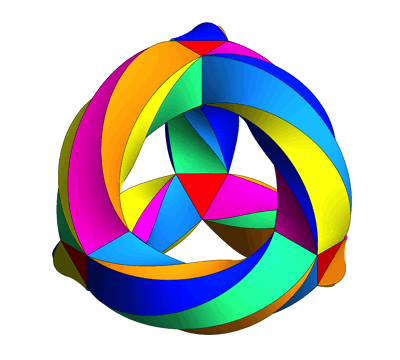
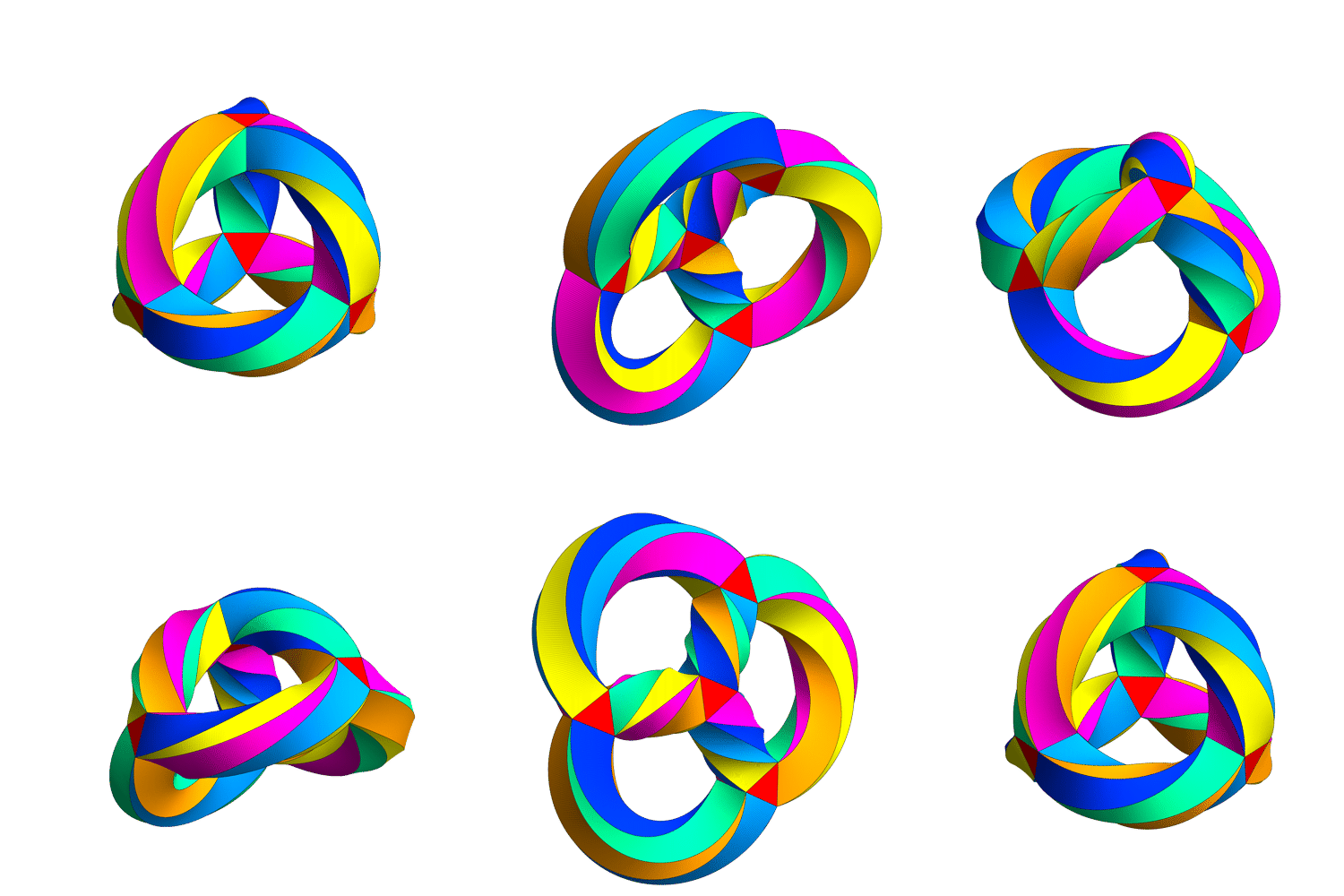
Klein's quartic curve


This is called Klein's quartic curve. It can be turned inside out and it gets reflected in the process.


See John Baez's page for more information.

Friday, May 13, 2005

"High-energy physics: An emptier emptiness?" by Frank Wilczek

In Nature News & Views

A new experiment at Brookhaven using colliding gold ions provides surprising evidence about a fundamental concept in physics: the vacuum. It appears that you can get something from nothing, the vacuum is unstable and new particles can be spontaneously created in empty space. Gack.


A side view of one of the first high-energy collisions captured by the Solenoidal Tracker of the STAR detector at the Relativistic Heavy Ion Collider (RHIC). The initial head-on collision of two gold ions, each consisting of a total of 197 protons and neutrons, occurs at the mid-point of the central tube (running across the image from right to left). The tracks indicate the paths taken by thousands of subatomic particles created in the fireball of energy set free in these collisions. Several layers of detectors, arranged concentrically around the central tube, and encased in a powerful magnet, allow the identification of these particles. (Courtesy of Brookhaven National Laboratory, STAR collaboration.)

Thursday, May 12, 2005

"Robotics: Self-reproducing machines" by Zykov et.al.

article in Nature May 12, 2005. See also Robots master reproduction by Andreas von Bubnoff, news article in the same issue of Nature and A Chip Off the Robotic Block by Adrian Cho in Science.


a, Basic module, with an illustration of its internal actuation mechanism. b, Snapshots from the first 10 s showing how a four-module robot transforms when its modules swivel simultaneously. c, Sequence of frames showing the self-reproduction process, which spans about 2.5 min and runs continuously without human intervention, apart from the replenishing of building blocks at the two 'feeding' locations (circled in red). (For movie, see supplementary information.)

The video is surreal, the motion of the little blocks seems very organic somehow.

A modular machine made of four swiveling blocks uses electromagnets to reproduce itself in a matter of minutes. You have to give it pre-made fresh blocks and put them in a convenient location. This is definitely lowering the bar for self-reproduction, the blocks are complicated little devices themselves. People manage to reproduce themselves using fairly simple chemicals as buidling blocks, though we too require seven essential amino acids that we can't fabricate ourselves. As the authors themselves point out: "We circumvent the long-standing hurdle of what counts as self-replication by suggesting that self-replicability is not a binary property that a system either possesses or not, but is a continuum dependent on the amount of information being copied." Hence a strategy leading to more convincing self-reproduction might involve incrementally simplifying a system of rather complex building blocks, rather than starting from scratch with a satisfyingly elementary substrate.

Tuesday, May 10, 2005

Hoag's Object


This bizzare object was discovered in 1950 by astronomer Art Hoag. It's a bright ring of hot blue stars surrounding a nucleus of yellow stars. Take a close look just above the nucleus - you'll see yet another ring galaxy.

Hoag's Object at Hubble

A recent paper: Hoag's Object a Soliton?

A NASA Hoag's Object page with an explanation and reference links.

Short Gamma Ray Burst on May 9th


Neutron-star cataclysm? A faint patch of light (green arrow) on the fringes a distant galaxy may mark the spot where two neutron stars collided, in this image taken on the morning of 9 May.
CREDIT: J. Bloom/UC Berkeley/WIYN Telescope

Science Online reported the first Short Gamma Ray Burst directly observed, by the NASA Swift satellite at midnight on May 9th. You can find up to the minute news on this and other Gamma Ray Bursters at NASA.


Swift

Link to a previous post about the December 27th Giant Gamma Ray Flash.

Nature article:
Swift satellite spies cosmic crash

Sunday, May 08, 2005

Shelia Chandra, vocalist

Beautiful, eerie, Indian influenced music: Shelia Chandra Official Site, Shelia Chandra at Amazon. She was featured on the soundtrack of "Lord of the Rings: The Two Towers", the "Breath of Life" track. Other tracks I've enjoyed:


"Speaking in Tongues III" - Moonsung 1999

"Speaking in Tounges I", "Ever So Lonely/Eyes/Ocean" - Weaving My Ancestors' Voices 1992
"Lament", "Strange Minaret" - The Struggle 1985
"Ever so Lonely"- Third Eye (Monsoon) 1982

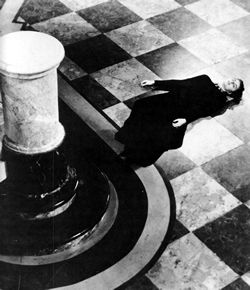
"Notorious", a film by Alfred Hitchcock

with Ingrid Bergman, Cary Grant and Claude Rains. Claude Rains creepy mother is credited as Madame Konstantin, a perfect name for the part.


Hitchcock and Bergman.

One of the greatest films ever, story by Ben Hecht (who also wrote "Front Page"). The scene on the staircase at the end is marvelous.


On the staircase.


At the track.


The elegant Criterion DVD cover


What was in the coffee?

Saturday, May 07, 2005

"The Prince" by Niccolo Machiavelli


Nicolo Machiavelli(1469-1527)

Relevance to Iraq?

"... there is nothing more difficult to carry out, nor more doubtful of success, nor more dangerous to handle, than to initiate a new order of things. For the reformer has enemies in those who profit by the old order, and only lukewarm defenders in all those who would profit by the new order, this lukewarmness arising partly from fear of their adversaries, ...; and partly from the incredulity of mankind, who do not truly believe in anything new until they have actual experience of it. Thus it arises that on every opportunity for attacking the reformer, his opponents do so with the zeal of partisans, the others only defend him half-heartedly, so that between them he runs great danger."

"For it must be noted, that men must either be caressed or else annihilated; they will revenge themselves for small injuries, but cannot do so for great ones; the injury therefore that we do to a man must be such that we need not fear his vengeance.

But maintaining a garrison ..., one will spend much more, and consume all the revenues of that state in guarding it, so that the acquisition will result in a loss, besides giving much greater offense, since it injures every one in that state with the quartering of the army on it; which being an inconvenience felt by all, every one becomes an enemy, and these are enemies which can do mischief, as though beaten, they remain in their homes."

Classic Machiavellianisms

"That in taking a state the conqueror must arrange to commit all his cruelties at once, so as not to have to recur to them every day."

“Love is a bond men easily break,” says Machiavelli, “but fear of punishment holds them in check. Therefore, it is better to be feared than loved.”

"... fortune is a woman, and it is necessary, if you wish to master her, to conquer her by force ..."

Monday, May 02, 2005

Toulouse-Lautrec and Montmartre

at the National Gallery of Art, Washington, D.C. March 20 - June 12, 2005.

While personally I'm not that wild about Toulouse-Lautrec there was plenty of other great stuff at the exhibition, I loved the posters of Chéret and Steinlen for example.
Dance Hall Days - French posters from Chéret to Toulouse–Lautrec


Poster "Musée Grévin" by Jules Chéret


Tournée du Chat Noir by Théophile Alexandre Steinlen


Van Gogh spent time in Montmartre as well.


Agostina Segatori dans le Café du Tambourin
by Vincent Van Gogh

Exhibit at the National Gallery of Art, Washington D.C.

Saturday, April 30, 2005

Way Cool Worm


Cooler. Pompeii worms tolerate scalding temperatures but temper the environment for other creatures.
CREDIT: Ifremer/PHARE/O. Dugornay

"Discovered in the early 1980s, the Pompeii worm (Alvinella pompejana) is the most heat-tolerant animal known. It can survive at temperatures as high as 80°C, according to some scientists. The worm makes its home in thin-walled tubes anchored in the sides of hydrothermal smokers that spew acidic seawater heated to 300°C or more by magma. The smokers are coated in a 10-centimeter thick layer of gel teaming with bacteria."
--- Vent Worms Make Good Neighbors in Science Magazine


Pompeii Worm Page
at the University of Delaware.

Friday, April 29, 2005

"The Tempest", by William Shakespeare

Philip Goodwin and Daniel Breaker (Photo: Richard Termine)

directed by Kate Whoriskey at The Shakespeare Theatre in Washington D.C. March 22 - May 22, 2005.

This production featured a truly aerial Ariel, played by Daniel Breaker high above the stage, often upside-down in a flying harness. Stephano was played by Floyd King, who did a hilarious job. The shipwreck in the opening scene was fabulous.

Full fathoms five thy father lies
Of his bones are coral made
Those are pearls that were his eyes
Nothing of him that doth fade
But doth suffer a sea change
Into something rich and strange

New Hubble Images


Eagle Nebula
Credit: NASA, ESA, and The Hubble Heritage Team (STScI/AURA)


Hubble Image Gallery

"Automatic effects of alcohol cues on sexual attraction", by Friedman et. al.


Alcohol is traditionally believed to effect libido, but in a test of 82 male undergraduates at the University of Missouri at Columbia, they didn't even have to drink the stuff! Just a subliminal flash of the word "beer" on a computer screen was enough to influence the perceived attractiveness of depicted females, at least for the "Show Me State" males. It didn't seem to change ratings of the female's intelligence however.

The Nature News Article

"Modigliani: Beyond the Myth", edited by Mason Klein


A beautiful book from Yale University Press, it's a catalog from a recent exhibition which just ended at the Philips Collection in Washington, D.C. In fact, I saw it today, the final day of a multi-city tour. I also got a great Modigliani T-shirt, lucky me. I'd never been to the Philips Collection before, it's in lovely Dupont Circle, conveniently located on the Metro.


Metropolian Museum, New York


Photograph of the artist as a young man

Salt Fingers, Ocean Mixing


In the mix. Warm salt fingers (light-colored) dribble down as fresh water (darker) rises.
CREDIT: B. Merryfield/ Institute of Ocean Sciences/ Office of Naval Research

Bill Merryfield's salt finger tutorial

"Salty Fingers Do the Mixing" in Science Magazine.

Human Genetics Project from National Geographic, IBM

Earlier this month, the National Geographic Society and IBM announced a project to produce a sharper picture of human migrations by analyzing DNA samples from 100,000 people (Science, 15 April, p. 340). The Web site of the Genographic Project is worth a look for the lavishly illustrated backgrounders on genetics and migrations. A timeline depicts what we know about the human expansion from Africa beginning about 60,000 years ago, stopping at landmarks such as the controversial Cactus Hill site in Virginia. Evidence found there suggests that people reached the Americas thousands of years earlier than previously thought. Another section explains how to send in your DNA and find out where your ancestors originated. Genealogical curiosity will cost you $99.95 plus shipping for the test kit.
--- Science Magazine Netwatch

National Geographics Gengraphics Page

Exploding German Toads Baffle Scientists


Undated but recent filer shows a dead toad in a Hamburg, Germany lake. More than 1,000 toads have puffed up and exploded in a Hamburg pond in recent weeks, and German scientists still have no explanation for what is causing the combustion.(AP Photo/Florian Quand)

BERLIN - Why are toads puffing up and spontaneously exploding in northern Europe? It began in a posh German neighborhood and has spread across the border into Denmark. It's left onlookers baffled, but one German scientist studying the splattered amphibian remains now has a theory: Hungry crows may be pecking out their livers.

Local environmental workers in Hamburg have described it as a scene out of a horror or science fiction movie, with the bloated frogs agonizing and twitching for several minutes, inflating like a balloon before suddenly bursting.

"It's horrible," biologist Heidi Mayerhoefer was quoted as telling the Hamburger Morgenpost daily.

"The toads burst, the entrails slide out. But the animal isn't immediately dead — they keep struggling for several minutes."


Disappointingly, the Nature magazine web site poo-pooed the exploding German toad phenomenon: Has bubble burst over exploding toad tale?. "Evidence points to bloated toads and hungry birds, but not explosions" according to Nature. Party poopers!

Thursday, April 28, 2005

The Giant Gamma Ray Flash On 27 December 2004


Artist conception of the December 27, 2004 gamma ray flare expanding from SGR 1806-20 and impacting Earth’s atmosphere. Credit: NASA


An artist conception of the SGR 1806-20 magnetar including magnetic field lines.
Credit: NASA

In this weeks Nature, there's a series of articles on the giant flash of Dec 27, 2004: Nature article

This was a truly mind-boggling event. It was so powerful that it bounced off the Moon and lit up the Earth's upper atmosphere. The flash was brighter than anything ever detected from beyond our Solar System and lasted over a tenth of a second. Two similar flares had previously been detected from different sources during 30 years of observations. But it outshone both the preceding events by two orders of magnitude, releasing in its first fraction of a second as much energy as the Sun releases in a quarter of a million years.

SGR stands for soft gamma repeater, because they flare up randomly and release gamma rays.

A strange coincidence in timing has been noted (see this site, for example) - the Sumatra earthquake and tsunami occured the day before, December 26, 2004. Hmmm, maybe gravity waves, whatever, the day before that was Christmas, can't forget that either.

Link to a NASA article on the flash

Arnold's Cogent Analysis of the Situation

From an article in today's New York Times Paying on the Highway to Get Out of First Gear:
"Californians can't get from place to place on little fairy wings," said Gov. Arnold Schwarzenegger in announcing a plan in January that could allow private investors to build toll roads. "We are a car-centered state. We need roads."

The Governor himself utilizing California transportation systems

Wednesday, April 27, 2005

Philip Morrison, 89, died April 22


New York Times Obituary

His book reviews in Scientific American, written with his wife Phylis, used to be one of the highlights of the month. Every holiday season they had a children's book column, which was a wonderful source of gift ideas.
I attended one of his Search for Extraterrestrial Intelligence lectures in 10-250 at MIT. On the one hand, the whole idea was to find bug-eyed monsters in outer space, on the other hand, he was full of practical nuts-and-bolts communication and engineering details. Here's article of his on the PBS web site: Hunt for Alien Worlds.
He and his wife regularly attended the ART theater in Cambridge. I was there with a friend who excitedly pointed them out at the front of the theater (he was in a wheelchair). I was very surprised that she had even heard of this particular MIT physics professor much less be able to pick him out of a crowd. It turned out his PBS series was currently showing, he had become a TV star!

"The Hitchhiker's Guide to the Galaxy" by Douglas Adams


In case you're dead and didn't know, the book has been made into a major motion picture with a very fancy official website.
I re-read the book today, it had been awhile so I wanted to be sure I could say, with confidence, "but the book was much better".
While I remembered the book quite fondly, this time it started out as rather a disappointment, but about 2/3's of the way through I finally started snickering appreciatively.
My favorite passage from the book is so good, I quoted it for years having forgotten where I'd first seen it. Here's a mild paraphrase.
"The history of civilization passes through three distinct phases: those of Survival, Inquiry and Sophistication; otherwise known as the How, Why and Where phases.
The first phase is characterized by the question: How can we eat? the second by the question Why do we eat? and the third by the question Where shall we have lunch?

Tuesday, April 26, 2005

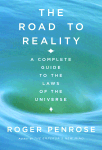
"The Road to Reality" by Roger Penrose


I've been dipping into Roger Penrose's new book, which presents an introduction (and beyond) to mathematical physics beginning with very elementary math - fractions!
Complex numbers are basic to understanding mathematical physics, especially quantum mechanics, moreover they're a useful and elegant tool throughout mathematics and physics. In particular there's quite a bit in the book about complex analysis. Basic texts and references for General Relativity and Quantum Theory (I myself own stacks of them) don't usually require much, if any, complex analysis - though it is certainly beautiful math and there are certain important applications in physics and elsewhere. That's an example of Penrose's idiosyncratic point of view, which sometimes I find a bit obscure but in other cases interesting, refreshing and provocative.

Here's a link to Martin Gardner's review in The New Criterion and to the review in the New York Times

In the beginning of the book Penrose presents a nice proof that the square root of two is an irrational number. This is hardly news, it dates to the time of Pythagoras, when it was supposedly considered so scandalous it was kept as a deep, dark secret. Probably this proof is well-know to everyone but me, but I had only remembered a proof involving prime decompositions and this one is more direct.

Assume there are positive integers p and q such that
(p/q)^2 = 2
so p^2 = 2q^2 and p must be even (because the square of an odd integer is also odd, but the square of p is even)
and hence p=2r for some positive integer r.
p^2 = (2r)^2 = 4r^2
2r^2 = q^2
So q is even as well, and q=2s for some positive integer s and furthermore p=4s.
2r^2 = 4s^2 and now s must be even, s=2t and p=8t.
This process can be repeated indefinitely, so p ends up having an infinite number of factors of two and hence p can't be a finite integer.
So the square root of two cannot be expressed as the ratio of two positive integers and hence is irrational.

Saturday, April 23, 2005