Sunday, May 29, 2005

How Did House Bands Become a Filipino Export? by John Bowe

An very droll article indeed in the New York Times Magazine, May 29, 2005.


Songbird performing at a resort in Danang, Vietnam

Gan's success depends on knowing his clients' taste. In Thailand, the most requested song is ''Hotel California.'' Taiwan is lately cuckoo for the macarena. The Chinese, he said, ''have not gone to the state of loud music. They are still at the state of like the early rock 'n' roll music, 60's music, Petula Clark, Burt Bacharach, evergreens, you know? 'Born Free,' 'Yesterday,' 'Unchained Melody,' 'I Can't Stop Loving You.''' The most commonly requested song in both China and Japan is Sinatra's ''My Way.'' And yet in the Philippines, Gan said, unless you're at an oldies club, audiences only want the current Top 40. ''If you request 'My Way,' you get shot. I'm not kidding. That actually happened.''


Frank's popularity varies among Asian audiences

Wednesday, May 25, 2005

Nuclear approach may help climate researchers pinpoint volcanic eruptions


Slice of tree showing rings with sample wedge removed.

"There's gold in them thar rings. Tree rings that is, and Penn State researchers are using the Breazeale Nuclear Reactor to measure gold and link the rings to volcanic eruptions."

"When Peter I. Kuniholm, professor of archaeology and dendrochronology and director of the Malcolm and Carolyn Wiener Laboratory for Aegean and Near Eastern Dendrochronology at Cornell, saw which tree rings held the highest gold levels, he quickly recognized that they dated to years of known volcanic eruptions.

Because trees add a ring a year to their trunks, if researchers know the cutting date of a tree or can calibrate the tree's rings against a previously dated tree, researchers can assign each ring accurately to a specific year. By isolated wood from just one ring, neutron activation analysis can measure the gold that the tree took up during that year with parts per billion sensitivity.

Neutron activation analysis uses the neutrons produced by a nuclear reactor to create temporary radioactive isotopes in a sample. Because each isotope has its own gamma radiation signal, the gamma radiation signal strength indicates the amount of that element present. "

"The preliminary results of analysis of one tree for the years 1411 through 1988 were presented in a recent issue of the Journal of Radioanalytical and Nuclear Chemistry.

Working with Kuniholm and John J. Chiment, another researcher at the dendrochronology laboratory, and Corrnell undergraduate students Pam Sullivan, Meg Underwood and Danielle Hauck, Unlu analyzed 577 rings from a Bosnian or palebark pine from Greece.

"We are looking at the last 500 to 600 years to gain confidence in the procedure," says Unlu. "The volcanic eruptions during that time are known, so we can make correlations. Then we will go back and look at the past 6,000 years."

Six thousand years into the past is the depth of the samples currently at Cornell's dendrochronology laboratory. The lab has already dated approximately 4.5 million tree rings to this time.

The researchers found that they successfully matched gold peaks to volcanic eruptions beginning with an eruption of the Soufriere Hills volcano in 1440 and including a 1480 eruption of Mt. St. Helens. However, the researchers also had high gold peaks for a number of years between 1480 and 1580 when there were no known volcanic eruptions.

"When we see major gold peaks but no volcanoes, it could be forest fires," says Unlu. "We cannot really tell if we are seeing a global signal or a regional or local signal when we are looking at only one tree."

How can a forest fire be confused with a major volcanic eruption? If the researchers are correct, easily. Unlu believes that the increased gold uptake during volcano years occurs because the volcanoes put large amounts of particulate matter into the atmosphere and change the environmental acidity as well as the rainfall, sunshine and temperature patterns creating a stressful situation for trees. The trees, to compensate for a lousy year, try to take up more nutrients, including copper, an essential element for tree growth and health. The gold is indiscriminately absorbed along with the copper, but the copper is used for tree metabolism while the gold remains in the new growth.

Another possible cause of the increased gold uptake could be through the leaves because of direct fallout from the volcanic eruptions, but Unlu believes it is the darkness and stress that push the trees to search for copper among other elements. To eliminate forest fires and other local events, the researchers want to look at other trees from other areas. They are currently looking at two dated trees from Turkey and one from California.

"The main problem in atmospheric science is they do not have enough data," says Hauck, now a graduate student in nuclear engineering at Penn State. "We want to correlate tree ring data with climate cycles to get a much better indication of what is natural and what is anthropogenic. Tree rings can help."

Large volcanic eruptions put particles into the wind, into the jet stream and have a global, rather than only local effect. Unlu would also like to go back and check the samples with high gold for other elements. Because neutron activation analysis is nondestructive, and the samples are no longer radioactive after about a month, this reanalysis for other elements is possible. Unlu now has a Nuclear Engineering Education and Research grant from the U.S. Department of Energy to continue his analysis of tree rings and correlation to volcanic activity and other climate events.
"

The original news release at Penn State University.

Tuesday, May 24, 2005

A Sensational Title

Carrying on with the theme of A Sensational Title coupled with quite serious research and scholarship, here are three titles for your consideration: Demonic Males; Sperm Wars; Women, Fire and Dangerous Things.

Demonic Males: Apes and the Origins of Human Violence is by Richard Wrangham and Dale Petersen. I first learned about the book after attending a performance of a George Bernard Shaw play at the ART in Harvard Square and sitting in on a subsequent panel discussion. Richard Wrangham was on the panel - he talked about his book, showed slides from his field research with Bonobos (a relative of chimpanzees) and even managed to somewhat tie it in with GBS. Bonobos are known as possibly the sexiest animals on earth and the slides didn't shy away from that fact. The next person on the panel commented that there was an old saying in theater, "never go on after children or animal acts" and it was true, the rest of the panel was at a serious disadvantage after Wrangham's spectacular presentation.

Sperm Wars: The Science of Sexby Robin Baker, combines research published in the most prestigious journals (by the author) with illustrative little scenarios that read like hard-core pornography. An "I buy Playboy/girl for the articles" kind of win-win.

Women, Fire and Dangerous Things: What Categories Reveal about the Mind by George Lakoff, is a quite serious work of Cognitive Science and Linguistics. Evidently there's a language (Australian?) with a grammar which groups the three categories of the title.

Sunday, May 22, 2005

"Middlemarch" a BBC production


One of the greatest books ever written leaps to life in this lavishly filmed BBC production, seen on Masterpiece Theatre. You’ll share the frustrations of George Eliot’s heroine (Dorothea Brooke, portrayed by a luminous Juliet Aubrey) whose desire to add meaning to her life conflicts with 19th-century provincial English culture. A turbulent, romantic epic shot on location in England and Italy.


My second favorite BBC series, exceeded only by the incomparable "I Claudius". Unfortunately, there was something wrong with the image, possbily due to my $40 Radio Shack DVD player (you get what you pay for, it seems). The image was stretched vertically and possbily chopped, which rendered the gentlemen's already tall black hats as monstrosities. Still it was a great production - I greedily finished the final three episodes in one sitting, last night.

Cooperate or Else!


"Go ahead, make my day." Dirty Harry succinctly informs a norm violator that he anticipates deriving satisfaction from inflicting altruistic punishment.
CREDIT: WARNER/MALPASO/THE KOBAL COLLECTION

Why exactly do people - and other animals as well - so often cooperate instead of pursuing their individual goals independently, especially in circumstances when there are opportunities for short-term gain by cheating? "It's better to be nice", "For the Good of the Group", and other such sentiments are all well and good, but why isn't altruistic behaviour "selected against" in a world ruled by evolution and the survival of the fittest? Natural selection works directly on individuals, but only indirectly on groups, so group selection is rather tricky in practice.

There have been several interesting new papers in the past year on the role of punishment in maintaining cooperative behaviour: from evolutionary, game-theoretic and neurobiological perspectives.


First a trio of classic books touching on the subject of cooperative behaviour:

    The Evolution of Cooperation by Robert Axelrod. The Prisoner's Dilemma, Tit for Tat.

    The Selfish Gene by Richard Dawkins. Kin Selection.

    Sociobiology by E.O. Wilson. The Magnum Opus.

Next a newspaper article on one of the colorful pioneers of the evolutionary theory of behaviour, Robert Trivers.
Boston Globe (March 27, 2005)

While researching Trivers I stumbled across a wonderful blog by a very attractive thinker Teardrop Souffle.


From an economic, game theoretic point of view, the article that introduced "The Paradox of the Commons":

The Tragedy of the Commons
by Garrett Hardin
Science (13 December 1968)
"In economic affairs, The Wealth of Nations (1776) popularized the "invisible hand," the idea that an individual who "intends only his own gain," is, as it were, "led by an invisible hand to promote . . . the public interest" (5). Adam Smith did not assert that this was invariably true, and perhaps neither did any of his followers. But he contributed to a dominant tendency of thought that has ever since interfered with positive action based on rational analysis, namely, the tendency to assume that decisions reached individually will, in fact, be the best decisions for an entire society"

The rebuttal to the invisible hand in population control is to be found in a scenario first sketched in a little-known pamphlet (6) in 1833 by a mathematical amateur named William Forster Lloyd (1794-1852).

The tragedy of the commons develops in this way. Picture a pasture open to all. It is to be expected that each herdsman will try to keep as many cattle as possible on the commons. Such an arrangement may work reasonably satisfactorily for centuries because tribal wars, poaching, and disease keep the numbers of both man and beast well below the carrying capacity of the land. Finally, however, comes the day of reckoning, that is, the day when the long-desired goal of social stability becomes a reality. At this point, the inherent logic of the commons remorselessly generates tragedy.

As a rational being, each herdsman seeks to maximize his gain. Explicitly or implicitly, more or less consciously, he asks, "What is the utility to me of adding one more animal to my herd?" This utility has one negative and one positive component.

1) The positive component is a function of the increment of one animal. Since the herdsman receives all the proceeds from the sale of the additional animal, the positive utility is nearly +1.

2) The negative component is a function of the additional overgrazing created by one more animal. Since, however, the effects of overgrazing are shared by all the herdsmen, the negative utility for any particular decision-making herdsman is only a fraction of 1.

Adding together the component partial utilities, the rational herdsman concludes that the only sensible course for him to pursue is to add another animal to his herd. And another; and another. . . . But this is the conclusion reached by each and every rational herdsman sharing a commons. Therein is the tragedy. Each man is locked into a system that compels him to increase his herd without limit--in a world that is limited. Ruin is the destination toward which all men rush, each pursuing his own best interest in a society that believes in the freedom of the commons. Freedom in a commons brings ruin to all.


Finally, a selection of recent articles on the role of sanctions in cooperative behaviour.

Emotion expression in human punishment behavior
by Erte Xiao and Daniel Houser
PNAS May 17, 2005
Evolutionary theory reveals that punishment is effective in promoting cooperation and maintaining social norms. Although it is accepted that emotions are connected to punishment decisions, there remains substantial debate over why humans use costly punishment. Here we show experimentally that constraints on emotion expression can increase the use of costly punishment. We report data from ultimatum games, where a proposer offers a division of a sum of money and a responder decides whether to accept the split, or reject and leave both players with nothing. Compared with the treatment in which expressing emotions directly to proposers is prohibited, rejection of unfair offers is significantly less frequent when responders can convey their feelings to the proposer concurrently with their decisions. These data support the view that costly punishment might itself be used to express negative emotions and suggest that future studies will benefit by recognizing that human demand for emotion expression can have significant behavioral consequences in social environments, including families, courts, companies, and markets.


Altruistic punishment and the origin of cooperation
by James H. Fowler
PNAS May 10, 2005
How did human cooperation evolve? Recent evidence shows that many people are willing to engage in altruistic punishment, voluntarily paying a cost to punish noncooperators. Although this behavior helps to explain how cooperation can persist, it creates an important puzzle. If altruistic punishment provides benefits to nonpunishers and is costly to punishers, then how could it evolve? Drawing on recent insights from voluntary public goods games, I present a simple evolutionary model in which altruistic punishers can enter and will always come to dominate a population of contributors, defectors, and nonparticipants. The model suggests that the cycle of strategies in voluntary public goods games does not persist in the presence of punishment strategies. It also suggests that punishment can only enforce payoff-improving strategies, contrary to a widely cited "folk theorem" result that suggests that punishment can allow the evolution of any strategy.


Human behaviour: Egalitarian motive and altruistic punishment (reply)
by ERNST FEHR* AND SIMON GÄCHTER
Nature (06 January 2005);
Fehr and Gächter reply - Fowler et al. raise an important question. They correctly argue that the desire to reduce inequality may motivate cooperators who altruistically punish free riders in our experiments. Also, the evolutionary history of humans suggests that egalitarianism shaped many human cultures and that egalitarian motives may, therefore, be a powerful force behind the punishment of free riders. In addition, recently developed proximate theories, which formalize the notion of inequality aversion, also suggest that egalitarian desires may be important. Fowler et al. contrast their egalitarianism hypothesis with our view that negative emotions against free riders drive punishment.


Human behaviour: Don't lose your reputation
by ERNST FEHR
Nature (06 January 2005);
Collective action in large groups whose members are genetically unrelated is a distinguishing feature of the human species. Individual reputations may be a key to a satisfactory evolutionary explanation.


Getting to Know You: Reputation and Trust in a Two-Person Economic Exchange
by Brooks King-Casas, Damon Tomlin, Cedric Anen, Colin F. Camerer, Steven R. Quartz, P. Read Montague1
Science (1 April 2005)
Using a multiround version of an economic exchange (trust game), we report that reciprocity expressed by one player strongly predicts future trust expressed by their partner—a behavioral finding mirrored by neural responses in the dorsal striatum. Here, analyses within and between brains revealed two signals—one encoded by response magnitude, and the other by response timing. Response magnitude correlated with the "intention to trust" on the next play of the game, and the peak of these "intention to trust" responses shifted its time of occurrence by 14 seconds as player reputations developed. This temporal transfer resembles a similar shift of reward prediction errors common to reinforcement learning models, but in the context of a social exchange. These data extend previous model-based functional magnetic resonance imaging studies into the social domain and broaden our view of the spectrum of functions implemented by the dorsal striatum.


Brain Study Shows Why Revenge Is Sweet
by John Roach
for National Geographic News
National Geographic New (August 27, 2004)
Revenge is sweet. Many of us have felt that way, and now scientists say they know why.

A new brain-imaging study suggests we feel satisfaction when we punish others for bad behavior. In fact, anticipation of this pleasure drives us to crack the whip, according to scientists behind the new research.

The findings, reported in today's issue of the journal Science, may partly explain a behavior known as altruistic punishment: Why do we reprimand people who have abused our trust or broken other social rules, even when we get no direct practical benefits in return?


The Neural Basis of Altruistic Punishment
by Dominique J.-F. de Quervain, Urs Fischbacher, Valerie Treyer, Melanie Schellhammer, Ulrich Schnyder, Alfred Buck, Ernst Fehr
Science (27 August 2004)
Many people voluntarily incur costs to punish violations of social norms. Evolutionary models and empirical evidence indicate that such altruistic punishment has been a decisive force in the evolution of human cooperation. We used H2 15O positron emission tomography to examine the neural basis for altruistic punishment of defectors in an economic exchange. Subjects could punish defection either symbolically or effectively. Symbolic punishment did not reduce the defector's economic payoff, whereas effective punishment did reduce the payoff. We scanned the subjects' brains while they learned about the defector's abuse of trust and determined the punishment. Effective punishment, as compared with symbolic punishment, activated the dorsal striatum, which has been implicated in the processing of rewards that accrue as a result of goal-directed actions. Moreover, subjects with stronger activations in the dorsal striatum were willing to incur greater costs in order to punish. Our findings support the hypothesis that people derive satisfaction from punishing norm violations and that the activation in the dorsal striatum reflects the anticipated satisfaction from punishing defectors.


Sweet Revenge?
by Brian Knutson
Science(27 August 2004)
Revenge feels good! Most of us take satisfaction in punishing violators of social norms and may even incur costs to do so. In a Perspective, Knutson takes us on a joy ride through the brain to seek the areas involved in the exacting of revenge. Intriguingly, it is the striatum, a key subcortical brain structure involved in feeling satisfaction, that is activated in human volunteers subjected to PET imaging as they play a game designed to elicit acts of revenge (de Quervain et al.).

Friday, May 20, 2005

Microsocopic Images

at The Micropolitan Museum of microscopic art forms.


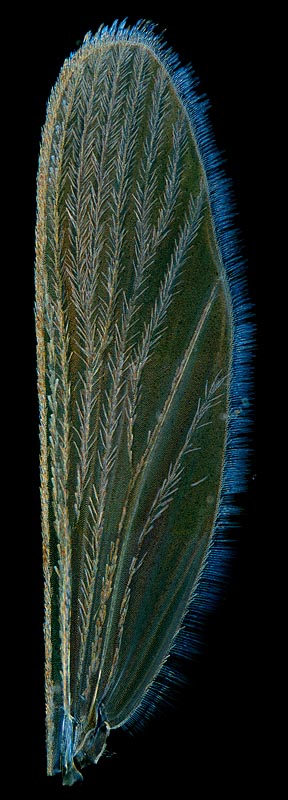
The fragile wing of a mosquito. If you smash a mosquito very carefully you can enjoy the beauty of its wings!


Bell animalcules are common in fresh water but can also be found in the sea. These colonial Ciliates live attached to a stalk. Find out more about their fresh water relatives on the smallest page on the web

Monday, May 16, 2005

The Poggendorff Illusion


Fig. 1. The Poggendorff illusion and its behavior. (A) When an obliquely oriented straight line is interrupted by a vertical occluder, the line segment on the right appears to be shifted downward with respect to the line segment on the left. (B) A similar effect occurs when the orientation of the interrupted line is reversed. In this case, the collinear extension on the right appears to be shifted upward. (C) When an oblique line is interrupted by parallel horizontal lines, the oblique line segments appear to be shifted horizontally with respect to each other. (D) The magnitude of the effect increases as the interrupted line is made more vertical. (E) The magnitude also increases as the width of the interruption increases. (F) The illusion is largely abolished when only the acute components of the stimulus are presented, but the effect is maintained when only the obtuse components are shown. (G) The illusion is diminished when the standard configuration is rotated so that the interrupted line is horizontal.


A new explanation for this illusion has just been published.

The Poggendorff illusion explained by natural scene geometry by Catherine Q. Howe, Zhiyong Yang, and Dale Purves in Proc. Natl. Acad. Sci. USA.
One of the most intriguing of the many discrepancies between perceived spatial relationships and the physical structure of visual stimuli is the Poggendorff illusion, when an obliquely oriented line that is interrupted no longer appears collinear. Although many different theories have been proposed to explain this effect, there has been no consensus about its cause. Here, we use a database of range images (i.e., images that include the distance from the image plane of every pixel in the scene) to show that the probability distribution of the possible locations of line segments across an interval in natural environments can fully account for all of the behavior of this otherwise puzzling phenomenon.

Sunday, May 15, 2005

"Cosmic Gall" by John Updike

Neutrinos, they are very small.
They have no charge and have no mass
And do not interact at all.
The earth is just a silly ball
To them, through which they simply pass,
Like dustmaids down a drafty hall
Or photons through a sheet of glass.
They snub the most exquisite gas,
Ignore the most substantial wall,
Cold shoulder steel and sounding brass,
Insult the stallion in his stall,
And, scorning barriers of class,
Infiltrate you and me. Like tall
And painless guillotines they fall
Down through our heads into the grass.
At night, they enter at Nepal
And pierce the lover and his lass
From underneath the bed—you call
It wonderful; I call it crass.

From TELEPHONE POLES AND OTHER POEMS
(Knopf) © 1960, 1988 John Updike.
Originally in The New Yorker. All rights reserved.

Note: in the meantime, it seems neutrinos do actually have some mass, alas - but that was a pretty big surprise.


John Hoyer Updike

Max Ernst: a Retrospective

exhibit at the Metropolitan in New York - April 7, 2005–July 10, 2005. See the review by John Updike in the New York Review of Books


"The Robing of the Bride", 1939 130 x 96 cm., Venice


Europe after the Rain II. Oil on canvas. 54 x 146 cm. 1940-42. Wadsworth Atheneum, Hartford, CT, USA

Europe after the Rain, we are told, was begun by Ernst in a European prison camp and finished in the United States—a precarious transit, in that dire time, for a crusty canvas two feet by five." says Updike in his review.


Adolf Hitler and Josef Goebbels view the exhibition of "degenerate art", Munich 1937

Hitler was definitely not a fan, Ernst happened to be Jewish:


Max Ernst (French, born Germany, 1891–1976)
The Blessed Virgin Chastises the Infant Jesus Before Three Witnesses: A.B., P.E. and the Artist, 1926
Oil on canvas; 77 1/4 x 51 1/4 in. (196 x 130 cm)
Museum Ludwig, Köln
© 2004 Artists Rights Society (ARS), New York/ADAGP, Paris

According to Updike's review, "The original exhibition including Ernst's assaultive painting The Blessed Virgin Chastises the Infant Jesus before Three Witnesses: A.B., P.E., and the Artist (1926) was closed by church pressure because of it; at the Met, alone on a large wall and protected by glass against possible Christian vandals, it exerts a sensuous spell."

"The House of Flying Daggers" a film by Zhang Yimou

now out on DVD.

Zhang Yimou's early films, "Red Sorghum" (1987), "Ju Dou" (1990), and "Raise the Red Lantern" (1991) were intimate, beautiful, devastating films centered around the oppression of women in pre-revolutionary China. His most recent films "Hero" and "House of Flying Daggers" are very different indeed. Martial arts spectaculars with big budgets and strong female fighters in lead roles, they are much less effective emotionally. The oppressed women in his earlier films were defiant, but they were completely powerless and their vulnerability made their strength of character impressive indeed. The newer films seem quite shallow in comparison.

However, "Hero" did have some of the most beautiful scenes I've ever seen in film, especially memorable were several scenes with ravishing depictions of water. Zhang Yimou's visual style is unmistakable, starting with the gorgeous shots of freshly dyed fabric sheets in "Ju Duo". But a big share of credit for the look of "Hero" has to go to cinematographer Christopher Doyle. He's shot so many stunning films, including "In the Mood for Love", directed by Wong Kar Wai.

The "Making of" documentary on the Flying Daggers DVD wasn't particularly striking, repetitiously filled with comments that all amounted to "Zhang Zimou is really, really good". However, it did explain one fairly odd transition in the film, the climatic fight scene takes place in a fairly substantial snow storm. But the scenes before it, essentially on the same day, were quite temperate. Apparently there was a freak October snow storm during the filming, totally unexpected of course, and the director just went with it.
Ang Lee is another talented director who succumbed to the lure of the big-budget martial arts blockbuster with his "Cringing Tiger". That film's critical and popular success was a total mystery to me. Chow Yun Fat is great in Hong Kong gangster movies, but he was utterly unconvincing in a costume period piece, never mind his deficiencies as a martial arts player.


The DVD cover


Beautiful watery scenes from "Hero"


Freak snowstorm in "Flying Daggers"

You can see a beautiful trailer for "Ju Dou", you might have to endure an annoying ad first, but it's worth it.

Saturday, May 14, 2005

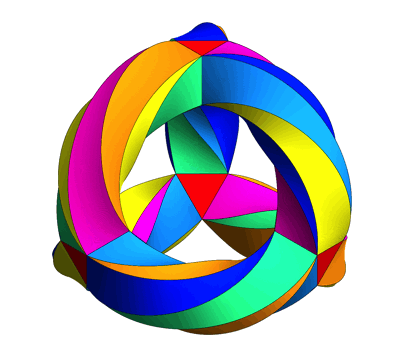
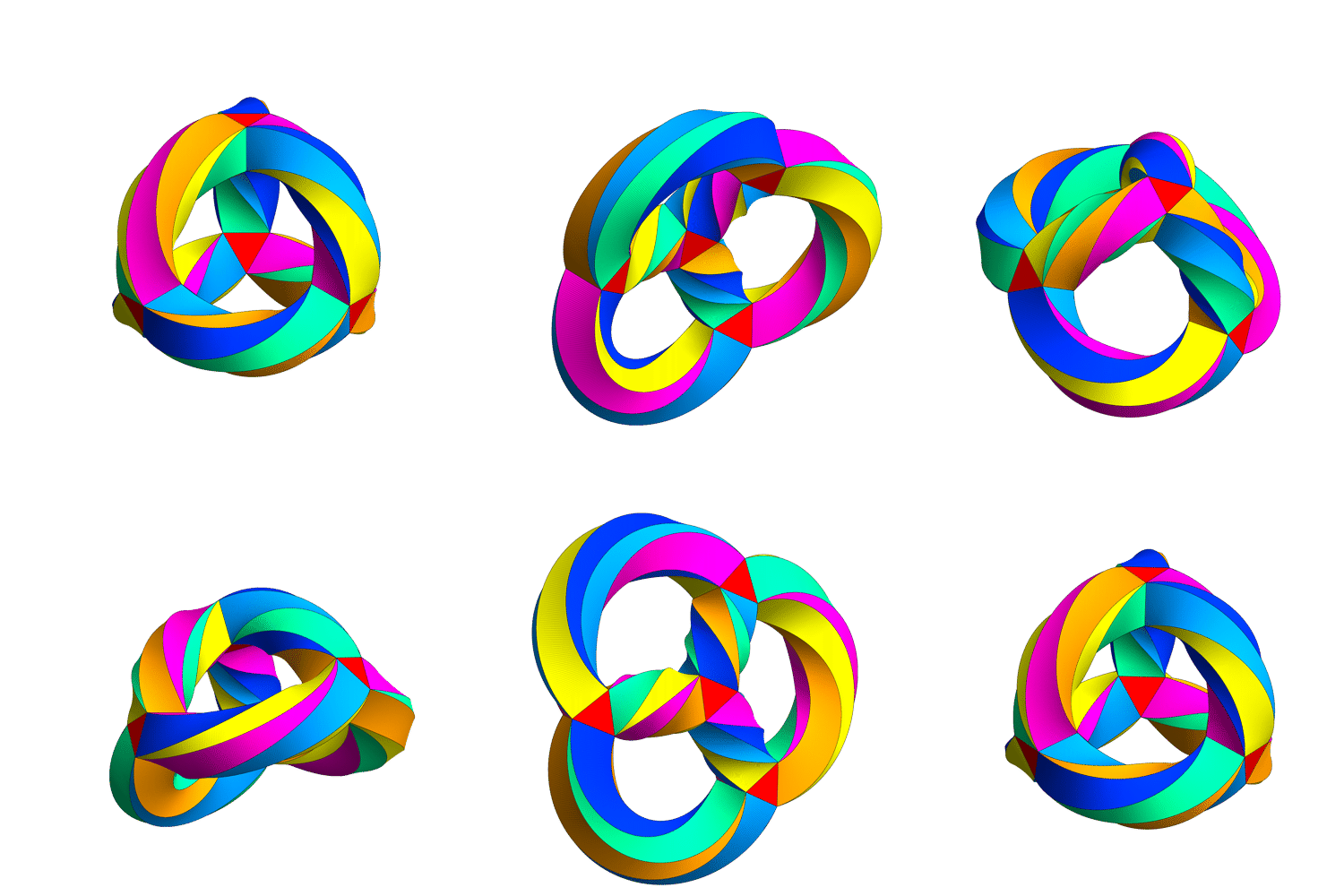
Klein's quartic curve


This is called Klein's quartic curve. It can be turned inside out and it gets reflected in the process.


See John Baez's page for more information.

Friday, May 13, 2005

"High-energy physics: An emptier emptiness?" by Frank Wilczek

In Nature News & Views

A new experiment at Brookhaven using colliding gold ions provides surprising evidence about a fundamental concept in physics: the vacuum. It appears that you can get something from nothing, the vacuum is unstable and new particles can be spontaneously created in empty space. Gack.


A side view of one of the first high-energy collisions captured by the Solenoidal Tracker of the STAR detector at the Relativistic Heavy Ion Collider (RHIC). The initial head-on collision of two gold ions, each consisting of a total of 197 protons and neutrons, occurs at the mid-point of the central tube (running across the image from right to left). The tracks indicate the paths taken by thousands of subatomic particles created in the fireball of energy set free in these collisions. Several layers of detectors, arranged concentrically around the central tube, and encased in a powerful magnet, allow the identification of these particles. (Courtesy of Brookhaven National Laboratory, STAR collaboration.)

Thursday, May 12, 2005

"Robotics: Self-reproducing machines" by Zykov et.al.

article in Nature May 12, 2005. See also Robots master reproduction by Andreas von Bubnoff, news article in the same issue of Nature and A Chip Off the Robotic Block by Adrian Cho in Science.


a, Basic module, with an illustration of its internal actuation mechanism. b, Snapshots from the first 10 s showing how a four-module robot transforms when its modules swivel simultaneously. c, Sequence of frames showing the self-reproduction process, which spans about 2.5 min and runs continuously without human intervention, apart from the replenishing of building blocks at the two 'feeding' locations (circled in red). (For movie, see supplementary information.)

The video is surreal, the motion of the little blocks seems very organic somehow.

A modular machine made of four swiveling blocks uses electromagnets to reproduce itself in a matter of minutes. You have to give it pre-made fresh blocks and put them in a convenient location. This is definitely lowering the bar for self-reproduction, the blocks are complicated little devices themselves. People manage to reproduce themselves using fairly simple chemicals as buidling blocks, though we too require seven essential amino acids that we can't fabricate ourselves. As the authors themselves point out: "We circumvent the long-standing hurdle of what counts as self-replication by suggesting that self-replicability is not a binary property that a system either possesses or not, but is a continuum dependent on the amount of information being copied." Hence a strategy leading to more convincing self-reproduction might involve incrementally simplifying a system of rather complex building blocks, rather than starting from scratch with a satisfyingly elementary substrate.

Tuesday, May 10, 2005

Hoag's Object


This bizzare object was discovered in 1950 by astronomer Art Hoag. It's a bright ring of hot blue stars surrounding a nucleus of yellow stars. Take a close look just above the nucleus - you'll see yet another ring galaxy.

Hoag's Object at Hubble

A recent paper: Hoag's Object a Soliton?

A NASA Hoag's Object page with an explanation and reference links.

Short Gamma Ray Burst on May 9th


Neutron-star cataclysm? A faint patch of light (green arrow) on the fringes a distant galaxy may mark the spot where two neutron stars collided, in this image taken on the morning of 9 May.
CREDIT: J. Bloom/UC Berkeley/WIYN Telescope

Science Online reported the first Short Gamma Ray Burst directly observed, by the NASA Swift satellite at midnight on May 9th. You can find up to the minute news on this and other Gamma Ray Bursters at NASA.


Swift

Link to a previous post about the December 27th Giant Gamma Ray Flash.

Nature article:
Swift satellite spies cosmic crash

Sunday, May 08, 2005

Shelia Chandra, vocalist

Beautiful, eerie, Indian influenced music: Shelia Chandra Official Site, Shelia Chandra at Amazon. She was featured on the soundtrack of "Lord of the Rings: The Two Towers", the "Breath of Life" track. Other tracks I've enjoyed:


"Speaking in Tongues III" - Moonsung 1999

"Speaking in Tounges I", "Ever So Lonely/Eyes/Ocean" - Weaving My Ancestors' Voices 1992
"Lament", "Strange Minaret" - The Struggle 1985
"Ever so Lonely"- Third Eye (Monsoon) 1982

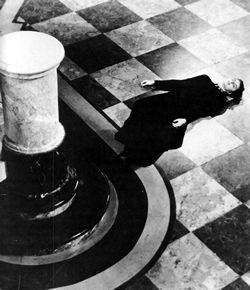
"Notorious", a film by Alfred Hitchcock

with Ingrid Bergman, Cary Grant and Claude Rains. Claude Rains creepy mother is credited as Madame Konstantin, a perfect name for the part.


Hitchcock and Bergman.

One of the greatest films ever, story by Ben Hecht (who also wrote "Front Page"). The scene on the staircase at the end is marvelous.


On the staircase.


At the track.


The elegant Criterion DVD cover


What was in the coffee?

Saturday, May 07, 2005

"The Prince" by Niccolo Machiavelli


Nicolo Machiavelli(1469-1527)

Relevance to Iraq?

"... there is nothing more difficult to carry out, nor more doubtful of success, nor more dangerous to handle, than to initiate a new order of things. For the reformer has enemies in those who profit by the old order, and only lukewarm defenders in all those who would profit by the new order, this lukewarmness arising partly from fear of their adversaries, ...; and partly from the incredulity of mankind, who do not truly believe in anything new until they have actual experience of it. Thus it arises that on every opportunity for attacking the reformer, his opponents do so with the zeal of partisans, the others only defend him half-heartedly, so that between them he runs great danger."

"For it must be noted, that men must either be caressed or else annihilated; they will revenge themselves for small injuries, but cannot do so for great ones; the injury therefore that we do to a man must be such that we need not fear his vengeance.

But maintaining a garrison ..., one will spend much more, and consume all the revenues of that state in guarding it, so that the acquisition will result in a loss, besides giving much greater offense, since it injures every one in that state with the quartering of the army on it; which being an inconvenience felt by all, every one becomes an enemy, and these are enemies which can do mischief, as though beaten, they remain in their homes."

Classic Machiavellianisms

"That in taking a state the conqueror must arrange to commit all his cruelties at once, so as not to have to recur to them every day."

“Love is a bond men easily break,” says Machiavelli, “but fear of punishment holds them in check. Therefore, it is better to be feared than loved.”

"... fortune is a woman, and it is necessary, if you wish to master her, to conquer her by force ..."

Monday, May 02, 2005

Toulouse-Lautrec and Montmartre

at the National Gallery of Art, Washington, D.C. March 20 - June 12, 2005.

While personally I'm not that wild about Toulouse-Lautrec there was plenty of other great stuff at the exhibition, I loved the posters of Chéret and Steinlen for example.
Dance Hall Days - French posters from Chéret to Toulouse–Lautrec


Poster "Musée Grévin" by Jules Chéret


Tournée du Chat Noir by Théophile Alexandre Steinlen


Van Gogh spent time in Montmartre as well.


Agostina Segatori dans le Café du Tambourin
by Vincent Van Gogh

Exhibit at the National Gallery of Art, Washington D.C.

Saturday, April 30, 2005

Way Cool Worm


Cooler. Pompeii worms tolerate scalding temperatures but temper the environment for other creatures.
CREDIT: Ifremer/PHARE/O. Dugornay

"Discovered in the early 1980s, the Pompeii worm (Alvinella pompejana) is the most heat-tolerant animal known. It can survive at temperatures as high as 80°C, according to some scientists. The worm makes its home in thin-walled tubes anchored in the sides of hydrothermal smokers that spew acidic seawater heated to 300°C or more by magma. The smokers are coated in a 10-centimeter thick layer of gel teaming with bacteria."
--- Vent Worms Make Good Neighbors in Science Magazine


Pompeii Worm Page
at the University of Delaware.

Friday, April 29, 2005

"The Tempest", by William Shakespeare

Philip Goodwin and Daniel Breaker (Photo: Richard Termine)

directed by Kate Whoriskey at The Shakespeare Theatre in Washington D.C. March 22 - May 22, 2005.

This production featured a truly aerial Ariel, played by Daniel Breaker high above the stage, often upside-down in a flying harness. Stephano was played by Floyd King, who did a hilarious job. The shipwreck in the opening scene was fabulous.

Full fathoms five thy father lies
Of his bones are coral made
Those are pearls that were his eyes
Nothing of him that doth fade
But doth suffer a sea change
Into something rich and strange

New Hubble Images


Eagle Nebula
Credit: NASA, ESA, and The Hubble Heritage Team (STScI/AURA)


Hubble Image Gallery

"Automatic effects of alcohol cues on sexual attraction", by Friedman et. al.


Alcohol is traditionally believed to effect libido, but in a test of 82 male undergraduates at the University of Missouri at Columbia, they didn't even have to drink the stuff! Just a subliminal flash of the word "beer" on a computer screen was enough to influence the perceived attractiveness of depicted females, at least for the "Show Me State" males. It didn't seem to change ratings of the female's intelligence however.

The Nature News Article

"Modigliani: Beyond the Myth", edited by Mason Klein


A beautiful book from Yale University Press, it's a catalog from a recent exhibition which just ended at the Philips Collection in Washington, D.C. In fact, I saw it today, the final day of a multi-city tour. I also got a great Modigliani T-shirt, lucky me. I'd never been to the Philips Collection before, it's in lovely Dupont Circle, conveniently located on the Metro.


Metropolian Museum, New York


Photograph of the artist as a young man

Salt Fingers, Ocean Mixing


In the mix. Warm salt fingers (light-colored) dribble down as fresh water (darker) rises.
CREDIT: B. Merryfield/ Institute of Ocean Sciences/ Office of Naval Research

Bill Merryfield's salt finger tutorial

"Salty Fingers Do the Mixing" in Science Magazine.

Human Genetics Project from National Geographic, IBM

Earlier this month, the National Geographic Society and IBM announced a project to produce a sharper picture of human migrations by analyzing DNA samples from 100,000 people (Science, 15 April, p. 340). The Web site of the Genographic Project is worth a look for the lavishly illustrated backgrounders on genetics and migrations. A timeline depicts what we know about the human expansion from Africa beginning about 60,000 years ago, stopping at landmarks such as the controversial Cactus Hill site in Virginia. Evidence found there suggests that people reached the Americas thousands of years earlier than previously thought. Another section explains how to send in your DNA and find out where your ancestors originated. Genealogical curiosity will cost you $99.95 plus shipping for the test kit.
--- Science Magazine Netwatch

National Geographics Gengraphics Page

Exploding German Toads Baffle Scientists


Undated but recent filer shows a dead toad in a Hamburg, Germany lake. More than 1,000 toads have puffed up and exploded in a Hamburg pond in recent weeks, and German scientists still have no explanation for what is causing the combustion.(AP Photo/Florian Quand)

BERLIN - Why are toads puffing up and spontaneously exploding in northern Europe? It began in a posh German neighborhood and has spread across the border into Denmark. It's left onlookers baffled, but one German scientist studying the splattered amphibian remains now has a theory: Hungry crows may be pecking out their livers.

Local environmental workers in Hamburg have described it as a scene out of a horror or science fiction movie, with the bloated frogs agonizing and twitching for several minutes, inflating like a balloon before suddenly bursting.

"It's horrible," biologist Heidi Mayerhoefer was quoted as telling the Hamburger Morgenpost daily.

"The toads burst, the entrails slide out. But the animal isn't immediately dead — they keep struggling for several minutes."


Disappointingly, the Nature magazine web site poo-pooed the exploding German toad phenomenon: Has bubble burst over exploding toad tale?. "Evidence points to bloated toads and hungry birds, but not explosions" according to Nature. Party poopers!

Thursday, April 28, 2005

The Giant Gamma Ray Flash On 27 December 2004


Artist conception of the December 27, 2004 gamma ray flare expanding from SGR 1806-20 and impacting Earth’s atmosphere. Credit: NASA


An artist conception of the SGR 1806-20 magnetar including magnetic field lines.
Credit: NASA

In this weeks Nature, there's a series of articles on the giant flash of Dec 27, 2004: Nature article

This was a truly mind-boggling event. It was so powerful that it bounced off the Moon and lit up the Earth's upper atmosphere. The flash was brighter than anything ever detected from beyond our Solar System and lasted over a tenth of a second. Two similar flares had previously been detected from different sources during 30 years of observations. But it outshone both the preceding events by two orders of magnitude, releasing in its first fraction of a second as much energy as the Sun releases in a quarter of a million years.

SGR stands for soft gamma repeater, because they flare up randomly and release gamma rays.

A strange coincidence in timing has been noted (see this site, for example) - the Sumatra earthquake and tsunami occured the day before, December 26, 2004. Hmmm, maybe gravity waves, whatever, the day before that was Christmas, can't forget that either.

Link to a NASA article on the flash

Arnold's Cogent Analysis of the Situation

From an article in today's New York Times Paying on the Highway to Get Out of First Gear:
"Californians can't get from place to place on little fairy wings," said Gov. Arnold Schwarzenegger in announcing a plan in January that could allow private investors to build toll roads. "We are a car-centered state. We need roads."

The Governor himself utilizing California transportation systems