One of the fundamental principles of particle physics is that particles and their anti-particles should have the same mass. So it was a big surprise when Fermilab MINOS collaboration found that the muon neutrino and muon antineutrino appear to have different masses. Neutrino experiments are extraordinarily difficult because neutrinos are so hard to detect. This result is still very preliminary. But if it does hold up, the impact on theoretical physics will be earthshaking.
See Neutrino surprise emerges from MINOS at PhysicsWorld .
Tuesday, September 21, 2010

Monday, September 20, 2010
The Sky in Boston tonight
was spectacular. Venus just after sunset in the West and a nearly full moon and a gigantic Jupiter in East, one of its closest approaches to Earth. All four of the major satellites of Jupiter were lined up and nearby was Uranus - actually the first time I believe I've ever seen it, with binoculars.
Unfortunately I couldn't see the following sight (Carina Nebula) with my binoculars, it is in the Southern Hemisphere, but the Hubble Space Telescope did.

Unfortunately I couldn't see the following sight (Carina Nebula) with my binoculars, it is in the Southern Hemisphere, but the Hubble Space Telescope did.

Dimensionality of the Universe
One of the most mysterious facts about our universe is that, for most purposes, it can be modelled as four-dimensional: with one dimension for time and three dimensions for space. Why four, why not three, why not 42? There have long been proposals that add more dimensions, especially extra spatial dimensions, which are curled up so tightly that we don't normally perceive them.
The following preprint proposes something different. At very small scales (subatomic) there are effectively fewer than three spatial dimensions while at very large scales (cosmological) there are effectively more than three spatial dimensions!
Vanishing Dimensions and Planar Events at the LHC
The following preprint proposes something different. At very small scales (subatomic) there are effectively fewer than three spatial dimensions while at very large scales (cosmological) there are effectively more than three spatial dimensions!
Vanishing Dimensions and Planar Events at the LHC
We propose that the effective dimensionality of the space we live in depends on the length scale we are probing. As the length scale increases, new dimensions open up. At short scales the space is lower dimensional; at the intermediate scales the space is three-dimensional; and at large scales, the space is effectively higher dimensional. This setup allows for some fundamental problems in cosmology, gravity, and particle physics to be attacked from a new perspective. The proposed framework, among the other things, offers a new approach to the cosmological constant problem and results in striking collider phenomenology and may explain elongated jets observed in cosmic-ray data.
Saturday, September 18, 2010
Codons matter
DNA codes for amino acids with triplets of bases (codons). There are four different bases and hence 64 different triplets. There are typically twenty different amino acids (plus start and stop signals) which need to be coded, so there is some redundancy - a single amino acid can have multiple codons which are all translated the same way. However, there is now evidence that the actual codon may make a difference. New Roles for Codon Usage in Science reports that two very similar but distinct proteins are modified differently, depending on the original codon.
Thursday, September 16, 2010
Tuesday, September 14, 2010
Bowerbirds use an optical illusion to trick their mates
Bowerbirds trick mates with optical illusions at Nature News. Male bowerbirds construct their bowers to create an optical illusion called forced perspective which makes them appear bigger than they really are.
The Problem of Time
The Problem of Time in Quantum Gravity
The problem of time in quantum gravity occurs because `time' is taken to have a different meaning in each of general relativity and ordinary quantum theory. This incompatibility creates serious problems with trying to replace these two branches of physics with a single framework in regimes in which neither quantum theory nor general relativity can be neglected, such as in black holes or in the very early universe.
Monday, September 13, 2010
The heliospheric current sheet
"The Sun with the heliosheet is like a bashful ballerina who is repeatedly trying to push her excessively high flaring skirt downward".


Wednesday, September 08, 2010
Universality
A first draft of a non-technical article on universality by Fields medallist Terence Tao. Talks about universality: when important attributes of a large-scale system can be independent of how the system works at smaller scales.
Tuesday, September 07, 2010
Solar Neutrinos
The preprint Solar neutrinos, helioseismology and the solar internal dynamics begins with an interesting history of the "solar neutrino problem".
The Mafia Game
The mafia game (or werewolf or assassin game) is a party game in which the organiser divides the players into two groups: the citizens and the mafia. The mafia are told who the other mafia are, but the citizens don't know. The game alternates between the "day" when all the players decide who to "lynch" and the "night" when just the mafia decide who to eliminate. The game ends when either all the citizens or all the mafia are eliminated.
The preprint A mathematical model of the Mafia game provides an analysis of strategy.
The preprint A mathematical model of the Mafia game provides an analysis of strategy.
Monday, September 06, 2010
Testing the Universality of Free Fall
There's an interesting debate in Nature about atom interferometry tests of gravitational redshifts and what they imply about the university of free fall and the Einstein equivalence principle. See the preprint Atom gravimeters and gravitational redshift and the reply. See also the preprint Gravitational Redshift, Equivalence Principle, and Matter Waves. One of the authors in this controversy is Nobel prize winner and Department of Energy secretary Steven Chu.
Saturday, September 04, 2010
The Copernican Principle
The Copernican Principle posits that the Earth is not in any particularly special location in the universe. Prior to Copernicus, the Earth had been placed in the center of the universe and historically there was much resistance to moving it - early in his career even Galileo had a fanciful rationale for putting the earth at the center.
The Standard Model of Cosmology pretty much enshrines the Copernican Principle. It has had some success explaining phenomenon like the extragalactic redshifts, microwave background radiation and the abundances of light elements.
However there are some difficulties with this model, especially the observed acceleration of the redshifts (Dark Energy) and the abundance of lithium 7.
The preprint Do primordial Lithium abundances imply there's no Dark Energy? explains these observations by heretically suggesting that the Earth might be in a rather special place after all: near the center of a gigantic void. See also The Cosmic Microwave Background in an Inhomogeneous Universe - why void models of dark energy are only weakly constrained by the CMB by the same authors.
The Standard Model of Cosmology pretty much enshrines the Copernican Principle. It has had some success explaining phenomenon like the extragalactic redshifts, microwave background radiation and the abundances of light elements.
However there are some difficulties with this model, especially the observed acceleration of the redshifts (Dark Energy) and the abundance of lithium 7.
The preprint Do primordial Lithium abundances imply there's no Dark Energy? explains these observations by heretically suggesting that the Earth might be in a rather special place after all: near the center of a gigantic void. See also The Cosmic Microwave Background in an Inhomogeneous Universe - why void models of dark energy are only weakly constrained by the CMB by the same authors.
Friday, September 03, 2010
A Light Sucker
Laser science: Suckers for light in Nature.
A Coherent perfect absorber is:
Backward lasing yields a perfect absorber
A Coherent perfect absorber is:
An optical device has been designed that performs a function exactly opposite to that of a laser. It perfectly absorbs incoming coherent radiation and turns it into thermal or electrical energy.
Backward lasing yields a perfect absorber
Just as a laser can emit coherent light from an amplifying medium, an absorbing medium can perfectly capture incoming radiation under the right conditions
CPA-based interferometers could thus have potential applications in the realization of transducers, modulators, or optical switches, for example, in on-chip integrated optical circuits based on Si waveguide/resonator technology.
The Sun's Elements
An Unsettled Debate About the Chemistry of the Sun in Science.
There's a debate about how much carbon, nitrogen, oxygen and neon the sun contains. NASA
NASA
There's a debate about how much carbon, nitrogen, oxygen and neon the sun contains.
 NASA
NASA
Thursday, September 02, 2010
Probability Puzzles
There's an intersting discussion of some confusing Probability Puzzles on John Baez's new blog.
“I have two children. One is a boy born on a Tuesday. What is the probability I have two boys?”
The "born on a Tuesday" information can't possibly make a difference, can it? So the answer should be same same as:
“I have two children. One is a boy. What is the probability I have two boys?”
Shoudn't it?
There's a thorough analysis at Some Thoughts on Tuesday's Child by Greg Egan.
“I have two children. One is a boy born on a Tuesday. What is the probability I have two boys?”
The "born on a Tuesday" information can't possibly make a difference, can it? So the answer should be same same as:
“I have two children. One is a boy. What is the probability I have two boys?”
Shoudn't it?
There's a thorough analysis at Some Thoughts on Tuesday's Child by Greg Egan.
Tuesday, August 31, 2010
Thursday, August 26, 2010
Collider Physics
There is currently much excitement in physics due to the LHC, the huge new European particle accelerator. This preprint explains the theoretical analysis of such experiments: Introduction to Collider Physics.
 Insertion of the vacuum-tank of the CMS detector in the LHC
 Insertion of the vacuum-tank of the CMS detector in the LHC
More Quantum Inequalities
Quantum mechanics: The usefulness of uselessness in Nature.
Bell pointed out that quantum mechanics violates certain inequalities that are true in classical physics. This article discusses other inequalities that even quantum mechanics respects but which distinguish it from "super quantum theories" that would be able to violate these inequalities.
Bell pointed out that quantum mechanics violates certain inequalities that are true in classical physics. This article discusses other inequalities that even quantum mechanics respects but which distinguish it from "super quantum theories" that would be able to violate these inequalities.
How big is the Proton?
The proton shrinks in size: Tiny change in radius has huge implications - in Nature.
Problems with Quantum Mechanics
Might I say immediately … we always have had a great deal of difficulty in understanding the world view that quantum mechanics represents … I cannot define the real problem, therefore I suspect there’s no real problem, but I am not sure there’s no real problem.Jeremy Bernstein in FAPP and Non-FAPP: A Pedagogical Essay discusses the foundations of quantum mechanics. Bernstein is a very good writer and he explains some aspects of this problematic field quite well. In the end, however, it still seems just as problematic as ever.
Richard Feynman
FAPP - For All Practical Purposes
Once Bernstein happened to visit physicist Erwin Schroedinger in his Vienna apartment.
There was no cat. He did not like cats.
Wednesday, August 25, 2010
Weak Lensing
Weak lensing, dark matter and dark energy preprint.
Weak gravitational lensing is rapidly becoming one of the principal probes of dark matter and dark energy in the universe. In this brief review we outline how weak lensing helps determine the structure of dark matter halos, measure the expansion rate of the universe, and distinguish between modified gravity and dark energy explanations for the acceleration of the universe. We also discuss requirements on the control of systematic errors so that the systematics do not appreciably degrade the power of weak lensing as a cosmological probe.
Tuesday, August 24, 2010
Nicole Oresme

Nicole Oresme was a sophisticated 14th century French philospher. He discussed and compared Earth-centered and Sun-centered models of the solar system and couldn't find any way to dismiss the Sun-centered model - though he personally didn't believe it. He also used techniques which were very close to Cartesian coordinate systems - over two hundred years before Descartes. See the Nicole Oresme article in the Stanford Encyclopedia of Philosophy.
RRAT's
Transient Radio Neutron Stars preprint.
Here I will review the high time resolution radio sky, focusing on millisecond scales. This is primarily occupied by neutron stars, the well-known radio pulsars and the recently identified group of transient sources known as Rotating RAdio Transients (RRATs). The RRATs appear to be abundant in the Galaxy, which at first glance may be difficult to reconcile with the observed supernova rate. However, as I will discuss, it seems that the RRATs can be explained as pulsars which are either extreme nullers, highly variable or weak/distant. I will re-cap some recent results including a re-analysis of the Parkes Multi-beam Pulsar Survey, which has identified several new sources, as well as the unusual timing behaviour of RRAT J1819-1458. This leads to an examination of where RRATs fit within the evolution of neutron stars post-supernova.
Measuring the mass of solar system planets using pulsar timing
Measuring the mass of solar system planets using pulsar timing
Apparently the pulse time of arrival from pulsars is so accurate it can help determine the masses of the planets of the solar system with accuracy comparable (or better) than data from spacecraft missions. That's because the motions of the other planets cause the Earth to wiggle in its orbit. The pulsar data allowed the researchers to determine the Earth's orbit so well, it could be used to determine the masses of the other planets!
See also Pulsar Signals Could Reveal Solar System Secrets at Science.
Apparently the pulse time of arrival from pulsars is so accurate it can help determine the masses of the planets of the solar system with accuracy comparable (or better) than data from spacecraft missions. That's because the motions of the other planets cause the Earth to wiggle in its orbit. The pulsar data allowed the researchers to determine the Earth's orbit so well, it could be used to determine the masses of the other planets!
See also Pulsar Signals Could Reveal Solar System Secrets at Science.
Monday, August 23, 2010
Hubble image of SN1987A
 HST SN1987A
When I saw this Hubble Space Telescope image of Supernova 1987A on Wikipedia, it was so spectacular at first I thought it must have been just some artist's conception.
Saturday, August 21, 2010
Picophytoplankton
Targeted metagenomics and ecology of globally important uncultured eukaryotic phytoplankton in PNAS.
Small (2-3μm) uncultured photosynthetic eukaryotic plankton (picophytoplankton) are a substantial component of the biomass and primary production in the oceans. Pico-prymnesiophytes genomes seem to be a mosaic, with the chloroplast and nuclear genomes from different lineages.
Small (2-3μm) uncultured photosynthetic eukaryotic plankton (picophytoplankton) are a substantial component of the biomass and primary production in the oceans. Pico-prymnesiophytes genomes seem to be a mosaic, with the chloroplast and nuclear genomes from different lineages.
Friday, August 20, 2010
The Pioneer Anomaly
The Pioneer Anomaly preprint.
Radio-metric Doppler tracking data received from the Pioneer 10 and 11 spacecraft from heliocentric distances of 20-70 AU has consistently indicated the presence of a small, anomalous, blue-shifted frequency drift uniformly changing with a rate of ~6 x 10^{-9} Hz/s. Ultimately, the drift was interpreted as a constant sunward deceleration of each particular spacecraft at the level of a_P = (8.74 +/- 1.33) x 10^{-10} m/s^2. This apparent violation of the Newton's gravitational inverse-square law has become known as the Pioneer anomaly; the nature of this anomaly remains unexplained. In this review, we summarize the current knowledge of the physical properties of the anomaly and the conditions that led to its detection and characterization. We review various mechanisms proposed to explain the anomaly and discuss the current state of efforts to determine its nature. A comprehensive new investigation of the anomalous behavior of the two Pioneers has begun recently. The new efforts rely on the much-extended set of radio-metric Doppler data for both spacecraft in conjunction with the newly available complete record of their telemetry files and a large archive of original project documentation. As the new study is yet to report its findings, this review provides the necessary background for the new results to appear in the near future. In particular, we provide a significant amount of information on the design, operations and behavior of the two Pioneers during their entire missions, including descriptions of various data formats and techniques used for their navigation and radio-science data analysis. As most of this information was recovered relatively recently, it was not used in the previous studies of the Pioneer anomaly, but it is critical for the new investigation.
Thursday, August 19, 2010
The Birthplace of the Sun
The Astrophysical Environment of the Solar Birthplace preprint.
Our Sun, like all stars, formed within a cold molecular cloud. Astronomical observations and theory provide considerable detail into this process. Yet cosmochemical observations of short lived radionuclides in primitive meteorites, in particular 60Fe, provide unequivocal evidence that the early solar system inherited fresh nucleosynthetic material from the core of a hot, massive star, almost certainly ejected in a supernova explosion. I give a short introduction to the fields of star formation and meteoritics and discuss how the reconciliation of their disparate clues to our origin places strong constraints on the environment of the Solar birthplace. Direct injection of supernova ejecta into a protoplanetary disk or a dense molecular core is unlikely since their small sizes require placement unusually close to the massive star. Lower density molecular cloud clumps can capture more ejecta but the radionuclides decay during the slow gravitational collapse. The most likely scenario is on the largest scales via the formation of enriched molecular clouds at the intersection of colliding supernova bubbles in spiral arms.
Saturday, August 14, 2010
The Earth's Inner Core
Earth's Moving, Melting Core in Science.
Strange forces are at work 5000 kilometers below Earth's surface. The inner core is acting in ways that scientists can't explain. Theoretically, the core should be drawing iron from its molten surroundings and crystallizing it into solid metal. But that alone doesn't account for a number of odd observations—unless, as a few scientists speculate, the core is also melting.
Tuesday, August 10, 2010
P is not equal to NP?
Vinay Deolalikar a research scientist at HP labs, has a preprint (on his web page) which is a preliminary draft of a proof that P is not equal to NP. Claimed resolutions of P=NP are rife on the internet. However, this draft preprint is from a reputable researcher. The P=NP question is one of the most important research problems of our time. Any proof of this importance will have to be carefully checked by the research community. We shall see!
See how this process has been playing out as of August 16, 2010: Step 1: Post Elusive Proof. Step 2: Watch Fireworks. in the New York Times.
See also A Tale of A Serious Attempt At P≠NP by Computer Scientist Richard J. Lipton at CACM.
See how this process has been playing out as of August 16, 2010: Step 1: Post Elusive Proof. Step 2: Watch Fireworks. in the New York Times.
See also A Tale of A Serious Attempt At P≠NP by Computer Scientist Richard J. Lipton at CACM.
Friday, July 30, 2010
A Peculiar Moon in Lord of the Rings
Lord of the Rings, the fantasy trilogy by J.R.R. Tolkein, takes place in Middle Earth, which has a different geography than our Earth, some different humanoids (Elves, Dwarfs, Hobbits) walking/talking trees (Ents) etc. But the weather, the vegetation and the animal life are mostly similar to ours. In particular, the sun, the moon and the stars seem pretty much the same. The characters are often out and about by night, so the phase and position of the moon is often mentioned. In one scene, however, the moon behaves a bit strangely.
In The Two Towers, Book Four, Chapter 4, Of Herbs and Stewed Rabbits, in the first page of that chapter, "The moon was now three nights from the full, but it did not climb over the mountains until nearly midnight, and the early night was very dark." The mountains are to the east of their location, which would block the early rising moon. Does "three nights from the full" mean the moon is waxing and it is three days before it will be full - or does it mean the moon is waning and it is three days after the full moon? I intuitively interpreted that as the first case: the moon is waxing, it's before the full moon. In Moon Phases in The Lord of the Rings there's an impressively detailed accounting which agrees with that interpretation. But when the moon is waxing, it will typically reach its highest point in the sky before midnight. This really only depends on the fact that the moon is illuminated by light reflected from the sun. In much of the rest of Tolkein, the moon does behave quite normally, for example: "If the Moon gave enough light, we would use it, but alas he sets early and is yet young and pale".
Here's another loony scene however. In the chapter In the house of tom bombadil: "In the dead night, Frodo lay in a dream without light. Then he saw the young moon rising;". Dreams are notoriously full of nonsense, so I guess we can't hold Tolkein responsible for unfortunate lunar behaviour in the bad dream of a little guy with hairy toes.
In societies without widespread artificial lighting, most people were very conscious of the phases of the moon. Today however, this is far from true. Mention the easily observed fact that the full moon typically rises around the same time as the sunset and then sets around sunrise and the expression on people's faces will all too often plainly reveal that this is news to them.
In The Two Towers, Book Four, Chapter 4, Of Herbs and Stewed Rabbits, in the first page of that chapter, "The moon was now three nights from the full, but it did not climb over the mountains until nearly midnight, and the early night was very dark." The mountains are to the east of their location, which would block the early rising moon. Does "three nights from the full" mean the moon is waxing and it is three days before it will be full - or does it mean the moon is waning and it is three days after the full moon? I intuitively interpreted that as the first case: the moon is waxing, it's before the full moon. In Moon Phases in The Lord of the Rings there's an impressively detailed accounting which agrees with that interpretation. But when the moon is waxing, it will typically reach its highest point in the sky before midnight. This really only depends on the fact that the moon is illuminated by light reflected from the sun. In much of the rest of Tolkein, the moon does behave quite normally, for example: "If the Moon gave enough light, we would use it, but alas he sets early and is yet young and pale".
Here's another loony scene however. In the chapter In the house of tom bombadil: "In the dead night, Frodo lay in a dream without light. Then he saw the young moon rising;". Dreams are notoriously full of nonsense, so I guess we can't hold Tolkein responsible for unfortunate lunar behaviour in the bad dream of a little guy with hairy toes.
In societies without widespread artificial lighting, most people were very conscious of the phases of the moon. Today however, this is far from true. Mention the easily observed fact that the full moon typically rises around the same time as the sunset and then sets around sunrise and the expression on people's faces will all too often plainly reveal that this is news to them.
Tuesday, July 27, 2010
The Darkest Galaxy
A Complete Spectroscopic Survey of the Milky Way Satellite Segue 1: The Darkest Galaxy arXiv preprint.
We present the results of a comprehensive Keck/DEIMOS spectroscopic survey of the ultra-faint Milky Way satellite galaxy Segue 1. We have obtained velocity measurements for 99.1% of the stars within 67 pc (2.3 half-light radii) of the center of Segue 1 that have colors and magnitudes consistent with membership, down to a magnitude limit of r=21.7. Based on photometric, kinematic, and metallicity information, we identify 71 stars as probable Segue 1 members, including some as far out as 87 pc. After correcting for the influence of binary stars using repeated velocity measurements, we determine a velocity dispersion of 3.7^{+1.4}_{-1.1} km/s, with a corresponding mass within the half-light radius of 5.8^{+8.2}_{-3.1} x 10^5 Msun. The stellar kinematics of Segue 1 require very high mass-to-light ratios unless it is far from dynamical equilibrium, even if the period distribution of unresolved binary stars is skewed toward implausibly short periods. With a total luminosity less than that of a single bright red giant and a V-band mass-to-light ratio of 3400 Msun/Lsun, Segue 1 is the darkest galaxy currently known. We critically re-examine recent claims that Segue 1 is a tidally disrupting star cluster and that kinematic samples are contaminated by the Sagittarius stream. The extremely low metallicities ([Fe/H] < -3) of two Segue 1 stars and the large metallicity spread among the members demonstrate conclusively that Segue 1 is a dwarf galaxy, and we find no evidence in favor of tidal effects. We also show that contamination by the Sagittarius stream has been overestimated. Segue 1 has the highest measured dark matter density of any known galaxy and will therefore be a prime testing ground for dark matter physics and galaxy formation on small scales
Saturday, July 24, 2010
Quantum Interference
Pairs Rule Quantum Interference in Science.
Quantum interference is one of the most mysterious features of quantum mechanics. In fact, Feynman referred to the double-slit interference experiment for single particles as the "only" mystery in quantum mechanics (1). On page 418 of this issue, Sinha et al. (2) describe a recent experiment that shows that quantum interference from a single photon arises only from pairs of possible paths through an interferometer. There is no need to invoke additional interference terms that might arise from interactions of three or more paths.
Friday, July 23, 2010
The Cyberiad by Stanislaw Lem
I'm in the middle of rereading one of my favorite collections of tales, "The Cyberiad" by Stanislaw Lem, translation by Michael Kandel. Originally in Polish, the English version is filled with delightful word play and whimsy.
"He who has had, has been, but he who hasn't been, has been had"
"He who has had, has been, but he who hasn't been, has been had"
A Film about East Timor
A Hero's Journey : A documentary film about forgiveness with Xanana Gusmao of East Timor (Timor-Leste) directed by Grace Phan.

Thursday, July 22, 2010
FREE FALL: World champion freediver Guillaume Nery special dive at Dean's Blue Hole, the deepest blue hole in the world filmed entirely on breath hold by the french champion Julie Gautier. This video is a FICTION and an ARTISTIC PROJECT. Edited by BLUENERY (c).
Tuesday, July 20, 2010
Cosmic Acceleration
Cosmology forum: Is dark energy really a mystery? in Nature.
The Universe is expanding. And the expansion seems to be speeding up. To account for that acceleration, a mysterious factor, 'dark energy', is often invoked. A contrary opinion — that this factor isn't at all mysterious — is here given voice, along with counter-arguments against that view.
Topological Insulators
Topological insulators: Star material in Nature.
Topological insulators are a new kind of material which conduct electricity only on their surfaces. There are new, inexpensive compounds based on bismuth which have created a lot of excitement.
Solid-state physics: U-turns strictly prohibited also in Nature.
Topological insulators are a new kind of material which conduct electricity only on their surfaces. There are new, inexpensive compounds based on bismuth which have created a lot of excitement.
Solid-state physics: U-turns strictly prohibited also in Nature.
According to theory, electrons on the surface of a topological insulator are not allowed to make U-turns. This notion, and some of its main consequences, has now been tested experimentally.
North Pacific Deep Water Formation in the last ice age
When Still Waters Ran Deep in Science.
"Deep water" and "bottom water"—the waters that fill the deep parts of ocean basins—form when surface waters become dense and sink. Today, this occurs in the northern North Atlantic and around Antarctica, but not in the North Pacific. There, surface waters do not become dense enough to sink more than a few hundred meters. In the past, however, it seems things were different. Recently, Okazaki et al. offered new insight into the ancient history of the ocean from radiocarbon data and modeling analyses (1). They suggest that deep water formed in the North Pacific at the beginning of the transition out of the last ice age.
The Mystery of Sea-Floor Methane
The Ongoing Mystery of Sea-Floor Methane in Science.
Each year, ocean sediments produce a quantity of methane equivalent to about half of the methane emitted to the atmosphere from all natural sources (1). Very little of the methane produced below the sea floor, however, reaches the ocean or the atmosphere; most is consumed by anaerobic microorganisms as it diffuses up through oxygen-poor (anoxic) sediments. Researchers recognized this process, known as anaerobic methane oxidation (AMO), nearly 35 years ago (2), but it remains poorly understood. Investigators have not been able to firmly establish the reaction mechanism, fully understand the factors that control oxidation rates, or isolate the responsible organisms. This represents a gaping hole in our understanding of one of Earth's primary sinks for methane. Recent studies of a rare but intriguing sedimentary environment–sea-floor seeps of methane-rich fluids–have provided new insights into the microorganisms that inhabit methane-rich sediments, but raised new questions regarding reaction mechanisms.
A Low Luminosity Supernova
The Subluminous Supernova 2007qd: A Missing Link in a Family of Low-Luminosity Type Ia Supernovae preprint.
We present multi-band photometry and multi-epoch spectroscopy of the peculiar Type Ia supernova (SN Ia) 2007qd, discovered by the SDSS-II Supernova Survey. It possesses physical properties intermediate to those of the peculiar SN 2002cx and the extremely low-luminosity SN 2008ha. Optical photometry indicates that it had an extraordinarily fast rise time of <= 10 days and a peak absolute B magnitude of -15.4 +/- 0.2 at most, making it one of the most subluminous SN Ia ever observed. Follow-up spectroscopy of SN 2007qd near maximum brightness unambiguously shows the presence of intermediate-mass elements which are likely caused by carbon/oxygen nuclear burning. Near maximum brightness, SN 2007qd had a photospheric velocity of only 2800 km/s, similar to that of SN 2008ha but about 4000 and 7000 km/s less than that of SN 2002cx and normal SN Ia, respectively. We show that the peak luminosities of SN 2002cx-like objects are highly correlated with both their light-curve stretch and photospheric velocities. Its strong apparent connection to other SN 2002cx-like events suggests that SN 2007qd is also a pure deflagration of a white dwarf, although other mechanisms cannot be ruled out. It may be a critical link between SN~2008ha and the other members of the SN 2002cx-like class of objects.
Friday, July 16, 2010
The Stern Gerlach Experiment
The Stern Gerlach Experiment by Jeremy Bernstein, preprint. A history and analysis of the Stern-Gerlach Experiment, a key piece of evidence for quantum mechanics.
Thursday, July 15, 2010
Nuclear Reactions
Nuclear Reactions preprint.
Nuclear reactions generate energy in nuclear reactors, in stars, and are responsible for the existence of all elements heavier than hydrogen in the universe. Nuclear reactions denote reactions between nuclei, and between nuclei and other fundamental particles, such as electrons and photons. A short description of the conservation laws and the definition of basic physical quantities is presented, followed by a more detailed account of specific cases: (a) formation and decay of compound nuclei; (b)direct reactions; (c) photon and electron scattering; (d) heavy ion collisions; (e) formation of a quark-gluon plasma; (f) thermonuclear reactions; (g) and reactions with radioactive beams. Whenever necessary, basic equations are introduced to help understand general properties of these reactions. Published in Wiley Encyclopedia of Physics, ISBN-13: 978-3-527-40691-3 - Wiley-VCH, Berlin, 2009.
Wednesday, July 14, 2010
Missing Baryons
Where are the missing baryons in clusters? preprint.
Here are a couple more preprints on the subject:
Evidence for the Missing Baryons in the Angular Correlation of the Diffuse X-ray Background;
The Baryon Content of Cosmic Structures.
Observations of clusters of galaxies suggest that they contain significantly fewer baryons (gas plus stars) than the cosmic baryon fraction. This `missing baryon' puzzle is especially surprising for the most massive clusters which are expected to be representative of the cosmic matter content of the universe (baryons and dark matter). Here we show that the baryons may not actually be missing from clusters, but rather are extended to larger radii than typically observed. The baryon deficiency is typically observed in the central regions of clusters (~0.5 the virial radius). However, the observed gas-density profile is significantly shallower than the mass-density profile, implying that the gas is more extended than the mass and that the gas fraction increases with radius. We use the observed density profiles of gas and mass in clusters to extrapolate the measured baryon fraction as a function of radius and as a function of cluster mass. We find that the baryon fraction reaches the cosmic value near the virial radius for all groups and clusters above 5e13 solar masses. This suggests that the baryons are not missing, they are simply located in cluster outskirts. Heating processes (shock-heating of the intracluster gas, plus supernovae and AGN feedback) that cause the gas to expand are likely explanations for these results. Upcoming observations should be able to detect these baryons.
Here are a couple more preprints on the subject:
Evidence for the Missing Baryons in the Angular Correlation of the Diffuse X-ray Background;
The Baryon Content of Cosmic Structures.
Friday, July 09, 2010
Tuesday, July 06, 2010
The history of Quarks
Memories of Murray and the Quark Model by George Zweig.
Life at Caltech with Murray Gell-Mann in the early 1960's is remembered. Our different paths to quarks, leading to different views of their reality, are described.
Thursday, July 01, 2010
Gravity Tricks
Gravitatomagnetic Analogs of Electric Transformers preprint.
Linearized general relativity admits a formulation in terms of gravitoelectric and gravitomagnetic fields that closely parallels the description of the electromagnetic field by Maxwell's equations. For steady mass currents, this formalism has been used to understand gravitomagnetic effects like the Lense-Thirring dragging of inertial frames. For time-varying mass-energy currents, the analog of Faraday's law suggests new effects based on the gravitational equivalent of a transformer where such currents take the place of electrical currents. New experimental possibilities are suggested including a novel coupling mechanism of electromagnetism to gravity, new tests of general relativity in the ultrarelativistic limit using particle beams in the LHC, and searches for a materials exhibiting the gravitational analog of ferromagnetism.
Friday, June 25, 2010
Graphene
Graphene Photonics and Optoelectronics preprint.
The richness of optical and electronic properties of graphene attracts enormous interest. Graphene has high mobility and optical transparency, in addition to flexibility, robustness and environmental stability. So far, the main focus has been on fundamental physics and electronic devices. However, we believe its true potential to be in photonics and optoelectronics, where the combination of its unique optical and electronic properties can be fully exploited, even in the absence of a bandgap, and the linear dispersion of the Dirac electrons enables ultra-wide-band tunability. The rise of graphene in photonics and optoelectronics is shown by several recent results, ranging from solar cells and light emitting devices, to touch screens, photodetectors and ultrafast lasers. Here we review the state of the art in this emerging field.
Thursday, June 24, 2010
Calculating the Day of the Week
A Method for Accelerating Conway's Doomsday Algorithm preprint.
A simplified version of Conway's Doomsday Algorithm for calculating the day of the week of any calendar date.
A simplified version of Conway's Doomsday Algorithm for calculating the day of the week of any calendar date.
The surprising effect of handling objects on subsequent decision-making
Incidental Haptic Sensations Influence Social Judgments and Decisions in Science.
Touch is both the first sense to develop and a critical means of information acquisition and environmental manipulation. Physical touch experiences may create an ontological scaffold for the development of intrapersonal and interpersonal conceptual and metaphorical knowledge, as well as a springboard for the application of this knowledge. In six experiments, holding heavy or light clipboards, solving rough or smooth puzzles, and touching hard or soft objects nonconsciously influenced impressions and decisions formed about unrelated people and situations. Among other effects, heavy objects made job candidates appear more important, rough objects made social interactions appear more difficult, and hard objects increased rigidity in negotiations. Basic tactile sensations are thus shown to influence higher social cognitive processing in dimension-specific and metaphor-specific ways.
Evolution of Microbial Cooperation
A Generalization of Hamilton’s Rule for the Evolution of Microbial Cooperation in Science.
Hamilton’s rule states that cooperation will evolve if the fitness cost to actors is less than the benefit to recipients multiplied by their genetic relatedness. This rule makes many simplifying assumptions, however, and does not accurately describe social evolution in organisms such as microbes where selection is both strong and nonadditive. We derived a generalization of Hamilton’s rule and measured its parameters in Myxococcus xanthus bacteria. Nonadditivity made cooperative sporulation remarkably resistant to exploitation by cheater strains. Selection was driven by higher-order moments of population structure, not relatedness. These results provide an empirically testable cooperation principle applicable to both microbes and multicellular organisms and show how nonlinear interactions among cells insulate bacteria against cheaters.
Ice Age Terminations
The Last Glacial Termination in Science.
A major puzzle of paleoclimatology is why, after a long interval of cooling climate, each late Quaternary ice age ended with a relatively short warming leg called a termination. We here offer a comprehensive hypothesis of how Earth emerged from the last global ice age. A prerequisite was the growth of very large Northern Hemisphere ice sheets, whose subsequent collapse created stadial conditions that disrupted global patterns of ocean and atmospheric circulation. The Southern Hemisphere westerlies shifted poleward during each northern stadial, producing pulses of ocean upwelling and warming that together accounted for much of the termination in the Southern Ocean and Antarctica. Rising atmospheric CO2 during southern upwelling pulses augmented warming during the last termination in both polar hemispheres.
Velocities in Globular Clusters
Testing Newtonian gravity in the low acceleration regime with globular clusters: the case of omega Centauri revisited preprint.
 Omega Centauri ESO
While this paper asserts that globular clusters cannot contain dark matter, it didn't actually seem to provide the reason why not. Upon googling, I didn't stumble upon a really definitive explanation of this, and it seemed that other researchers may disagree.
Stellar kinematics in the external regions of globular clusters can be used to probe the validity of Newton's law in the low acceleration regimes without the complication of non-baryonic dark matter. Indeed, in contrast with what happens when studying galaxies, in globular clusters a systematic deviation of the velocity dispersion profile from the expected Keplerian falloff would provide indication of a breakdown of Newtonian dynamics rather than the existence of dark matter. We perform a detailed analysis of the velocity dispersion in the globular cluster omega Centauri in order to investigate whether it does decrease monotonically with distance as recently claimed by Sollima et al. (2009), or whether it converges toward a constant value as claimed by Scarpa Marconi and Gilmozzi (2003B). We combine measurements from these two works to almost double the data available at large radii, in this way obtaining an improved determination of the velocity dispersion profile in the low acceleration regime. We found the inner region of omega Centauri is clearly rotating, while the rotational velocity tend to vanish, and is consistent with no rotation at all, in the external regions. The cluster velocity dispersion at large radii from the center is found to be sensibly constant. The main conclusion of this work is that strong similarities are emerging between globular clusters and elliptical galaxies, for in both classes of objects the velocity dispersion tends to remain constant at large radii. In the case of galaxies, this is ascribed to the presence of a massive halo of dark matter, something physically unlikely in the case of globular clusters. Such similarity, if confirmed, is best explained by a breakdown of Newtonian dynamics below a critical acceleration
 Omega Centauri ESO
While this paper asserts that globular clusters cannot contain dark matter, it didn't actually seem to provide the reason why not. Upon googling, I didn't stumble upon a really definitive explanation of this, and it seemed that other researchers may disagree.
Quantum Lithography
On the efficiency of quantum lithography - preprint.
Quantum lithography promises, in principle, unlimited feature resolution, independent of wavelength. However, in the literature at least two different theoretical descriptions of quantum lithography exist. They differ in to which extent they predict that the photons retain spatial correlation, and while both predict the same feature size, they differ vastly in predicting how efficiently a quantum lithographic pattern can be exposed.
Until recently, essentially all experiments reported have been performed in such a way that it is difficult to distinguish between the two theoretical explanations. However, recently an experiment was performed which gives different outcomes for the two theories. We comment on the experiment and show that the model that fits the data unfortunately indicates that the trade-off between resolution and efficiency in quantum lithography is very unfavorable.
Monday, June 21, 2010
Magnetic resonance force microscopy
Force-detected nuclear magnetic resonance: Recent advances and future challenges, preprint.
We review recent efforts to detect small numbers of nuclear spins using magnetic resonance force microscopy. Magnetic resonance force microscopy (MRFM) is a scanning probe technique that relies on the mechanical measurement of the weak magnetic force between a microscopic magnet and the magnetic moments in a sample. Spurred by the recent progress in fabricating ultrasensitive force detectors, MRFM has rapidly improved its capability over the last decade. Today it boasts a spin sensitivity that surpasses conventional, inductive nuclear magnetic resonance detectors by about eight orders of magnitude. In this review we touch on the origins of this technique and focus on its recent application to nanoscale nuclear spin ensembles, in particular on the imaging of nanoscale objects with a three-dimensional (3D) spatial resolution better than 10 nm. We consider the experimental advances driving this work and highlight the underlying physical principles and limitations of the method. Finally, we discuss the challenges that must be met in order to advance the technique towards single nuclear spin sensitivity -- and perhaps -- to 3D microscopy of molecules with atomic resolution
Monday, June 14, 2010
Neutrinoless Double Beta Decay
Nuclear Double Beta Decay, Fundamental Particle Physics, Hot Dark Matter, And Dark Energy preprint.
Nuclear double beta decay, an extremely rare radioactive decay process, is - in one of its variants - one of the most exciting means of research into particle physics beyond the standard model. The large progress in sensitivity of experiments searching for neutrinoless double beta decay in the last two decades - based largely on the use of large amounts of enriched source material in "active source experiments" - has lead to the observation of the occurrence of this process in nature (on a 6.4 sigma level), with the largest half-life ever observed for a nuclear decay process (2.2 x 10^{25} y). This has fundamental consequences for particle physics - violation of lepton number, Majorana nature of the neutrino. These results are independent of any information on nuclear matrix elements (NME)*. It further leads to sharp restrictions for SUSY theories, sneutrino mass, right-handed W-boson mass, superheavy neutrino masses, compositeness, leptoquarks, violation of Lorentz invariance and equivalence principle in the neutrino sector. The masses of light-neutrinos are found to be degenerate, and to be at least 0.22 +- 0.02 eV. This fixes the contribution of neutrinos as hot dark matter to >=4.7% of the total observed dark matter. The neutrino mass determined might solve also the dark energy puzzle. *{It is briefly discussed how important NME for 0nubb decay really are.}
Dark Matter: A Primer
Dark Matter: A Primer preprint.
see also this previous post: Dark Matter Review Article.
Dark matter is one of the greatest unsolved mysteries in cosmology at the present time. About 80% of the universe's gravitating matter is non-luminous, and its nature and distribution are for the most part unknown. In this paper, we will outline the history, astrophysical evidence, candidates, and detection methods of dark matter, with the goal to give the reader an accessible but rigorous introduction to the puzzle of dark matter. This review targets advanced students and researchers new to the field of dark matter, and includes an extensive list of references for further study
see also this previous post: Dark Matter Review Article.
Friday, June 11, 2010
Making Rope
The ancient art of laying rope
We describe a geometrical property of helical structures and show how it accounts for the early art of ropemaking. Helices have a maximum number of rotations that can be added to them -- and it is shown that for an $N$-ply this is a geometrical feature, not a material property. This geometrical insight explains why nearly identically appearing ropes can be made from very different materials and it is also the reason behind the unyielding nature of ropes. The maximally rotated strands behave as zero-twist structures. Under strain they neither rotate one or the other way. The necessity for the rope to be stretched while being laid, known from Egyptian tomb scenes, follows straightforwardly, as does the function of the top, an old tool for laying ropes. The repetitive structures of twisted metal wires in Viking arm and neck rings are discussed in the light of the new insight arising for the understanding of zero-twist structures. They are maximally rotated structures.
Saturday, June 05, 2010
Field Testing Sexual Selection in Crickets
Dance Like No One Is Watching, Sing Like No One Is Listening? in Science.
Genetic paternity testing and field observations of crickets challenge conventional wisdom about sex differences and fitness.
Freshwater Outburst from Lake Superior as a Trigger for the Cold Event 9300 Years Ago in Science.
Paleoclimate proxy records reveal a pervasive cooling event with a Northern Hemispheric extent ~9300 years ago. Coeval changes in the oceanic circulation of the North Atlantic imply freshwater forcing. However, the source, magnitude, and routing of meltwater have remained unknown. Located in central North America, Lake Superior is a key site for regulating the outflow of glacial meltwater to the oceans. Here, we show evidence for an ~45-meter rapid lake-level fall in this basin, centered on 9300 calibrated years before the present, due to the failure of a glacial drift dam on the southeast corner of the lake. We ascribe the widespread climate anomaly ~9300 years ago to this freshwater outburst delivered to the North Atlantic Ocean through the Lake Huron–North Bay–Ottawa River–St. Lawrence River valleys
The Lamb Shift
The Lamb Shift—Yesterday, Today, and Tomorrow in Science.
"Quantum field effects are magnified by collective interactions between many atoms."
"Quantum field effects are magnified by collective interactions between many atoms."
The Local Void
Local difficulty for Big Bang in Nature.
The relativistic Big Bang theory of cosmic evolution gives a good description of our expanding Universe on the grand scale. But closer to home, where we can observe galactic properties in detail, its predictions go awry. For instance, some of the largest galaxies in our neighbourhood are found in less crowded regions, contrary to standard-model predictions. And the region known as the Local Void contains many fewer galaxies than expected. The observations of nearby galaxies are more understandable if it is assumed that matter forms more rapidly into galaxies and clusters than current theory allows. Jim Peebles and Adi Nusser outline recent efforts by cosmologists to adapt fundamental theory to let new physics operate on the scale of galaxies, yet preserve the properties of the present model on cosmological scales
Wednesday, June 02, 2010
The Center of the Galaxy
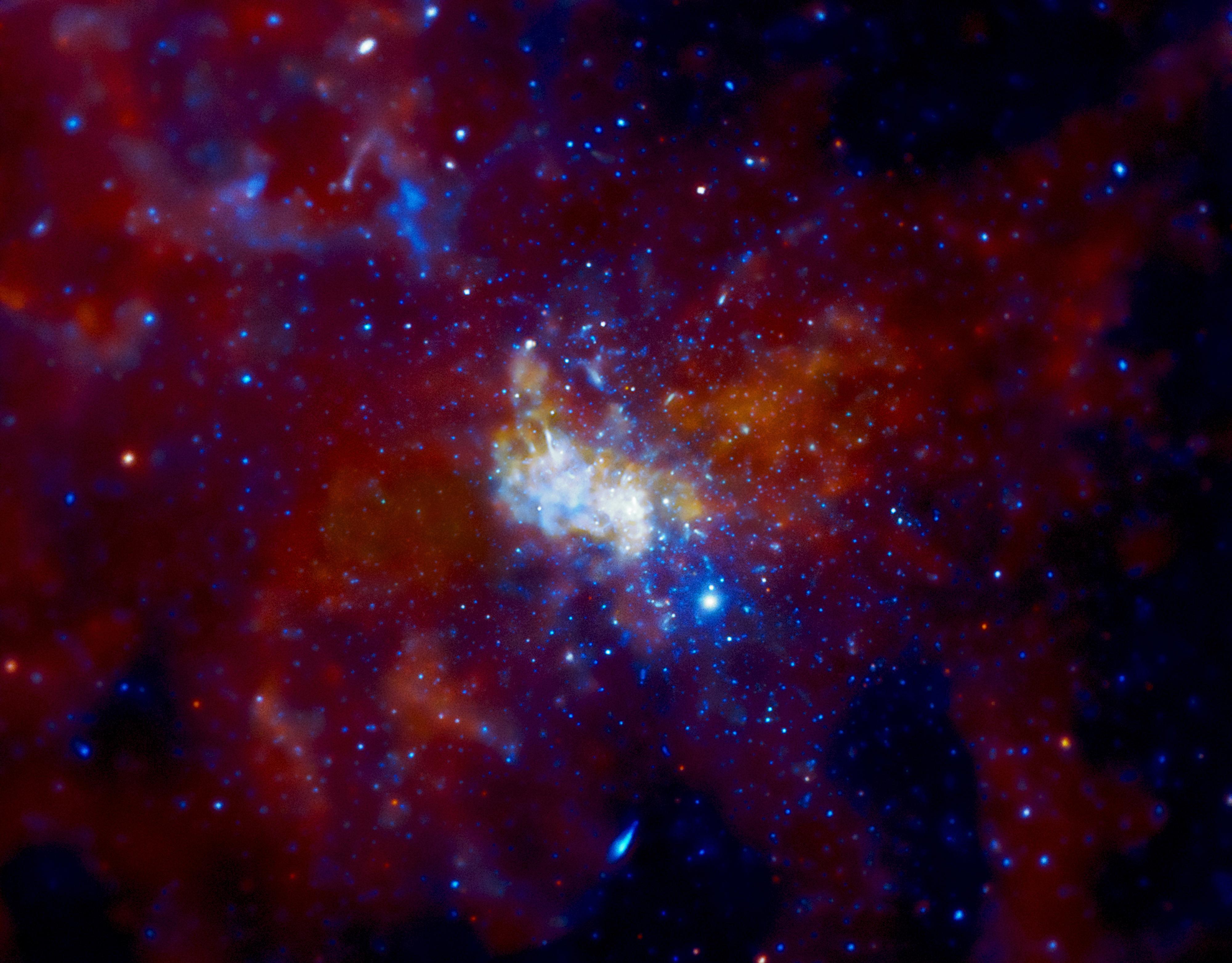
The Massive Black Hole and Nuclear Star Cluster in the Center of the Milky Way
 Chandra image of Sgr A*
The Galactic Center is an excellent laboratory for studying phenomena and physical occurring in many other galactic nuclei. The Center of our Milky Way is by far the closest galactic nucleus, and observations with exquisite resolution and sensitivity cover 18 orders of magnitude in energy of electromagnetic radiation. Theoretical simulations have become increasingly more powerful in explaining these measurements. This review summarizes the recent progress in observational and theoretical work on the central parsec, with a strong emphasis on the current empirical evidence for a central massive black hole and on the properties of the surrounding dense star cluster. We present the current evidence, from the analysis of the orbits of more than two dozen stars and from the measurements of the size and motion of the central compact radio source, Sgr A*, that this radio source must be a massive black hole of about 4.4 x 10^6 Solar Masses, beyond any reasonable doubt. We report what is known about the structure and evolution of the dense nuclear star cluster surrounding this black hole, including the astounding fact that stars have been forming in the vicinity of Sgr A* recently, apparently with a top-heavy stellar mass function. We discuss a dense concentration of fainter stars centered in the immediate vicinity of the massive black hole, three of which have orbital peri-bothroi of less than one light day. This 'S-star cluster' appears to consist mainly of young early-type stars, in contrast to the predicted properties of an equilibrium 'stellar cusp' around a black hole. This constitutes a remarkable and presently not fully understood 'paradox of youth'. We also summarize more briefly what is known about the emission properties of the accreting gas onto Sgr A* and how this emission is beginning to delineate the physical properties in the hot accretion zone around the event horizon.
 Chandra image of Sgr A*
Saturday, May 29, 2010
Tuesday, May 25, 2010
Solar System Dating
Astronomy with Radioactivities: (An Introduction to Astrophysics with
Decaying Isotopes)
Decaying Isotopes)
This chapter presents a (partial) review of the information we can derive on the early history of the Solar System from radioactive nuclei of very different half-life, which were recognized to have been present alive in pristine solids. In fact, radioactivities open for us a unique window on the evolution of the solar nebula and provide tools for understanding the crucial events that determined and accompanied the formation of the Sun. Discussing these topics will require consideration of (at least) the following issues. i) The determination of an age for solar system bodies, as it emerged especially from the application of radioactive dating. ii) A synthetic account of the measurements that proved the presence of radioactive nuclei (especially those of half-life lower than about 100 Myr) in the Early Solar System (hereafter ESS). iii) An explanation of their existence in terms of galactic nucleosynthesis, and/or of local processes (either exotic or in-situ) preceding and accompanying the formation of the Sun. This will also need some reference to the present scenarios for star formation, as applied to the ESS
Monday, May 24, 2010
Grand Unified Theories
The Algebra of Grand Unified Theories
The Standard Model of particle physics may seem complicated and arbitrary, but it has hidden patterns that are revealed by the relationship between three "grand unified theories": theories that unify forces and particles by extending the Standard Model symmetry group U(1) x SU(2) x SU(3) to a larger group. These three theories are Georgi and Glashow's SU(5) theory, Georgi's theory based on the group Spin(10), and the Pati-Salam model based on the group SU(2) x SU(2) x SU(4). In this expository account for mathematicians, we explain only the portion of these theories that involves finite-dimensional group representations. This allows us to reduce the prerequisites to a bare minimum while still giving a taste of the profound puzzles that physicists are struggling to solve.
Sunday, May 23, 2010
Flow My Tears, the Policeman Said
Flow My Tears, the Policeman Said is a paranoid science fiction novel by Philip K. Dick.
Scrutinizing him, she said, 'Maybe your're not a celebrity; maybe I've reverted back to my delusional period. They said I probably would, sometime. Sooner or later. Maybe it's later now.'
'That,' he pointed out, 'would make me a hallucination of yours. Try harder; I don't feel completely real.'
She laughed.
The Big Sleep
The Big Sleep is a detective novel by Raymond Chandler.
"You know what Canino will do? Beat my teeth out and kick me in the stomach for mumbling."
See The Simple of Art of Murder for a previous post about Raymond Chandler.
"You know what Canino will do? Beat my teeth out and kick me in the stomach for mumbling."
See The Simple of Art of Murder for a previous post about Raymond Chandler.
A Simple Heart
A Simple Heart is a story by Gustave Flaubert, it's one of my favorites. Sad, funny, droll - a person, place and time that has no particular intrinsic interest but despite that (or perhaps because of it) a great story.
Wednesday, May 19, 2010
Terahertz Lenses
X-Ray Vision, Without the Radiation in Science. "X-ray–like imaging without the harmful radiation and cell phones with more bandwidth are closer to reality now that researchers have developed a novel type of lens that works with terahertz frequencies. The new lens is a metamaterial, an artificial material with a structure made from many tiny parts, and it could drastically expand what lenses can do. "
Sunday, May 16, 2010
Thursday, May 13, 2010
The Inner Core
Hemispherical anisotropic patterns of the Earth’s inner core in PNAS.
It has been shown that the Earth’s inner core has an axisymmetric anisotropic structure with seismic waves traveling ∼3% faster along polar paths than along equatorial directions. Hemispherical anisotropic patterns of the solid Earth’s core are rather complex, and the commonly used hexagonal-close-packed iron phase might be insufficient to account for seismological observations. We show that the data we collected are in good agreement with the presence of two anisotropically specular east and west core hemispheres. The detected travel-time anomalies can only be disclosed by a lattice-preferred orientation of a body-centered-cubic iron aggregate, having a fraction of their [111] crystal axes parallel to the Earth’s rotation axis. This is compelling evidence for the presence of a body-centered-cubic Fe phase at the top of the Earth’s inner core
Ultrasmall Archaea
Enigmatic, ultrasmall, uncultivated Archaea in PNAS.
Metagenomics has provided access to genomes of as yet uncultivated microorganisms in natural environments, yet there are gaps in our knowledge—particularly for Archaea—that occur at relatively low abundance and in extreme environments. Ultrasmall cells (< 500 nm in diameter) from lineages without cultivated representatives that branch near the crenarchaeal>/euryarchaeal divide have been detected in a variety of acidic ecosystems.
Monday, May 10, 2010
Manta Rays
Once again I've had the good fortune to visit the Manta Rays of San Benedicto Island, in the Pacific off the coast of Mexico. Thanks again to Gregory Colbert, his film crew and friends, and the crew of the Nautilus Explorer for another wonderful trip.
I haven't been able to find a reference to the tubes just above the corners of the manta's mouth pictured below. Thanks to Sten Johansson of the Nautilus Explorer for the photos and for pointing out this interesting feature. Please comment if you can identify these structures, a reference or link to the literature would be especially welcome!


I haven't been able to find a reference to the tubes just above the corners of the manta's mouth pictured below. Thanks to Sten Johansson of the Nautilus Explorer for the photos and for pointing out this interesting feature. Please comment if you can identify these structures, a reference or link to the literature would be especially welcome!


Newton and the Counterfeiter
Newton and the Counterfeiter: The Unknown Detective Career of the World's Greatest Scientist a book by Thomas Levenson is about Isaac Newton and William Chaloner a notorious counterfeiter that Newton prosecuted when he was Warden of the Royal Mint.
While Newton was perhaps the greatest scientific genius of all time, and even a very competent functionary - as detailed in this book - he was strictly mortal in the realm of financial investments. He lost a fortune in the South Sea Bubble of 1720 which rankled him greatly, admitting "that he could not calculate the madness of the people."
While Newton was perhaps the greatest scientific genius of all time, and even a very competent functionary - as detailed in this book - he was strictly mortal in the realm of financial investments. He lost a fortune in the South Sea Bubble of 1720 which rankled him greatly, admitting "that he could not calculate the madness of the people."
Saturday, April 24, 2010
Paleocene-Eocene Thermal Maximum
Did Monster Eruptions Warm the World? in Science.
The Paleocene-Eocene Thermal Maximum occured 55 million years ago. Temperatures rose over 5C and there were mass extinctions - many classes of current mammals arose afterwards. Researchers have recently found evidence of massive undersea volcanic eruptions near Iceland from that time period. The volcanic release of methane may have caused the warming.
The Paleocene-Eocene Thermal Maximum occured 55 million years ago. Temperatures rose over 5C and there were mass extinctions - many classes of current mammals arose afterwards. Researchers have recently found evidence of massive undersea volcanic eruptions near Iceland from that time period. The volcanic release of methane may have caused the warming.
Friday, April 23, 2010
Dark Matter Review Article
Dark Matter in Modern Cosmology preprint.
The presence of Dark Matter (DM) is required in the universe regulated by the standard general relativistic theory of gravitation. The nature of DM is however still elusive to any experimental search. We discuss here the process of accumulation of evidence for the presence of DM in the universe, the astrophysical probes for the leading DM scenarios that can be obtained through a multi-frequency analysis of cosmic structures on large scales, and the strategies related to the multi-messenger and multi-experiment astrophysical search for the nature of the DM.
Sunday, April 18, 2010
Cosmic microwave background anisotropies
Lecture notes on the physics of cosmic microwave background anisotropies
We review the theory of the temperature anisotropy and polarization of the cosmic microwave background (CMB) radiation, and describe what we have learned from current CMB observations. In particular, we discuss how the CMB is being used to provide precise measurements of the composition and geometry of the observable universe, and to constrain the physics of the early universe. We also briefly review the physics of the small-scale CMB fluctuations generated during and after the epoch of reionization, and which are the target of a new breed of arcminute-resolution instruments
Dark Energy
Why all these prejudices against a constant?
The expansion of the observed universe appears to be accelerating. A simple explanation of this phenomenon is provided by the non-vanishing of the cosmological constant in the Einstein equations. Arguments are commonly presented to the effect that this simple explanation is not viable or not sufficient, and therefore we are facing the "great mystery" of the "nature of a dark energy". We argue that these arguments are unconvincing, or ill-founded.
Galaxy Structure
The Universal Faber-Jackson Relation
The mass distribution in Spirals
In the context of modified Newtonian dynamics, the fundamental plane, as the observational signature of the Newtonian virial theorem, is defined by high surface brightness objects that deviate from being purely isothermal: the line-of-sight velocity dispersion should slowly decline with radius as observed in luminous elliptical galaxies. All high surface brightness objects (e.g. globular clusters, ultra-compact dwarfs) will lie, more or less, on the fundamental plane defined by elliptical galaxies, but low surface brightness objects (dwarf spheroidals) would be expected to deviate from this relation. This is borne out by observations. With MOND, the Faber-Jackson relation (the power-law relation between luminosity and velocity dispersion), ranging from globular clusters to clusters of galaxies and including both high and low surface brightness objects, is the more fundamental and universal scaling relation in spite of its larger scatter. Faber-Jackson reflects the presence of an additional dimensional constant (the MOND acceleration) in the structure equation
The mass distribution in Spirals
In the past years a wealth of observations has unraveled the structural properties of the Dark and Luminous mass distribution in spirals. These have pointed out to an intriguing scenario not easily explained by present theories of galaxy formation. The investigation of individual and coadded objects has shown that the spiral rotation curves follow, from their centers out to their virial radii, a Universal profile (URC) that arises from the tuned combination of a stellar disk and of a dark halo. The importance of the latter component decreases with galaxy mass. Individual objects, on the other hand, have clearly revealed that the dark halos encompassing the luminous discs have a constant density core. This resulting observational scenario poses important challenges to presently favored theoretical
Tuesday, April 13, 2010
DSLR with nice HD Video Capabilities
"The Last 3 Minutes"
shot with the Canon 5D Mark II DSLR. Try to watch in full screen mode with HD on by following the link that's mentioned.
"The Last 3 Minutes" From Shane Hurlbut, ASC from Shane Hurlbut, ASC on Vimeo.
shot with the Canon 5D Mark II DSLR. Try to watch in full screen mode with HD on by following the link that's mentioned.
One Hedge Fund that made money fueling the Bubble
The Magnetar Trade: How One Hedge Fund Helped Keep the Bubble Going at ProPublica.
"A hedge fund, Magnetar, helped create arcane mortgage-based instruments, pushed for risky things to go inside them and then bet against the investments"
"A hedge fund, Magnetar, helped create arcane mortgage-based instruments, pushed for risky things to go inside them and then bet against the investments"
Sunday, April 11, 2010
More about the mathematician Perelman
He Conquered the Conjecture by John Allen Paulos in the New York Review of Books is a review of Perfect Rigor: A Genius and the Mathematical Breakthrough of the Century by Masha Gessen a biography of the Russian mathematician Grigoriy Perelman who recently solved a long-standing problem in topology, the Poincaré conjecture.
Markets, Theory and Reality
Hedging America by Robert M. Solow in the magazine The New Republic. Solow is a Nobel Prize winning economist who also happened to teach my macroeconomics class at MIT many a moon ago. The article discusses the theory behind markets and how the reality from time to time falls conspicuously short.
Friday, April 09, 2010
The Economics of Dueling
The Deadliest of Games: The Institution of Dueling.
Recent historical research indicates that ritualistic dueling had a rational basis. Basically, under certain social and economic conditions, individuals must ght in order to maintain their personal credit and social standing. We use a repeated two-player sequential game with random matching to show how the institution of dueling could have functioned as a costly but incentive-compatible means by which individuals could demonstrate their good faith dealings by defending their "honor".
Saturday, April 03, 2010
Why was the ancient Earth so warm?
Early Earth: Faint young Sun redux Early in the Earth's history (several billion years ago) it is thought that the Sun was dimmer, so much so that the oceans would have been frozen. However there is ample evidence that the oceans were mostly liquid during that period. Greenhouse gases in the atmosphere may have kept the Earth warm. But there's a new theory that the Earth's surface may have also been darker in the past, allowing it to retain more heat from the fainter sun and resulting in warmer temperatures.
Prospects for Personal Genomics
Multiple personal genomes await by J. Craig Venter in Nature. Gene sequencing pioneer Venter reviews the current state of the art. One difficult problem is due to chromosomes occuring in pairs, one from each parent. Apparently it isn't easy to distinguish the two copies and the differences between them.
Ice Age Flood went to the Arctic not Atlantic
River reveals chilling tracks of ancient flood in Nature. After the end of the last ice age there was another cool period, the Younger Dryas, 13,000 years ago. One theory was that a huge freshwater lake in Canada, formed from melted glaciers, suddenly drained into the North Atlantic, disrupted the warm water conveyer belt there, resulting in a resumption of cold conditions in the Northern Hemisphere. But now it appears that instead Lake Agassiz drained north into the Arctic Ocean. Did that flood still cause the Younger Dryas cold period?
Chemistry of the Ancient Oceans
Ocean Chemistry and Early Animals in Science. Animal life requires oxygen. What stages took place before the current oxygenated ocean chemistry and animal communities beccame established around 542 million years ago?
Quark Masses
Mass of the Common Quark Finally Nailed Down in Science.
Currently there are six known flavors of quarks, each with a different mass. The masses haven't been known with much accuracy, in part because quarks are never found in isolation, they are are always found bound with other quarks. The binding interaction is so strong that most of the mass of the bound particle (like a proton or neutron) is due to the energy of interaction. These new theorectical calculations may give the quark masses to a greater degree of accuracy.
Currently there are six known flavors of quarks, each with a different mass. The masses haven't been known with much accuracy, in part because quarks are never found in isolation, they are are always found bound with other quarks. The binding interaction is so strong that most of the mass of the bound particle (like a proton or neutron) is due to the energy of interaction. These new theorectical calculations may give the quark masses to a greater degree of accuracy.
Friday, April 02, 2010
Powerful People are Better Liars
Powerful Lies an article from Columbia Business School.
"Most people become stressed when lying, but new research shows that people with power feel just fine when lying — and are better at getting away with it."
"Most people become stressed when lying, but new research shows that people with power feel just fine when lying — and are better at getting away with it."
Monday, March 22, 2010
Arthropod Phylogeny
Arthropod relationships revealed by phylogenomic analysis of nuclear protein-coding sequences in Nature.
See also Surprising New Branches on Arthropod Family Tree
The the newly defined sister group to the Hexapoda (insects and related species) is the Xenocarida or strange shrimp some unusual recently discovered marine crustaceans. So insects are actually more closely related to some oddball marine crustaceans than other terrestrial arthropods such as spiders.
The evolutionary interrelationships of arthropods has long been a matter of dispute. A new phylogeny applies an arsenal of techniques to more than 41,000 base pairs of DNA from 75 arthropod species. The results support the idea that insects are land–living crustaceans, that crustaceans comprise a diverse assemblage of at last three distinct arthropod types, and that myriapods (millipedes and centipedes) comprise the closest relatives of this great 'pancrustacean' group
See also Surprising New Branches on Arthropod Family Tree
The the newly defined sister group to the Hexapoda (insects and related species) is the Xenocarida or strange shrimp some unusual recently discovered marine crustaceans. So insects are actually more closely related to some oddball marine crustaceans than other terrestrial arthropods such as spiders.
High Energy Cosmic Rays
Cosmic-ray theory unravels in Nature.
Could they be iron nuclei instead of protons?
Astrophysicists ponder whether ultrahigh-energy particles really do come from the centre of galaxies
Could they be iron nuclei instead of protons?
Pregnant fathers selective abortion
Evolutionary biology: Pregnant fathers in charge in Nature.
Pipefish and related species provide rare examples of extreme male parental care. Controlled breeding experiments allow the resulting conflicts of interest between female, male and offspring to be explored
The Golden Ratio found in a magnet
Solid-state physics: Golden ratio seen in a magnet
The golden ratio — an exact 'magic' number often claimed to be observed when taking ratios of distances in ancient and modern architecture, sculpture and painting — has been spotted in a magnetic compound
Sterile Neutrinos
Hunt for the sterile neutrino heats up in Nature.
Neutrinos like to keep to themselves. These ghostly particles are so reluctant to interact with ordinary matter that billions zip harmlessly through each person every day, and it takes giant, specialized detectors to capture even a handful of them. Now astronomers are finding hints of an even more elusive type of neutrino, one so shy that it could never be detected directly: the sterile neutrino
Sunday, March 21, 2010
Fairness Behaviour Across Societies
Fairness in Modern Society in Science.
Experiments in psychology and economics have demonstrated that in industrialized societies all over the world, a substantial fraction of individuals will be fair in anonymous interactions and will punish unfairness (1, 2). However, it has not been clear whether this benevolent, prosocial behavior depends on innate human psychology or norms peculiar to industrialized societies. Henrich et al. explored the motivation for fairness in anonymous interactions across dramatically diverse societies and on page 1480 of this issue (3), they report that this behavior increases with the level of the society's market integration, measured as households' average percentage of calories that are purchased.
Controlling Turbulence
Controlling Turbulence in Science.
Pipes feature strongly in the infrastructure of everyday life, from domestic water pipes to oil and natural gas conduits. A primary consequence of the onset of turbulence in the fluid flowing through the pipes is the dramatically increased power required to pump stuff at the same rate. Thus, the incentives to understand and control the transition process are strong. However, more than 100 years after Osborne Reynolds's seminal experiments on the transition of flow through a pipe from a laminar (smooth) to a turbulent state, the exact physical mechanism that drives this phenomenon still vexes the fluid mechanics community. On page 1491 of this issue, Hof et al. (1) describe a mechanism that feeds energy into a turbulent flow system, allowing the onset of the transition to be manipulated and even the suppression of the turbulence
Is Depression Adaptive?
The bright side of being blue:
Depression as an adaptation for analyzing complex problems
by Paul W. Andrews and J. Anderson Thomson, Jr.
see also Depression’s Upside in the New York Times.
Depression as an adaptation for analyzing complex problems
by Paul W. Andrews and J. Anderson Thomson, Jr.
Depression ranks as the primary emotional condition for which help is sought. Depressed people often have severe, complex problems, and rumination is a common feature. Depressed people often believe that their ruminations give them insight into their problems, but clinicians often view depressive rumination as pathological because it is difficult to disrupt and interferes with the ability to concentrate on other things. Abundant evidence indicates that depressive rumination involves the analysis of episode-related problems. Because analysis is time consuming and requires sustained processing, disruption would interfere with problem-solving. The analytical rumination (AR) hypothesis proposes that depression is an adaptation that evolved as a response to complex problems and whose function is to minimize disruption of rumination and sustain analysis of complex problems. It accomplishes this by giving episode-related problems priority access to limited processing resources, by reducing the desire to engage in distracting activities (anhedonia), and by producing psychomotor changes that reduce exposure to distracting stimuli. Because processing resources are limited, the inability to concentrate on other things is a tradeoff that must be made to sustain analysis of the triggering problem. The analytical rumination hypothesis is supported by evidence from many levels, including genes, neurotransmitters and their receptors, neurophysiology, neuroanatomy, neuroenergetics, pharmacology, cognition and behavior, and the efficacy of treatments. In addition, we address and provide explanations for puzzling findings in the cognitive and behavioral genetics literatures on depression. In the process, we challenge the belief that serotonin transmission is low in depression. Finally, we discuss implications of the hypothesis for understanding and treating depression.
see also Depression’s Upside in the New York Times.
Subscribe to:
Posts (Atom)

