Intergalactic space is filled with a pervasive medium of ionized gas, the Intergalactic Medium (IGM).
The reionization of the IGM is one of the principal unsolved problems of cosmological structure formation.
Intergalactic space is filled with a pervasive medium of ionized gas, the Intergalactic Medium (IGM).
The reionization of the IGM is one of the principal unsolved problems of cosmological structure formation.
During several Earth flybys carried out since 1990, some spacecrafts have experienced an unexpected and until now unexplained anomalous velocity increase. This phenomenon is called the flyby anomaly and looks like the effect of an instantaneous acceleration of the spacecraft at the time of closest approach to Earth.
We discuss the basic difficulties in understanding the origin of the highest energy particles in the Universe - the ultrahigh energy cosmic rays (UHECR). It is difficult to imagine the sources they are accelerated in. Because of the strong attenuation of UHECR on their propagation from the sources to us these sources should be at cosmologically short distance from us but are currently not identified. We also give information of the most recent experimental results including the ones reported at this conference and compare them to models of the UHECR origin.
The FIGGS (Faint Irregular Galaxy GMRT Survey) is aimed at creating a multi-wavelength observational data base for a volume limited sample of the faintest gas rich galaxies.
These very large dynamical mass to blue luminosity ratios naturally lead one to ask whether extremely gas rich dwarf galaxies have abnormally small baryon fractions, i.e. have they just been inefficient at forming stars, or did they end up with less than the typical baryon fraction?
We now know that neutrinos have masses and that the flavor eigenstates (νelectron, νmuon, νtau ) are not the mass eigenstates (ν1, ν2, ν3).
my wife used to live along the flight path of a smallish airport, and often all the garage doors in the neighbourhood would start opening and closing on their own when a plane flew over.
[In talking to an Arab nationalist leader] I said complete independence was what we ultimately wished to give. "My lady" he answered—we were speaking Arabic —"complete independence is never given; it is always taken."
We have constructed a fully functional, fully integrated radio receiver from a single carbon nanotube. The nanotube serves simultaneously as all essential components of a radio: antenna, tunable band-pass filter, amplifier, and demodulator. A direct current voltage source, as supplied by a battery, powers the radio. Using carrier waves in the commercially relevant 40-400 MHz range and both frequency and amplitude modulation techniques, we demonstrate successful music and voice reception.
Researchers at the university have bred a strain of "mighty mice," known as PEPCK-Cmus mice because of specific genetic enhancements, that can run for six hours at a speed of 20 meters per minute, or a total of 5 or 6 kilometers.
By fundamental physics, I mean the search for a small set of laws which in principle determine everything we can calculate about the universe. The reductionist dream – not always practical, but very seductive. Where do we stand in the search for these laws? What do we know, and what are the mysteries? Why do many physicists feel stuck?
Electrically charged particles, such as the electron, are ubiquitous. By contrast, no elementary particles with a net magnetic charge have ever been observed, despite intensive and prolonged searches. We pursue an alternative strategy, namely that of realising them not as elementary but rather as emergent particles, i.e., as manifestations of the correlations present in a strongly interacting many-body system. The most prominent examples of emergent quasiparticles are the ones with fractional electric charge e/3 in quantum Hall physics. Here we show that magnetic monopoles do emerge in a class of exotic magnets known collectively as spin ice: the dipole moment of the underlying electronic degrees of freedom fractionalises into monopoles. This enables us to account for a mysterious phase transition observed experimentally in spin ice in a magnetic field, which is a liquid-gas transition of the magnetic monopoles. These monopoles can also be detected by other means, e.g., in an experiment modelled after the celebrated Stanford magnetic monopole search.
We report our discovery and observations of the peculiar Type IIn supernova SN2006gy in NGC1260, revealing that it reached a peak magnitude of -22, making it the most luminous supernova ever recorded. It is not yet clear what powers the total radiated energy of 1e51 erg, but we argue that any mechanism -- thermal emission, circumstellar interaction, or 56Ni decay -- requires a very massive progenitor star. The circumstellar interaction hypothesis would require truly exceptional conditions around the star probably experienced an LBV eruption like the 19th century eruption of eta Carinae. Alternatively, radioactive decay of 56Ni may be a less objectionable hypothesis. That power source would imply a large Ni mass of 22 Msun, requiring that SN2006gy was a pair-instability supernova where the star's core was obliterated. SN2006gy is the first supernova for which we have good reason to suspect a pair-instability explosion. Based on a number of lines of evidence, we rule out the hypothesis that SN 2006gy was a ``Type IIa'' event. Instead, we propose that the progenitor may have been a very massive evolved object like eta Carinae that, contrary to expectations, failed to completely shed its massive hydrogen envelope before it died. Our interpretation of SN2006gy implies that the most massive stars can explode earlier than expected, during the LBV phase, preventing them from ever becoming Wolf-Rayet stars. SN2006gy also suggests that the most massive stars can create brilliant supernovae instead of dying ignominious deaths through direct collapse to a black hole.
Among the placental mammals, phylogenetic branching events have been inferred by using either nucleotide sequence data (4–11) or rare insertion/deletion patterns (12–15). Many of the results recognize four primary eutherian groups: Afrotheria, Xenarthra, Laurasiatheria, and Euarchontoglires. Afrotherians (e.g., elephants, hyraxes, manatees, aardvarks, tenrecs, and allies) are a clade of mammals that originated in Africa, and whose extant members still mostly remain on that continent with the exception of Asian elephants and sirenians such as the Florida manatee. The Xenarthra includes the sloths, armadillos, and anteaters that today are restricted to South and Central America (although some Xenarthra, such as the nine-banded armadillo, have recently dispersed to North America). The Laurasiatheria (e.g., bats, eulipotyphlans, pangolins, carnivores, perrisodactyls, and cetartiodactyls) is a diverse clade including extant lineages that originated in the ancient northern continent of Laurasia. The Euarchontoglires includes the species from five living mammalian orders (e.g., primates, treeshrews, flying lemurs, rabbits, and rodents). This last group remains the most controversial, and a number of recent studies have suggested it is not valid (4, 6, 7).
Visual attention mechanisms are known to select information to process based on current goals, personal relevance, and lower-level features. Here we present evidence that human visual attention also includes a high-level category-specialized system that monitors animals in an ongoing manner. Exposed to alternations between complex natural scenes and duplicates with a single change (a change-detection paradigm), subjects are substantially faster and more accurate at detecting changes in animals relative to changes in all tested categories of inanimate objects, even vehicles, which they have been trained for years to monitor for sudden life-or-death changes in trajectory. This animate monitoring bias could not be accounted for by differences in lower-level visual characteristics, how interesting the target objects were, experience, or expertise, implicating mechanisms that evolved to direct attention differentially to objects by virtue of their membership in ancestrally important categories, regardless of their current utility.
In its original version [1] (and as
retold in the whimsical setting of Refs. [2, 3]), a physicist,
Alice, is challenged by a mean king to precisely ascer-
tain the outcome of an ideal measurement that the king
performs of a spin-1/2 observable randomly chosen from
the mutually complementary set {ˆσx, ˆσy, ˆσz}.
There has been mounting evidence that the large-angle cosmic microwave background (CMB) anisotropy has anomalies roughly at 3 sigma level.
How far over the edge of the table can we reach by stacking n identical, homogeneous, frictionless blocks of length 1? A classical solution achieves an overhang asymptotic to 1/2 ln n. This solution is widely believed to be optimal. We show, however, that it is exponentially far from optimality by constructing simple n-block stacks that achieve an overhang of cn^1/3, for some constant c>0.
Resistance to certain scientific ideas derives in large part from assumptions and biases that can be demonstrated experimentally in young children and that may persist into adulthood. In particular, both adults and children resist acquiring scientific information that clashes with common-sense intuitions about the physical and psychological domains. Additionally, when learning information from other people, both adults and children are sensitive to the trustworthiness of the source of that information. Resistance to science, then, is particularly exaggerated in societies where nonscientific ideologies have the advantages of being both grounded in common sense and transmitted by trustworthy sources.
Recent astronomical observations of SNIa, CMB, as well as BAO in the Sloan Digital Sky Survey suggest that the current Universe has entered a stage of an accelerated expansion with the redshift transition at about z=0.5. While the simplest candidates for explanation of this fact is cosmological constant/vacuum energy there exist a serious problem of coincidence. In the theoretical cosmology we can find many possible approaches alleviating this problem by applying new physics or other conception of dark energy. We consider state of art candidates for the description of accelerating Universe in the framework of the Bayesian model selection. We point out advantages as well as troubles of this approach. We find that the combination of four data bases gives a stringent posterior probability of the LambdaCDM model which is 74%. This fact is a quantitative exemplification of a turmoil in modern cosmology over the Lambda problem.
Traditional models of economic decision-making assume that people are self-interested rational maximizers. Empirical research has demonstrated, however, that people will take into account the interests of others and are sensitive to norms of cooperation and fairness. In one of the most robust tests of this finding, the ultimatum game, individuals will reject a proposed division of a monetary windfall, at a cost to themselves, if they perceive it as unfair. Here we show that in an ultimatum game, humans' closest living relatives, chimpanzees (Pan troglodytes), are rational maximizers and are not sensitive to fairness. These results support the hypothesis that other-regarding preferences and aversion to inequitable outcomes, which play key roles in human social organization, distinguish us from our closest living relatives.
In engineering, it could open up the possibility of intercontinental communications by means of microwave-frequency gravitational waves directly through the interior of the Earth, which is transparent to such waves. This would eliminate the need of communications satellites, and would allow an economical means of communication with people deep underground or underwater in submarines in the oceans. Such a new direction of gravitational-wave engineering could aptly be called “gravity radio”

It's nature's fastest quick-change artist: In less than the time it takes a beam of light to travel a tenth of a millimeter, vanadium dioxide can switch from a transparent to a reflective, mirror-like state.
How this material (VO2) can turn from a transparent insulator into a reflective metal so rapidly has physicists scratching their heads, but a collaboration among researchers at Vanderbilt, Oak Ridge National Laboratory and Lawrence Berkeley National Laboratory has clocked the transfiguration at one-tenth of a trillionth of a second.
The Pioneer 10/11 spacecraft yielded the most precise navigation in deep space to date. However, their radio-metric tracking data received from the distances between 20--70 astronomical units from the Sun has consistently indicated the presence of a small, anomalous, Doppler frequency drift. The drift is a blue frequency shift that can be interpreted as a sunward acceleration of a_P = (8.74 +/- 1.33) x 10^{-10} m/s^2 for each particular spacecraft. This signal has become known as the Pioneer anomaly; the nature of this anomaly remains unexplained.
Recently new Pioneer 10 and 11 radio-metric Doppler and flight telemetry data became available. The newly available Doppler data set is significantly enlarged when compared to the data used in previous investigations and is expected to be the primary source for the investigation of the anomaly. In addition, the flight telemetry files, original project documentation, and newly developed software tools are now used to reconstruct the engineering history of both spacecraft. With the help of this information, a thermal model of the Pioneer vehicles is being developed to study possible contribution of thermal recoil force acting on the two spacecraft. The ultimate goal of these physics engineering efforts is to evaluate the effect of on-board systems on the spacecrafts' trajectories.
Jack has decided to increase advertising revenues by digitally inserting Mr. Seinfeld into NBC shows like “Law & Order” and “Deal or No Deal.” Jack calls his computer-generated fakery “SeinfeldVision.” The counterfeited comedian shows up at Rockefeller Center to complain, and that’s when the show goes a little wobbly: Mr. Seinfeld is strangely ill at ease playing himself, making his self-impersonation unpersuasive.
"At home,” she added, “I cry” — about, among other things, not being home enough.
The galaxies found in this study are remarkable in that they contain a large stellar mass, have small physical sizes and that their main epoch of star formation occured at z >= 10. Galaxies with similar properties have, however, also been found by others.
Considerable observational evidence has built up over
the past few years that a substantial fraction of the mas-
sive galaxies around us today were already massive at
very early epochs.
America has more than two million citizens behind bars, the highest absolute and per capita rate of incarceration in the world. Black Americans, a mere 13 percent of the population, constitute half of this country’s prisoners. A tenth of all black men between ages 20 and 35 are in jail or prison; blacks are incarcerated at over eight times the white rate.
The effect on black communities is catastrophic: one in three male African-Americans in their 30s now has a prison record, as do nearly two-thirds of all black male high school dropouts.
...
The rate at which blacks commit homicides is seven times that of whites.
The Schielandse Hoge Zeedijk dyke along the river Hollandse IJssel was all that protected three million people in the provinces of South and Noord Holland from flooding. A section of this dyke, known as the Groenendijk, was not reinforced with stone revetments. The waterlevel was just below the crest and the seaside slope was weak. Volunteers worked to reinforce this stretch. Neverthelesss, the Groenendijk collapsed under the pressure around 5:30 am on 1 February. The seawater moved into the deep polder. In desperation, the mayor of Nieuwerkerk commandeered the river ship de Twee Gebroeders (The Two Brothers) and ordered the owner to plug the hole in the dike by navigating the ship into it. Fearing that the ship might break through and dive into the polder, captain Arie Evegroen took a row boat with him. The mayor's plan turned out to be successful, as the ship lodged itself firmly into the dike, saving many lives.
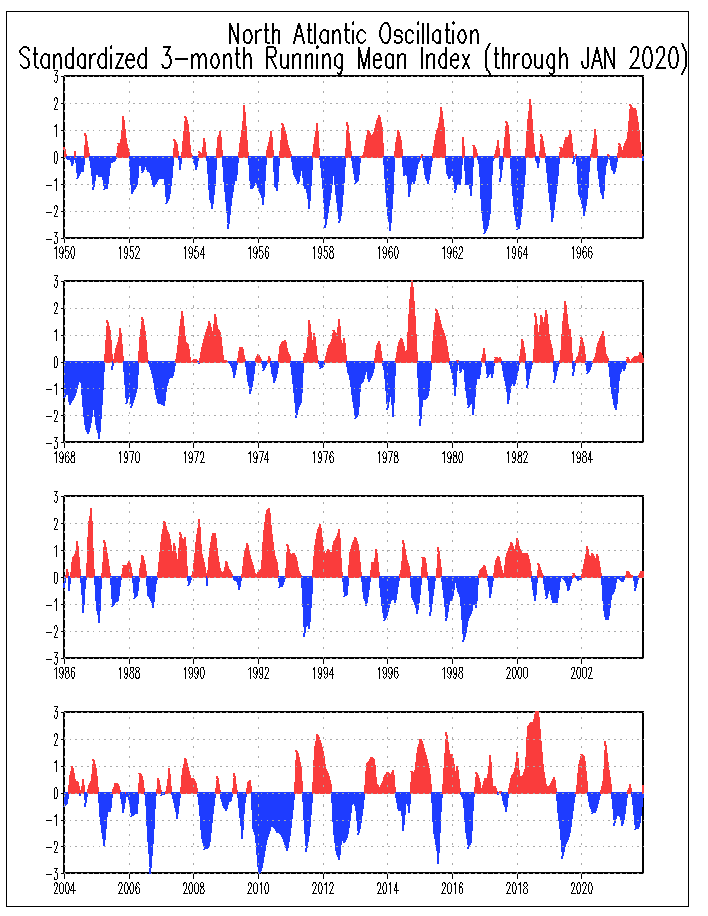 NOAA graphic
Unlike many of his European counterparts, Franklin showed a distinctly American obsession with practicality and efficiency. As a child he suggested to his father that if all the meat being salted for the winter meals were blessed at once, it would not be necessary to say grace at each meal, resulting in "a vast saving of time."





Males pit their genes against females by chucking DNA out of eggs.
The sperm of the male ant appears to be able to destroy the female DNA within a fertilized egg, giving birth to a male that is a clone of its father. Meanwhile the female queens make clones of themselves to carry on the royal female line
In an ant species — or is it two species? — females are produced only by females and males only by males. Explanations of this revelation have to invoke some decidedly offbeat patterns of natural selection.


How do neurons in the brain represent movie stars, famous buildings and other familiar objects? Rare recordings from single neurons in the human brain provide a fresh perspective on the question.
'Grandmother cell' is a term coined by J. Y. Lettvin to parody the simplistic notion that the brain has a separate neuron to detect and represent every object (including one's grandmother). The phrase has become a shorthand for invoking all of the overwhelming practical arguments against a one-to-one object coding scheme. No one wants to be accused of believing in grandmother cells. But on page 1102 of this issue, Quiroga et al.3 describe a neuron in the human brain that looks for all the world like a 'Jennifer Aniston' cell. Ms Aniston could well become a grandmother herself someday. Are vision scientists now forced to drop their dismissive tone when discussing the neural representation of matriarchs?


The three years 2001 to 2003 were the golden years of solar neutrino research. In this period, scientists solved a mystery with which they had been struggling for four decades. The solution turned out to be important for both physics and for astronomy. In this article, I tell the story of those fabulous three years.
Entanglement is perhaps the most non-classical manifestation of quantum mechanics. Among its many interesting applications to information processing, it can be harnessed to reduce the amount of communication required to process a variety of distributed computational tasks. Can it be used to eliminate communication altogether? Even though it cannot serve to signal information between remote parties, there are distributed tasks that can be performed without any need for communication, provided the parties share prior entanglement: this is the realm of pseudo-telepathy.
One of the earliest uses of multi-party entanglement was presented by Mermin in 1990. Here we recast his idea in terms of pseudo-telepathy: we provide a new computer-scientist-friendly analysis of this game. We prove an upper bound on the best possible classical strategy for attempting to play this game, as well as a novel, matching lower bound. This leads us to considerations on how well imperfect quantum-mechanical apparatus must perform in order to exhibit a behaviour that would be classically impossible to explain. Our results include improved bounds that could help vanquish the infamous detection loophole.


Much of my current research involves studies of the sexually cannibalistic Australian redback spider (Latrodectus hasselti), and its close relatives, the black widows (genus Latrodectus). Redback spiders are intriguing because males actively 'encourage' females to cannibalize them while they mate. Unlike most other sexually cannibalistic species (e.g., praying mantids) where males attempt to escape from the female's jaws, redback males actually 'somersault' onto the female's mouthparts during copulation = male sexual sacrifice.

(A) Copulation begins with the male standing on the female's abdomen. Both spiders are facing in the same direction and are 'belly to belly'. The male has two copulatory organs (the palps) that are attached at the anterior-most part of his 'head' (cephalothorax). Copulation begins when one of the palps is inserted into the female's genital opening. In most other black widow spiders, the pair copulates while in this posture.
(B) In redbacks, however, a few seconds after palp insertion, the male, using the palp as a pivot, moves into a 'headstand' posture.
(C) The male then quickly turns through 180 degrees, landing with his 'back' (the dorsal surface of the abdomen), directly above the female's fangs. In most matings, the female begins to extrude digestive enzymes almost immediately. She also pierces the male's abdomen with her fangs and begins to consume him while he is transferring sperm.

Take a look at these two snapshots. Which man is more babyfaced? Most viewers would say it's the person on the right. And that's the person who lost a 2004 U.S. congressional election to his more mature-faced and competent-looking opponent. In fact, about 70% of recent U.S. Senate races were accurately predicted based on which candidates looked more competent from a quick glance at their faces. This remarkable effect, reported by Todorov et al. on page 1623 of this issue, likely reflects differences in "babyfacedness". A more babyfaced individual is perceived as less competent than a more mature-faced, but equally attractive, peer of the same age and sex. Although we like to believe that we "don't judge a book by its cover," superficial appearance qualities such as babyfacedness profoundly affect human behavior in the blink of an eye.
A rapid and large global warming event, the Paleocene-Eocene Thermal Maximum (PETM), raised interior ocean temperatures by 4º to 5ºC around 55 million years ago, a rise not equaled in any single event since then. This warming, whose origin is still debated, was accompanied by a dramatic negative carbon isotopic excursion. One hypothesis is that the release of 2000 gigatons of carbon from the destabilization of methane clathrates on the sea floor account for both the carbon isotopic signal and the temperature increase. Zachos et al. (p. 1611) now show that the carbonate compensation depth (roughly the depth at which calcium carbonate is no longer found in the sediment, because of dissolution during sinking) of the ocean rose by more than 2 kilometers during the PETM, which could have happened only if the amount of CO2 added to the ocean was much more than that which has been estimated in the clathrate scenario. They find that 4000 gigatons of carbon would have been needed, so the release of clathrates alone could not have been the cause of the warming.


Some male prairie voles are devoted fathers and faithful partners, while others are less satisfactory on both counts. The spectrum of behavior is shaped by a genetic mechanism that allows for quick evolutionary changes, two researchers from Emory University report in today's issue of Science.
...
People have the same variability in their DNA, with a control section that comes in at least 17 lengths detected so far, Dr. Young said.
...
The Emory researchers recently noticed that in their prairie vole colony, some fathers spent more time with their pups and some less. They traced the source of this variability to its molecular roots, a variation in the length of the DNA region that controls a certain gene.
This is the gene for the vasopressin receptor, the device used by neurons to respond to vasopressin. Voles with long and short DNA segments had different patterns of vasopressin receptors in their brains, which presumably changed their response to the hormone.
Prairie voles are renowned for being faithful mates, but some individuals are more faithful than others. The difference may lie in their so-called junk DNA.
... Elizabeth Hammock and Lawrence Young of Emory University in Atlanta, Georgia, report that fidelity and other social behaviors in male prairie voles seem to depend on the length of a particular genetic sequence in a stretch of DNA between their genes. The longer this repetitive sequence, or microsatellite, the more attentive males were to their female partner and their offspring. Those with shorter microsatellites neglected their mates and pups, at least to some degree.
Although there's no evidence that human infidelity or poor parenting stems from similar variations, Hammock and Young, as well as other researchers, have begun to explore whether microsatellites can account for behavioral differences between people and primates such as chimps and bonobos.
The reductionist program, roughly speaking, is to build up the description of Nature from a few laws that govern the behavior of elementary entities, and that can't be derived from anything simpler. This definition is loose at both ends.
On the output side, because in the course of our investigations we find that there are important facts about Nature that we have to give up on predicting. These are what we - after the fact! - come to call contingencies. Three historically important examples of different sorts are the number of planets in the Solar System, the precise moment that a radioactive nucleus will decay, or what the weather will be in Boston a year from today. In each of these cases, the scientific community at first believed that prediction would be possible. And in each case, it was a major advance to realize that there are good fundamental reasons why it is not possible.
On the input side, because it is difficult - perhaps impossible - ever to prove the non-existence of simpler principles. I'll revisit this aspect at the end of the lecture.
Nevertheless, and despite its horrible name, the reductionist program has been and continues to be both inspiring and astoundingly successful. Instead of trying to refine an arbitrary a priori definition of this program, it is more edifying to discuss its best fruits. For beyond question they do succeed to an astonishing extent in "reducing" matter to a few powerful abstract principles and a small number of parameters.
Although it is usually passed over in silence, I think it is very important philosophically, and deserves to be emphasized, that our standard cosmology is radically modest in its predictive ambitions. It consigns almost everything about the world as we find it to contingency. That includes not only the aforementioned question of the number of planets in the Solar System, but more generally every specific fact about every specific object or group of objects in the Universe, apart from a few large-scale statistical regularities. Indeed, specific structures are supposed to evolve from the primordial perturbations, and these are only characterized statistically. In inflationary models these perturbations arise as quantum fluctuations, and their essentially statistical character is a consequence of the laws of quantum mechanics.
This unavoidably suggests the question whether we might find ourselves forced to become even more radically modest. Let us suppose for the sake of argument the best possible case, that we had in hand the fundamental equations of physics. Some of my colleagues think they do, or soon will. Even then we have to face the question of what principle determines the solution of these equations that describes the observed Universe. Let me again suppose for the sake of argument the best possible case, that there is some principle that singles out a unique acceptable solution. Even then there is a question we have to face: If the solution is inhomogeneous, what determines our location within it?
As we have just discussed, the laws of reductionist physics do not suffice to tell us about the specific properties of the Sun, or of Earth. Indeed, there are many roughly similar but significantly different stars and planets elsewhere in the same Universe. On the other hand, we can aspire to a rational, and even to some extent quantitative, “derivation” of the parameters of the Sun and Earth based on fundamental laws, if we define them not by pointing to them as specific objects – that obviates any derivation – but rather by characterizing broad aspects of their behavior.
In principle any behavior will do, but possibly the most important and certainly the most discussed is their role in supporting the existence of intelligent observers, the so-called anthropic principle. There are many peculiarities of the Sun and Earth that can be explained this way. A crude example is that the mass of the Sun could not be much bigger or much smaller than it actually is because it would burn out too fast or not radiate sufficient energy, respectively.
Now if the Universe as we now know it constitutes, like the Solar System, an inhomogeneity within some larger structure, what might be a sign of it? If the parameters of fundamental physics crucial to life – just the ones we’ve been discussing! – vary from place to place, and most places are uninhabitable, there would be a signature to expect. We should expect to find that some of these parameters appear very peculiar – highly nongeneric – from the point of view of fundamental theory, and that relatively small changes in their values would preclude the existence of intelligent observers. Weinberg has made a case that the value of the cosmological term Lambda fits this description;and I’m inclined to think that ... and several other combinations of the small number of ingredients in our reduced description of matter and astrophysics do too. A fascinating set of questions is suggested here, that deserves careful attention.
There some aspects of QCD I find deeply troubling – though I’m not sure if I should!
I find it disturbing that it takes vast computer resources, and careful limiting procedures, to simulate the mass and properties of a proton with decent accuracy. And for real-time dynamics, like scattering, the situation appears pretty hopeless. Nature, of course, gets such results fast and effortlessly. But how, if not through some kind of computation, or a process we can mimic by computation?
Does this suggest that there are much more powerful forms of computation that we might aspire to tap into? Does it connect to the emerging theory of quantum computers? These musings suggest some concrete challenges: Could a quantum computer calculate QCD processes efficiently? Could it defeat the sign problem, that plagues all existing algorithms with dynamical fermions? Could it do real-time dynamics, which is beyond the reach of existing, essentially Euclidean, methods?
Or, failing all that, does it suggest some limitation to the universality of computation?
Deeply related to this is another thing I find disturbing. If you go to a serious mathematics book and study the rigorous construction of the real number system, you will find it is quite hard work and cumbersome. QCD, and for that matter the great bulk of physics starting with classical Newtonian mechanics, has been built on this foundation. In practice, it functions quite smoothly. It would be satisfying, though, to have a “more reduced” description, based on more primitive, essentially discrete structures. Fredkin and recently Wolfram have speculated at length along these lines. I don’t think they’ve got very far, and the difficulties facing such a program are immense. But it’s an interesting issue.
But all this progress should not mark an end. Rather it allows us to ask – that’s easy enough! – and (more impressive) to take meaningful, concrete stabs at answering some truly awesome questions. Do all the fundamental interactions derive from a single underlying principle? What is the quantum symmetry of space-time? To what extent are the laws of physics uniquely determined? Why is there any (baryonic) matter at all? What makes the dark matter? Why is there so little dark energy, compared to what it “should” be? Why is there so much, compared to everything else in the Universe? These are not merely popularizations or vulgarizations but genuine, if schematic, descriptions of a few of our ongoing explorations.
TThis is a broad and in places unconventional overview of the strengths and shortcomings of our standard models of fundamental physics and of cosmology. The emphasis is on ideas that have accessible experimental consequences. It becomes clear that the frontiers of these subjects share much ground in common.
..., one set of exogenous parameters in the standard model of cosmology specifies a few average properties of matter, taken over large spatial volumes. These are the densities of ordinary matter (i.e., of baryons), of dark matter, and of dark energy.
We know quite a lot about ordinary matter, of course, and we can detect it at great distances by several methods. It contributes about 3% of the total density.
Concerning dark (actually, transparent) matter we know much less. It has been “seen” only indirectly, through the influence of its gravity on the motion of visible matter. We observe that dark matter exerts very little pressure, and that it contributes about 30% of the total density.
Finally dark (actually, transparent) energy contributes about 67% of the total density. It has a large negative pressure. From the point of view of fundamental physics this dark energy is quite mysterious and disturbing, as I’ll elaborate shortly below.
Perhaps not quite so sharply posed, but still very promising, is the problem of the origin of the highest energy cosmic rays. It remains controversial whether there so many events observed at energies above those where protons or photons could travel cosmological distances that explaining their existence requires us to invoke new fundamental physics. However this plays out, we clearly have a lot to learn about the compositions of these events, their sources, and the acceleration mechanisms.
The observed values of the ratios ...[formulas for the cosmological density ratios] are extremely peculiar from the point of view of fundamental physics, as currently understood. Leading ideas from fundamental theory about the origin of dark matter and the origin of baryon number ascribe them to causes that are at best very remotely connected, and existing physical ideas about the dark energy, which are sketchy at best, don’t connect it to either of the others. Yet the ratios are observed to be close to unity. And the fact that these ratios are close to unity is crucial to cosmic ecology; the world would be a very different place if their values were grossly
different from what they are.
Several physicists, among whom S. Weinberg was one of the earliest and remains among the most serious and persistent, have been led to wonder whether it might be useful, or even necessary, to take a different approach, invoking anthropic reasoning. Many physicists view such reasoning as a compromise or even a betrayal of the goal of understanding the world in rational, scientific terms. Certainly, some adherents of the “Anthropic Principle” have overdone it. No such “Principle” can substitute for deep principles like symmetry and locality, which support a vast wealth of practical and theoretical applications, or the algorithmic
description of Nature in general. But I believe there are specific, limited circumstances in which anthropic reasoning is manifestly appropriate and unavoidable.
It has become conventional to say that our knowledge of fundamental physical law is summarized in a Standard Model. But this convention lumps together two quite different conceptual structures, and leaves out another. I think it is more accurate and informative to say that our current, working description of fundamental physics is based on three standard conceptual systems. These systems are very different; so different, that it is not inappropriate to call them the Good, the Bad, and the Ugly. They concern, respectively, the coupling of vector gauge particles, gravitons, and Higgs particles. It is quite a remarkable fact, in itself, that every nonlinear interaction we need to summarize our present knowledge of the basic (i.e., irreducible) laws of physics involves one or another of these particles.
Looking critically at the structure of a single standard model family, as displayed in Figure 3, one has no trouble picking out flaws.
The gauge symmetry contains three separate pieces, and the fermion representation contains five separate pieces. While this is an amazingly tight structure, considering the wealth of phenomena described, it clearly fails to achieve the ultimate in simplicity and irreducibility. Let me remind you, in this context, that electroweak “unification” is something of a misnomer. There are still two separate symmetries, and two separate coupling constants, in the electroweak sector of the standard model. It is much more accurate to speak of electroweak “mixing”.
Worst of all, the abelian U(1) symmetry is powerless to quantize its corresponding charges. The hypercharge assignments – indicated in Figure 3 by the numerical subscripts – must be chosen on purely phenomenological grounds. On the face of it, they appear in a rather peculiar pattern. If we are counting continuous parameters, the freedom to choose their values takes us from three to seven (and more, if we restore the families). The electrical neutrality of atoms is a striking and fundamental fact, which has been checked to extraordinary precision, and which is central to our understanding of Nature. In the standard model this fact appears, at a classical level, to require finely tuned hand-adjustment.
What makes this very tight, predictive, and elegant theory of quantum gravity “bad” is not that there is any experiment that contradicts it. There isn’t. Nor, I think, is the main problem that this theory cannot supply predictions for totally academic thought experiments about ultrahigh energy behavior. It can’t, but there are more pressing issues, that might have more promise of leading to contact between theory and empirical reality.
A great lesson of the standard model is that what we have been evolved to perceive as empty space is in fact a richly structured medium. It contains symmetry-breaking condensates associated with electroweak superconductivity and spontaneous chiral symmetry breaking in QCD, an effervescence of virtual particles, and probably much more. Since gravity is sensitive to all forms of energy it really ought to see this stuff, even if we don’t. A straightforward estimation suggests that empty space should weigh several orders of magnitude of orders of magnitude (no misprint here!) more than it does. It “should” be much denser than a neutron star, for example. The expected energy of empty space acts like dark energy, with negative pressure, but there’s much too much of it.
To me this discrepancy is the most mysterious fact in all of physical science, the fact with the greatest potential to rock the foundations. We’re obviously missing some major insight here. Given this situation, it’s hard to know what to make of the ridiculously small amount of dark energy that presently dominates the Universe!
We know of no deep principle, comparable to gauge symmetry or general covariance, which constrains the values of these couplings tightly. For that reason, it is in this sector where continuous parameters proliferate, into the dozens. Basically, we introduce each observed mass and weak mixing angle as an independent input, which must be determined empirically. The phenomenology is not entirely out of control: the general framework (local relativistic quantum field theory, gauge symmetry, and renormalizability) has significant consequences, and even this part of the standard model makes many non-trivial predictions and is highly over-constrained. ...
Neutrino masses and mixings can be accommodated along similar lines, if we expand the framework slightly. ... The flavor/Higgs sector of fundamental physics is its least satisfactory part. Whether measured by the large number of independent parameters or by the small number of powerful ideas it contains, our theoretical description of this sector does not attain the same level as we’ve reached in the other sectors. This part really does deserve to be called a “model” rather than a “theory”.
Finally let me mention one redeeming virtue of the Higgs sector. (“Virtue” might be too strong; actually, what I’m about to do is more in the nature of advertising a bug as a feature.)
The character of jets is dominated by the influence of intrinsically nonabelian gauge dynamics. These proven insights into fundamental physics ramify in many directions, and are far from being exhausted. I will discuss three rewarding explorations from my own experience, whose point of departure is the hard Yang-Mills interaction, and whose end is not yet in sight. Given an insight so profound and fruitful as Yang and Mills brought us, it is in order to try to consider its broadest implications, which I attempt at the end.
Physicists usually have a nonchalant attitude when the number of dimensions is extended to infinity. Optimism is the rule, and every infinite sequence is presumed to be convergent, unless proven guilty.
A slightly different perspective on renormalizability is associated with the philosophy of effective field theory. According to this philosophy it is presumptuous, or at least unnecessarily committal, to demand that our theories be self-contained up to arbitrarily large energies. So we should not demand that the effect of a high-mass cutoff, which marks the breakdown of our effective theory, can be removed entirely. Instead, we acknowledge that new degrees of freedom may open up at the large mass scale, and we postulate only that these degrees of freedom approximately decouple from low-scale physics. By requiring that the effective theory they leave behind should be self-contained and approximately valid up to the high mass scale, we are then led to a similar "effective" veto, which outlaws quantitatively significant nonrenormalizable couplings.
Of course, this philosophy only puts off the question of consistency, passing that burden on to the higher mass-scale theory. Presumably this regress must end somewhere, either in a fully consistent quantum field theory or in something else (string theory?).
Most theoretical physicists today have come around to the point of view that the standard model of which we're so proud, the quantum field theory of weak, electromagnetic and strong interactions, is nothing more than a low energy approximation to a much deeper and quite different underlying field theory
If there are to be simple explanations for complex phenomena, what form can they take?
One archetype is symmetry. In fundamental physics, especially in the twentieth century, symmetry has been the most powerful and fruitful guiding principle. By tying together the description of physical behavior in many different circumstances – at different places, at different times, viewed at different speeds and, of course, in different gauges! – it allows us to derive a wealth of consequences from our basic hypotheses. When combined with the principles of quantum theory, symmetry imposes very stringent consistency requirements, as we have discussed, leading to tight, predictive theories, of which Yang-Mills theory forms the archetype within the archetype.
(In the present formulation of physics quantum theory itself appears as a set of independent principles, which loosely define a conceptual framework. It is not absurd to hope that in the future these principles will be formulated more strictly, in a way that involves symmetry deeply.)
A different archetype, which pervades biology and cosmology, is the unfolding of a program. Nowadays we are all familiar with the idea that simple computer programs, unfolded deterministically according to primitive rules, can produce fantastically complicated patterns, such as the Mandelbrot set and other fractals; and with the idea that a surprisingly small library of DNA code directs biological development.
These archetypes are not mutually exclusive. ConwayÂ’s Game of Life, for example, uses simple, symmetric, deterministic rules, always and everywhere the same; but it can, operating on simple input, produce extremely complex, yet highly structured output.
In fundamental physics to date, we have mostly got along without having to invoke partial unfolding of earlier, primary simplicity as a separate explanatory principle. In constructing a working model of the physical world, to be sure, we require specification of initial conditions for the fundamental equations. But we have succeeded in paring these initial conditions down to a few parameters describing small departures from space-time homogeneity and thermal equilibrium in the very early universe; and the roles of these two aspects of world-construction, equations and initial conditions, have remained pretty clearly separated. Whether symmetry will continue to expand its explanatory scope, giving rise to laws of such power that their solution is essentially unique, thus minimizing the role of initial conditions; or whether “fundamental” parameters (e.g., quark and lepton masses and mixing angles) in fact depend upon our position within an extended, inhomogeneous Multiverse, so that evolutionary and anthropic considerations will be unavoidable; or whether some deeper synthesis will somehow remove the separation, is a great question for the future.


