Thursday, March 10, 2011
Star Clusters
Families of dynamically hot stellar systems over ten orders of magnitude in mass is a survey of star clusters in size from a few hundred to giant elliptical galaxies with a trillion stars.

Friday, March 04, 2011
Too much argon 40 on the moon
The decay of radioactive isotope potassium 40 to argon 40 is one of the main ways of finding the age of rocks: see Potassium-argon dating at Wikipedia.
But on the moon, the Apollo missions found much more argon 40 than could be explained by potassium decay. Other explanations don't look so great either, see: On the question of the 40Ar excess in lunar soils.
But on the moon, the Apollo missions found much more argon 40 than could be explained by potassium decay. Other explanations don't look so great either, see: On the question of the 40Ar excess in lunar soils.
Globular clusters have little dark matter
Apparently globular clusters have little or no dark matter:
Evidence Against Dark Matter Halos Surrounding the Globular Clusters MGC1 and NGC 2419. This preprint also finds the motion of stars in these globular clusters is consistent with Newtonian gravity and not MOND, even though the clusters are in the low acceleration range in which MOND is supposed to make a difference. However previous see the blog post Velocities in Globular Clusters for a report that MOND does work in GCs!
Maybe globular clusters originated as the nuclear cluster of a galaxy: the preprint Nuclear Star Clusters mentions this as a possibility while discussing the star clusters at the center of galaxies.
In contrast Dwarf spheroidal galaxies are dark matter dominated.
Evidence Against Dark Matter Halos Surrounding the Globular Clusters MGC1 and NGC 2419. This preprint also finds the motion of stars in these globular clusters is consistent with Newtonian gravity and not MOND, even though the clusters are in the low acceleration range in which MOND is supposed to make a difference. However previous see the blog post Velocities in Globular Clusters for a report that MOND does work in GCs!
Maybe globular clusters originated as the nuclear cluster of a galaxy: the preprint Nuclear Star Clusters mentions this as a possibility while discussing the star clusters at the center of galaxies.
In contrast Dwarf spheroidal galaxies are dark matter dominated.
Wednesday, March 02, 2011
The Gamma Ray bubbles of the Milky Way

NASA's Fermi Telescope Finds Giant Structure in our Galaxy
Here's the preprint announcing the discovery: Giant Gamma-ray Bubbles from Fermi-LAT: AGN Activity or Bipolar Galactic Wind?.
These bubbles are gigantic and may have been created by an episode of Galactic center activity 1-2 Mya Fermi Bubbles: Evidence for a Possible Recent AGN Jet Activity in the Galaxy.
On the other hand maybe they are really, really old! The Fermi Bubbles: Giant, Multi-Billion-Year-Old Reservoirs of Galactic Center Cosmic Rays
Tuesday, March 01, 2011
The Missing Satellites Problem
The standard of model of the cosmology Lambda-CDM predicts that our Milky Way galaxy should have many more satellite galaxies than we actually see: Dwarf Galaxy Problem. It could be that some are actually missing or perhaps they are fainter than expected and hard to detect. See the preprints Notes on the Missing Satellites Problem for a review and also Too big to fail? The puzzling darkness of massive Milky Way subhalos.
Guarding the Germline
The great apes (humans, gorillas and chimps) are able to reproduce for many decades -longer than other primates. Researchers have discovered a genetic change which is active in human testis that helps guard the genome and ensure the quality of sperm. See the original report Endogenous retrovirus drives hitherto unknown proapoptotic p63 isoforms in the male germ line of humans and great apes in PNAS and Those retroviruses get everywhere at the MicrobiologyBytes blog.
It wasn't clear to me if this also occurs in Orangutans, the paper said the change occurred about 15 million years ago and the Orangutans diverged 12-16Mya Comparative and demographic analysis of orang-utan genomes. Female orangutans are fertile for 30 years, fairly similar to human females. What about the males?
It wasn't clear to me if this also occurs in Orangutans, the paper said the change occurred about 15 million years ago and the Orangutans diverged 12-16Mya Comparative and demographic analysis of orang-utan genomes. Female orangutans are fertile for 30 years, fairly similar to human females. What about the males?
Sunday, February 27, 2011
Modified Gravity works well for Gas Rich Galaxies
The motion of stars and gas in galaxies surprisingly is not so easily explained by the gravity they produce. They tend to follow flat rotation curves - after a certain distance the velocity tends to be the same whether a star is nearer or farther from the center of the galaxy. It had been expected that more distant stars and gas would be moving slower. The most popular explanation for this is dark matter , that 80% of the mass of galaxies like our Milky Way is some new unseen form that doesn't interact much, except by gravity. Another possible explanation is MOND, a theory that modifies gravity when it is very weak. A recent preprint shows that MOND works very well for gas-rich galaxies while dark matter is rather less natural and convincing: A Novel Test of the Modified Newtonian Dynamics with Gas Rich Galaxies.
Saturday, February 26, 2011
An Unusual Earlier Ice Age
There was an earlier ice age in the southern supercontinent Gondwana at the boundary between the Ordovician and Silurian periods around 445 million years ago. This ice age was unusual in that it occurred while CO2 levels were high and also coincided with a major extinction event. See The Magnitude and Duration of Late Ordovician–Early Silurian Glaciation in Science.
Monday, February 21, 2011
Video of Mantis Shrimp doing Somersaults!
From the underwater filming experts Scubazoo.
See also Mantis Shrimps are Really, Really Cute and New Form of Vision Discovered for more about mantis shrimps.
Thursday, February 03, 2011
The Downsizing Problem for Galaxies
It was commonly thought that galaxies form and grow larger by mergers of smaller masses. However, it has been observed that galaxies with high redshifts (which indicates that they are being observed at an early time) are on average larger than galaxies at low redshifts. This is the Downsizing Problem. The preprints Feedback in Galaxy Formation and The Many Manifestations of Downsizing: Hierarchical Galaxy Formation Models confront Observations discuss this and other problems in galaxy formation theory.
Saturday, January 29, 2011
Polar Ring Galaxies
Polar Ring Galaxies have a large ring of material perpendicular to the main galaxy. See also Polar Disk Galaxy found in Wall between Voids.

Source: Hubblesite.org
Source: Hubblesite.org
Another Void Model of Cosmic Acceleration
Supernovae observations published in 1998 surprisingly indicated that the expansion of the universe is accelerating - with the standard explanation being Dark Energy. A very different explanation for this acceleration is the possibility that we are near the center of a gigantic void in the distribution of galaxies. Many such Voids (smaller, but still mind-bogglingly large themselves) have been found. The preprint Reconciling the local void with the CMB elaborates on earlier proposals by relaxing the assumption that the Cosmic Microwave Background (CMB) is scale-invariant.
Here's an earlier blog post on this topic: Void Models of Cosmic Acceleration.
Here's an earlier blog post on this topic: Void Models of Cosmic Acceleration.
Friday, January 14, 2011
Ghost Imaging
Quantum effects are sometimes very strange and occasionally even useful. Ghost imaging is a particularly bizarre example. It's possible to create an image using pairs of photons. One photon is sent to the subject and the other is sent to the camera. An image of the subject is created using the photon which is received by the camera - even though that photon was never anywhere near the subject! This is possible because of the (weird) quantum nature of photons. Here's a blog post that discusses recent research in which the photon source is classical instead of quantum - supposedly you can even use sunlight. Making ghost images by getting sunlight to act quantum
Wednesday, January 12, 2011
Neandertals Cooked
Neandertals have often been characterized as highly carnivorous but now it appears that they ate a variety of plant foods and even cooked them: Microfossils in calculus demonstrate consumption of plants and cooked foods in Neanderthal diets at PNAS and here's a link to the full paper.
Tuesday, January 11, 2011
Top Quark Asymmetry
There are six quarks in the standard model of physics, the heaviest is the top quark. The Tevatron at Fermilab in Batavia, Illinois had earlier detected an unexpected asymmetry in top quark/antiquark production, but it wasn't overwhelmingly significant statistically speaking. New results in 2011 are more significant - see this preprint: Evidence for a Mass Dependent Forward-Backward Asymmetry in Top Quark Pair Production . There's a discussion at the Résonaances blog.
Monday, January 10, 2011
One Way Ticket to Mars
Getting to the planet Mars isn't so difficult, as it turns out - it's coming back that's hard. Are you you willing to permanently relocate? To Boldly Go: A One-Way Human Mission to Mars discusses the possibilities.
Extinctions and Ocean Anoxia
There were a series of massive extinctions during the Cambrian period around 500 million years ago, the period when the first modern animals are found. There is new evidence that the extinctions coincided with dramatic decreases in ocean oxygen levels: Biogeochemistry: Toxic Cambrian oceans in Nature.
Sunday, January 02, 2011
The Flood Myth
There's a big flood in the book of Genesis as well as other cultures: Flood myth. One hypothesis is that those stories originated from the time when the Black Sea basin was mainly dry land: Black Sea deluge theory at Wikipedia and The Search for Noah's Flood at National Geographic. Here's another possibility: Lost Civilization May Have Existed Beneath the Persian Gulf. During the last Ice Age the Persian Gulf was dry land and may have been heavily settled. Maybe the flooding there as water levels rose at the end of the Ice Age was the origin of the stories?
Saturday, January 01, 2011
Renormalization
Quantum Field Theory (QFT)is the basic framework for both particle physics and condensed matter physics. However, disturbingly, QFT calculations are plagued by unwanted infinities. All too often, when we use the theory to calculate some observable property - for example, the mass of a particle - our calculation diverges, there is no finite solution. This can't be a good thing, especially when we find in our laboratories that the mass of that particle is indeed finite. Ordinarily, this would seem like a really good reason to throw up our hands and find ourselves a better theory. But theoretical physicists are made of sterner stuff. Whenever they stumble across one of these infinities they simply use the actual observed laboratory value instead. They then proceed with their calculations until they hit another observable infinity and do it again. For certain happy theories, clever people have proved that it's only necessary to resort to the process of kludging in laboratory values a finite number of times. The theory is then said to be renormalizable and the lucky physicist who creates such a theory may well get a Nobel Prize. Steven Weinberg got his Nobel Prize after the theory of electroweak interactions which he helped create was shown to be renormalizable. In the 2009 preprint Living with Infinities Weinberg discusses the problems with infinities in QFT.
Hanny's Voorwerp
Hanny's Voorwerp is mysterious green object found by an amateur during the Galaxy Zoo project, which enlists the public to help classify galaxies over the internet.
 http://antwrp.gsfc.nasa.gov/apod/ap080625.html
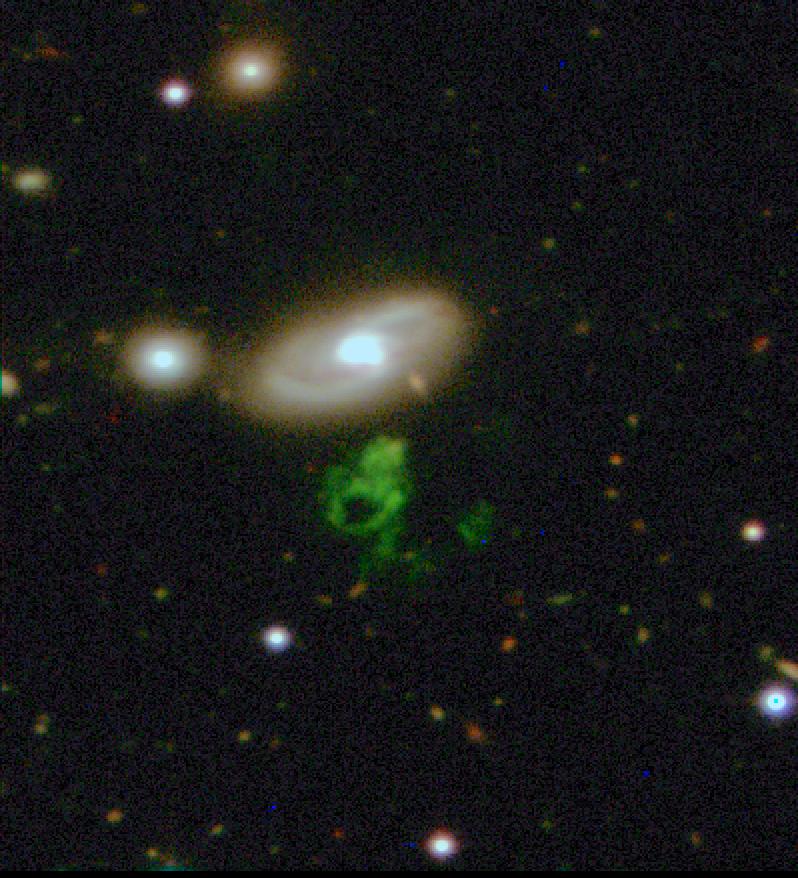 http://antwrp.gsfc.nasa.gov/apod/ap080625.html
Wednesday, December 29, 2010
Replication Fall Offs
The replication of experimental results is a fundamental part of the scientific process. If you get some interesting results, someone else should try it too, to make sure what you got wasn't just a fluke. The Truth Wears Off: Is there something wrong with the scientific method? in the New Yorker documents many examples of scientific research in which there was an initial report of significance, followed by a sequence of replication attempts which yielded poor confirmation. Many of these cases were in medicine and psychology, fields in which experimental trials are extremely difficult and expensive.
This really isn't surprising at all. Scientific research is now a major industry. Thousands upon thousands of people are out there racking their brains to come up with new results. Each individual may try and discard dozens or hundreds of ideas before stumbling across something interesting and apparently significant. Now let's imagine a million people around the world are flipping coins every day. On some days, some of the flippers will get a very skewed outcome. A tiny number of people might even get a skewed result several days in a row. But if they keep trying to "replicate" their results, they will eventually find that the significance falls off due to a regression toward the mean. Alas, despite all the training and talent that goes into science, most of the novel ideas researchers try out will not end up being significant. But when thousands of insignificant ideas are tested, a small percentage will end up looking good - initially. Researchers are paid to get results, they will keep trying new ideas until they get a skewed result. But was that result truly significant, or was it just a statistical fluke? There are billions of circuit elements following Ohm's law in the computer I'm typing this with - that's not a statistical fluke. Some scientific results have been tested and replicated an astronomical number of times, especially when they prove useful in technology. But it shouldn't be surprising if difficult experiments - especially involving complicated living organisms - often prove to be disappointing despite some initial promise.
The Journal of Irreproducible Results collects science humor. Some of the examples in the New Yorker article aren't too funny however, especially in the medical field.
This really isn't surprising at all. Scientific research is now a major industry. Thousands upon thousands of people are out there racking their brains to come up with new results. Each individual may try and discard dozens or hundreds of ideas before stumbling across something interesting and apparently significant. Now let's imagine a million people around the world are flipping coins every day. On some days, some of the flippers will get a very skewed outcome. A tiny number of people might even get a skewed result several days in a row. But if they keep trying to "replicate" their results, they will eventually find that the significance falls off due to a regression toward the mean. Alas, despite all the training and talent that goes into science, most of the novel ideas researchers try out will not end up being significant. But when thousands of insignificant ideas are tested, a small percentage will end up looking good - initially. Researchers are paid to get results, they will keep trying new ideas until they get a skewed result. But was that result truly significant, or was it just a statistical fluke? There are billions of circuit elements following Ohm's law in the computer I'm typing this with - that's not a statistical fluke. Some scientific results have been tested and replicated an astronomical number of times, especially when they prove useful in technology. But it shouldn't be surprising if difficult experiments - especially involving complicated living organisms - often prove to be disappointing despite some initial promise.
The Journal of Irreproducible Results collects science humor. Some of the examples in the New Yorker article aren't too funny however, especially in the medical field.
Tuesday, December 28, 2010
Human Activity and Fires
Humans cause fires, right? Only You Can Prevent Forest Fires! It might seem that in places and times with less human presence and activity there should be fewer fires. But there is now evidence to the contrary: The Burning Issue in Science reports that evidence from Antarctic ice cores shows declining levels of fire in the Southern Hemisphere until the 1600's, followed by a dramatic peak in the 1800's and now unprecedented low levels of burning.
Sunday, December 26, 2010
Origins of Life at Higher Temperatures
Modern biology depends on an intricate web of chemical reactions, many of which are vastly accelerated by enzymes, which themselves are typically large molecules made by complicated machinery. How did this extraordinary network manage to evolve from a nonliving environment? This paper in PNAS, The Impact of temperature on the time required for the establishment of primordial biochemistry, and for the evolution of enzymes, points out in that many important biochemical reactions proceed much faster in higher temperature environments, which might have been typical in the early earth.
Monday, December 13, 2010
Sipidan
I've been scuba diving at Sipidan in Malaysia for five weeks now. Some of the highlights have included: swimming in the middle of school of 80 bumphead parrotfish, helping my dive guide Niger rescue a sea turtle which had a rope tied to its arms (today), watching two tiny (3 cm) cuttlefish apparently gobbling up even tinier shrimp by shooting out a long thin retractable tentacle out from the midst of their other tentacles (yesterday).
Allister Lee's blog Aquatastic has lots of nice pictures of Sipidan.
Allister Lee's blog Aquatastic has lots of nice pictures of Sipidan.
Saturday, December 11, 2010
Money Spoils the Fun
People will do some things just for the fun of it. What happens if you provide a financial reward for the same task? The task in this case is to try to press a button exactly 5 seconds after a cue. This study shows that that the financial reward can undermine the appeal of a task people will do for fun: Neural basis of the undermining effect of monetary reward on intrinsic motivation and Removing financial incentives demotivates the brain
Friday, December 10, 2010
Entanglement at High Temperature
Entanglement is one of the most characteristic attributes of "quantum weirdness". Entangled systems are usually microscopic and low temperature. But when the system is not in thermal equilibrium, it should be possible to create entanglement at higher temperatures. Applications may include photosynthesis and perhaps even practical devices some day. See Quantum physics: Hot entanglement in Nature.
Tuesday, December 07, 2010
Is there a problem with Quantum Theory?
Jeremy Bernstein recounts the history of controversies in the interpretation of quantum theory in the preprint Dear Fellow Quantum Mechanics. In particular to we need to take a quantum/probabilistic view of past events as well as future ones? Creepy.
Thursday, November 11, 2010
How Cats Drink
I had always heard that the raspy hairs on the cat's tongue were what enabled it to lap up water so neatly. Not at all. The cat flicks the tip of its tongue into the water which shoots up a stream of water and the cat, with perfect timing, closes its jaws over the stream to capture it - four times a second! See For Cats, a Big Gulp With a Touch of the Tongue in The New York Times
Sunday, November 07, 2010
Spidan Diving
I've been diving in Sipidan and Mabul in Malaysia for the past couple of days. Two of the highlights were a purple hairy squat lobster (not a lobster but a tiny crab that lives on sponges and looks pretty much how it sounds) and a pair of sea moths or dragonfish, which at first glance look like a 3 cm long bit of scum sitting on the sand but are actually intricate little creatures under a cheap magnifying glass.
Saturday, November 06, 2010
Atlantic Deep Water Reversal
Warm water sinks in the North Atlantic, forming a deep water current which flows southward at the bottom of the Atlantic all the way to Antarctica. This has a profound effect on our climate - for example, contributing to the warm temperatures Europe enjoys despite its northernly latitude. However, during the last Ice Age the deep Atlantic current may have actually been reversed, flowing instead from south to north. See Reversed flow of Atlantic deep water during the Last Glacial Maximum in Nature.
Friday, November 05, 2010
Reionization Early Galaxies
According to the theory of the Big Bang, the cosmic microwave background was formed when then the temperature cooled so that that electrons and protons could combine to form atoms of neutral hydrogen. Currently however, the inter galactic medium consists mainly of ionized hydrogen gas. When and how this gas became reionized is one of the biggest puzzles in current cosmology. See Early star-forming galaxies and the reionization of the Universe in Nature.
Thursday, November 04, 2010
The Murders in the Rue Morgue
At the moment I'm in Kota Kinabula, Malaysia on the island of Borneo. Earlier this afternoon I wandered into a little bookstore near my hotel, browsed through the classics section and idly picked up a copy of The Murders in the Rue Morgue by Edgar Allan Poe, which is often credited as one of the earliest detective stories. I just read it. If you, dear detective, browse back a few posts in this blog, you may be able to perceive a tiny bit of a correlation between that story and my own recent activities. The correlation was not premeditated: I'm not sure if I've actually read Poe's story before, - but if I did, it was long ago and I definitely didn't remember the pertinent coincidence, because I was amusing myself by trying to figure out the mystery as the story went along.
Wednesday, November 03, 2010
Unintuitive Mathematics
Some mathematical methods can seem rather unintuitive in practice and worse, sometimes yield startling and uninintuive results - for example Goedel's incompleteness theorem and Cantorian set theory. Terence Tao continues his discussion of mathematical techniques in The “no self-defeating object” argument, and the vagueness paradox.
Tuesday, November 02, 2010
Why Medical Studies are Often Wrong
Lies, Damned Lies, and Medical Science in the Atlantic Magazine.
Much of what medical researchers conclude in their studies is misleading, exaggerated, or flat-out wrong. So why are doctors—to a striking extent—still drawing upon misinformation in their everyday practice? Dr. John Ioannidis has spent his career challenging his peers by exposing their bad science.
Much of what medical researchers conclude in their studies is misleading, exaggerated, or flat-out wrong. So why are doctors—to a striking extent—still drawing upon misinformation in their everyday practice? Dr. John Ioannidis has spent his career challenging his peers by exposing their bad science.
A Clever Auto Security Attack
An electronic car lock jammer (inexpensive and readily available) can be used by thieves to prevent a car owner from locking their car. After the owner leaves the vicinity of their unlockable car, the robbers collect any valuables left inside. See Thieves jam key-fob lock signals in mystery car thefts: Tech-savvy blaggers lift swag leaving windows intact
Problem Solving Strategies in Real Analysis
Fields medallist Terence Tao let's us in on his problem solving strategies - many of which are specific to the subject he was teaching, Real Analysis, but some of them are more generic.
Orangutans
I just spent a week at an Orangutan sanctuary in Malaysia. Unsurprisingly, they have a great sense of balance - Harry was standing on my arms waving his hands in the air with the greatest of ease, somewhere in between these frames alas.


Wednesday, October 20, 2010

Gravitational Lensing
One of the most intriguing predictions of Einstein's theory of gravity, General Relativity, is that light rays are bent by massive objects. For example, if two galaxies are closely lined up from our point of view, the foreground galaxy can magnify the image of the background galaxy or create multiple images, etc. The source for the gravity of the foreground object could even be the mysterious substance "Dark matter". Hence gravitational lensing is a tool that can tell us something about the distribution of Dark matter - see the preprint Gravitational Lensing
Quantum Theory and Relativity
There are subtle issues with the compatability of the two workhorse theories of contemporary physics: special relativity and quantum mechanics. The EPR paradox from the 1930's (the E stands for Einstein) and Bell's Theorem from the 1960's are two of the classic examples. The weight of suspicion often tends to fall on the quantum side. Einstein, notably unenthusiastic about the fundamental role of probability in quantum mechanics, believed that "God does not throw dice". John Bell, when asked if quantum mechanics could be wrong replied, "I hesitated to think it might be wrong; but I knew it was rotten". Nonetheless quantum mechanics has turned out to be fantastically accurate and the basis for much our current understanding of matter and radiation - likewise for special relativity. The preprint Can quantum theory and special relativity peacefully coexist? discusses the issues.
Tuesday, October 19, 2010


UFO Over Harvard


UFO Over Harvard, October 11, 2010, 6:52pm
Taken from my place looking west. I might have been shooting through a closed window, not sure. I didn't notice the "UFO" at the time and it didn't appear in the previous or the next frames, taken at the same place and direction with minutes. The crescent moon was also near the horizon just outside the frame to the left. What was it?
Counterfactual Reasoning in Mathematics
In mathematics, we often assume something (not P), show that it leads to a logical contradiction, and then conclude that P is in fact true. Mathematician Terence Tao has an interesting discussion of proof by contradiction and related techniques in The “no self-defeating object” argument, revisited.
Friday, October 15, 2010
Void Models of Cosmic Acceleration
Spatial and temporal tuning in void models for acceleration is another preprint that makes the Void model appear rather contrived. Here a couple of my previous posts on the topic: A Vote for the Copernican Principle and The Copernican Principle.
Wednesday, October 13, 2010
À rebours
I recently stumbled upon the "decadent" 1884 novel À rebours by Joris-Karl Huysmans - a character in the book collects Redon paintings (see also my previous post).


The illustrations by Arthur Zaidenberg are scanned from the 1931 Illustrated Editions issue of A Rebours.
The protagonist has gemstones set in the back of a tortoise, which causes its death.


The illustrations by Arthur Zaidenberg are scanned from the 1931 Illustrated Editions issue of A Rebours.
The protagonist has gemstones set in the back of a tortoise, which causes its death.
Tuesday, October 12, 2010
Odilon Redon
 |
| Ophelia among the flowers |


My whole originality, therefore,
consists in having made improbable beings live humanly
according to the laws of the probable,
by as far as possible putting the logic of the visible
at the service of the invisible.
-ODILON REDON (1898)


Crying Spider - Smiling Spider.
Monday, October 11, 2010
The Cosmic Distance Ladder
How do we know the distance to objects that are really, really far away, like planets, stars and galaxies? Astronomers use a cosmic distance ladder to correlate different kinds of evidence about distances. Mathematician Terence Tao explains the cosmic distance ladder in a set of slides with plenty of nice graphics.
Thursday, October 07, 2010
The Kuiper Belt
More and more objects are being found in the Kuiper Belt, out beyond the planet Neptune. Some of them are quite large - over 2,000 kms in diameter. Paired objects are also quite common, some of the pairs are only loosely bound by gravity. Some of these observation pose difficulties for the standard theories of Solar System formation. See Kuiper Belt may be born of collisions at Nature.
The Accelerating Universe
The Accelerating Universe preprint.
In this article we review the discovery of the accelerating universe using type Ia supernovae. We then outline ways in which dark energy - component that causes the acceleration - is phenomenologically described. We finally describe principal cosmological techniques to measure large-scale properties of dark energy.
Wednesday, October 06, 2010
Steam Airships
Water vapor is actually significantly lighter than dry air. Hence a steam balloon or airship would have characteristics in between those of helium and hot air balloons. There are some issues, alas - condensation for example. The Flying Kettle web page describes one such project.
Monday, October 04, 2010
Where do Cosmic Rays Come From?
Cosmic rays, high energy particles, mostly protons and alpha rays, are bombarding our atmosphere. How are they accelerated and where do they come from? We don't know. It is thought that the cosmic rays originating within the Milky Way are generated by supernovas, though there are no direct observations. However, there are good reasons to believe that extremely high energy cosmic rays originate outside our galaxy. There's a review in the preprint The Search for the Sources of the Cosmic Rays One Century after their Discovery
A Quantum Tripwire
The quantum tripwire can detect an intruder with a very low probability of being noticed and low probabilities of false negatives and false positives. It uses the quantum Zeno effect. It is reported to work in realistic conditions. Here's the preprint: An Invisible Quantum Tripwire.
Wednesday, September 29, 2010
No hawks in church please
I'm reading The Wars of the Roses by Alison Weir. King Henry VI of England was pious, even to the extent that he would not allow his courtiers to bring their hawks into church. Apparently in the middle ages it was customary to bring your hawks and dogs to church and there were even cases when the right to do so was an express stipulation.
Strange radio pulses
In 2007 there was a report in Science of an intense radio burst which overloaded the detector at the Parkes radiotelescope in Australia. It was originally thought that the burst must be of extragalactic origin and of incredible power. But in the meantime 16 additional similar pulses have been identified at Parkes - however they clearly originate on or near the Earth. But the exact source is still unknown: Radio Bursts with Extragalactic Spectral Characteristics Show Terrestrial Origins . The authors of that report whimsically refer to these odd bursts as "Perytons" after a winged deer which casts the shadow of a man in Borges' Book of Imaginery Beings.
 |
| Parkes radio telescope |
Tuesday, September 28, 2010
Post 666
This is my 666th blog post. In honor of this rather dubious milestone, here's a selection of 42 of the over one hundred articles I've edited on another website, Wikipedia.
Aerobic anoxygenic phototrophic bacteria: very abundant marine plankton.
Big Bang nucleosynthesis: there is an unexplained discrepancy for the element Lithium.
Linda B. Buck: a Nobel prize winner in biology - recently retracted publications.
Lois McMaster Bujold: award winning scifi and fantasy author.
Cartesian Coordinates: French philosopher Oreseme anticipated Descartes by centuries.
Cassiopeia A: a supernova remnant and a very strong radio source.
Clovis point: beautiful spear points from ancient America.
Coherent perfect absorber: a time-reversed laser.
Dwarf galaxy problem: there aren't as many as expected.
Geminga: an unusual neutron star which generated the Local Bubble.
J. Richard Gott: Princeton professor of astrophysics with a Doomsday Theory.
GSI anomaly: unexplained oscillations detected at a German laboratory.
Guzheng: a classical Chinese musical instrument.
Haptophyte: tiny uncultured pico-prymnesiophytes are ecologically important.
Helical Dirac fermion: behaves like a massless relativistic particle.
Helitron: DNA which replicates by a rolling-circle mechanism.
Inner Core: the central core of the earth has an East-West asymmetry.
Richard J. Lipton: computer scientist, Gödel's Lost Letter and P=NP is his blog.
Local Void: a vast empty region of space near our Milky Way galaxy.
Mira B: the companion of the variable star Mira is now believed to be a white dwarf.
National Spatial Reference System: is a coordinate system managed by the US.
Pre-solar nebula: a supernova shock wave may have triggered the formation of the Sun.
Puerto Plata: is a resort town on the north coast of the Dominican Republic.
Ptychography: allows X-ray microscopes without using lenses.
Quantum Gravity: this theory has a Problem with Time.
The Rose of Versailles: is a Japanese manga set during the French Revolution.
RX J0852.0-4622: a nearby supernova which should have been visible around 1250.
SCP 06F6: an extremely luminous supernova.
Second harmonic imaging microscopy: useful in imaging in living tissues.
Segue 1: a dwarf galaxy dominated by Dark Matter.
Three Tales: the tale A Simple Heart by Flaubert inspired the novel Flaubert's Parrot.
Time dilation : A surprising consequence of relativity.
Topological insulator: an exotic material that has insulating and conducting regions.
Torquetum: a medieval astronomical instrument.
Transit of Venus: Venus will cross the face of the Sun again in 2012.
Type IIn supernovae: extremely energetic supernovae.
Type IIb supernovae: a star with a mostly helium core explodes.
Venus: the planet was completely resurfaced 300-600 million years ago.
Water window: water is transparent to part of the X-ray spectrum.
Xenocarida: the "strange shrimp" are a group of recently discovered Crustacea.
Shing-Tung Yau: distinguished mathematician, Poincaire conjecture controversy.
Zero Morphism: is a concept in the mathematical subject Category Theory.
 |
| The Number of the Beast is 666 - William Blake |
Aerobic anoxygenic phototrophic bacteria: very abundant marine plankton.
Big Bang nucleosynthesis: there is an unexplained discrepancy for the element Lithium.
Linda B. Buck: a Nobel prize winner in biology - recently retracted publications.
Lois McMaster Bujold: award winning scifi and fantasy author.
Cartesian Coordinates: French philosopher Oreseme anticipated Descartes by centuries.
Cassiopeia A: a supernova remnant and a very strong radio source.
Clovis point: beautiful spear points from ancient America.
Coherent perfect absorber: a time-reversed laser.
Dwarf galaxy problem: there aren't as many as expected.
Geminga: an unusual neutron star which generated the Local Bubble.
J. Richard Gott: Princeton professor of astrophysics with a Doomsday Theory.
GSI anomaly: unexplained oscillations detected at a German laboratory.
Guzheng: a classical Chinese musical instrument.
Haptophyte: tiny uncultured pico-prymnesiophytes are ecologically important.
Helical Dirac fermion: behaves like a massless relativistic particle.
Helitron: DNA which replicates by a rolling-circle mechanism.
Inner Core: the central core of the earth has an East-West asymmetry.
Richard J. Lipton: computer scientist, Gödel's Lost Letter and P=NP is his blog.
Local Void: a vast empty region of space near our Milky Way galaxy.
Mira B: the companion of the variable star Mira is now believed to be a white dwarf.
National Spatial Reference System: is a coordinate system managed by the US.
Pre-solar nebula: a supernova shock wave may have triggered the formation of the Sun.
Puerto Plata: is a resort town on the north coast of the Dominican Republic.
Ptychography: allows X-ray microscopes without using lenses.
Quantum Gravity: this theory has a Problem with Time.
The Rose of Versailles: is a Japanese manga set during the French Revolution.
RX J0852.0-4622: a nearby supernova which should have been visible around 1250.
SCP 06F6: an extremely luminous supernova.
Second harmonic imaging microscopy: useful in imaging in living tissues.
Segue 1: a dwarf galaxy dominated by Dark Matter.
Three Tales: the tale A Simple Heart by Flaubert inspired the novel Flaubert's Parrot.
Time dilation : A surprising consequence of relativity.
Topological insulator: an exotic material that has insulating and conducting regions.
Torquetum: a medieval astronomical instrument.
Transit of Venus: Venus will cross the face of the Sun again in 2012.
Type IIn supernovae: extremely energetic supernovae.
Type IIb supernovae: a star with a mostly helium core explodes.
Venus: the planet was completely resurfaced 300-600 million years ago.
Water window: water is transparent to part of the X-ray spectrum.
Xenocarida: the "strange shrimp" are a group of recently discovered Crustacea.
Shing-Tung Yau: distinguished mathematician, Poincaire conjecture controversy.
Zero Morphism: is a concept in the mathematical subject Category Theory.
Oxygen increase in the Devonian Period
There's new evidence of a substantial increase in ocean oxygen content during the Devonian period about 400 million years ago. That was around the time that vascular plants arose, so perhaps that's what caused the increase. At the same time more complicated animals such as predatory fish evolved - so perhaps the higher level of oxygen is what made that possible. See Plants set stage for evolutionary drama in Nature.
Monday, September 27, 2010
Shakespearean Titles
Many literary works derived their titles from passages in Shakespeare, e.g. Brave New World, The Sound and the Fury.
Another one of my favorites is the poem/novel Pale Fire by Vladimir Nabokov.
The moon's an arrant thief,
And her pale fire she snatches from the sun.
Timon of Athens
Once I got caught in a strange web created by Nabokov and another author which involved the following lines from Pale Fire:
Space is a swarming in the eyes,
and Time a singing in the ears
I was reading the Nabokov novel Ada. In Ada Nabokov mentioned the lines above as quoted by "the invented philosopher Martin Gardiner". I thought I was hallucinating, since coincidentally I was also in the middle of reading a popular science book The Ambidextrous Universe with a nearly identical author - Martin Gardner. Fortunately it happened to be the second edition of the Ambidextrous Universe, which, when I read further, provided the explanation. Nabokov's misspelling of Gardner's name was probably deliberate!
By the way, it probably wouldn't be too surprising if even a humble blog might have had the nerve to derive its title from a well-known passage in Shakespeare.
Another one of my favorites is the poem/novel Pale Fire by Vladimir Nabokov.
The moon's an arrant thief,
And her pale fire she snatches from the sun.
Timon of Athens
Once I got caught in a strange web created by Nabokov and another author which involved the following lines from Pale Fire:
Space is a swarming in the eyes,
and Time a singing in the ears
I was reading the Nabokov novel Ada. In Ada Nabokov mentioned the lines above as quoted by "the invented philosopher Martin Gardiner". I thought I was hallucinating, since coincidentally I was also in the middle of reading a popular science book The Ambidextrous Universe with a nearly identical author - Martin Gardner. Fortunately it happened to be the second edition of the Ambidextrous Universe, which, when I read further, provided the explanation. Nabokov's misspelling of Gardner's name was probably deliberate!
By the way, it probably wouldn't be too surprising if even a humble blog might have had the nerve to derive its title from a well-known passage in Shakespeare.
Two Plays by Tom Stoppard
I just reread The Real Inspector Hound and After Magritte, two plays by Tom Stoppard. The Real Inspector Hound, a parody of the "murder at the stately English country home" genre, is much the better. But my favorite exchange was in After Magritte:
THELMA: ... All I can say is I'll be glad when it's all over and things are back to normal. It's making you short-tempered and argumentative. You contradict everything I say --
HARRIS: (heatedly) That I deny --
What if, instead of contradicting her, Harris had agreed with Thelma and said "You're right"?
Stoppard has worked on film scripts as well as theater. The dystopian film Brazil, directed by Terry Gilliam, is one of my favorites. I didn't realize that he also contributed much of the dialog for Indiana Jones and the Last Crusade, a Steven Spielberg film that I also enjoyed.
This (substantive) modification of Stoppard's dialog has bothered me:
ALICE: You contradict everything I say.
BOB: You're right.
I considered whether this might be some variant of the Liar Paradox similar to:
The next sentence is false.
The previous sentence is true.
That really is a logical paradox: try to make the first sentence true - it doesn't work; try to make the first sentence false - it doesn't work either.
But there's really no logical problem with Alice and Bob. Alice's statement is false and so is Bob's. Bob's response falsifies Alice's previous statement. Bob proves Alice wrong by agreeing with her. However since Bob proved Alice wrong, in a certain sense he actually did contradict her. Which would seem to make Alice's statement true (or at least it could be true - assuming all of Bob's other statements also contradicted her). But didn't I just say it was false? Still it isn't really a paradox in pure logic. Is it?
While we're at it, let's take a look at this stripped-down version of Stoppard's original Thelma and Harris exchange:
THELMA: You contradict everything I say.
HARRIS: That I deny.
Thelma's statement could be true (at least when Harris contradicts her in all other cases - let's go ahead assume that). The Harris statement denies what Thelma just said, that denial counts as a contradiction (I suppose) and so the Harris statement is consistent with the meaning of Thelma's assertion. Hence, the Harris statement supports Thelma's assertion. Then given that we're assuming Harris otherwise contradicts Thelma, Thelma's statement must be true. On the other hand, Thelma asserts that Harris contradicts everything she says and Harris' subsequent statement supports that. If Harris' statement supports Thelma's statement, it can hardly be contradicting her. So Thelma's statment must be false. But didn't I just say Thelma's statement must be true? Oops.
What do you think? But please, don't contradict everything I say.

"if it was so, it might be; and if it were so, it would be; but as it isn't, it ain't. That's logic."
--- Tweedledee in Through the Looking Glass by Lewis Carroll.
THELMA: ... All I can say is I'll be glad when it's all over and things are back to normal. It's making you short-tempered and argumentative. You contradict everything I say --
HARRIS: (heatedly) That I deny --
What if, instead of contradicting her, Harris had agreed with Thelma and said "You're right"?
Stoppard has worked on film scripts as well as theater. The dystopian film Brazil, directed by Terry Gilliam, is one of my favorites. I didn't realize that he also contributed much of the dialog for Indiana Jones and the Last Crusade, a Steven Spielberg film that I also enjoyed.
This (substantive) modification of Stoppard's dialog has bothered me:
ALICE: You contradict everything I say.
BOB: You're right.
I considered whether this might be some variant of the Liar Paradox similar to:
The next sentence is false.
The previous sentence is true.
That really is a logical paradox: try to make the first sentence true - it doesn't work; try to make the first sentence false - it doesn't work either.
But there's really no logical problem with Alice and Bob. Alice's statement is false and so is Bob's. Bob's response falsifies Alice's previous statement. Bob proves Alice wrong by agreeing with her. However since Bob proved Alice wrong, in a certain sense he actually did contradict her. Which would seem to make Alice's statement true (or at least it could be true - assuming all of Bob's other statements also contradicted her). But didn't I just say it was false? Still it isn't really a paradox in pure logic. Is it?
While we're at it, let's take a look at this stripped-down version of Stoppard's original Thelma and Harris exchange:
THELMA: You contradict everything I say.
HARRIS: That I deny.
Thelma's statement could be true (at least when Harris contradicts her in all other cases - let's go ahead assume that). The Harris statement denies what Thelma just said, that denial counts as a contradiction (I suppose) and so the Harris statement is consistent with the meaning of Thelma's assertion. Hence, the Harris statement supports Thelma's assertion. Then given that we're assuming Harris otherwise contradicts Thelma, Thelma's statement must be true. On the other hand, Thelma asserts that Harris contradicts everything she says and Harris' subsequent statement supports that. If Harris' statement supports Thelma's statement, it can hardly be contradicting her. So Thelma's statment must be false. But didn't I just say Thelma's statement must be true? Oops.
What do you think? But please, don't contradict everything I say.

"if it was so, it might be; and if it were so, it would be; but as it isn't, it ain't. That's logic."
--- Tweedledee in Through the Looking Glass by Lewis Carroll.
Time Will End
The preprint Eternal inflation predicts that time will end argues that cosmological theories which include "eternal inflation" will lead to the end of time - their estimate is 5 billion years for our galaxy. It may seem like you still have plenty of time, but it's never too soon to panic.
Saturday, September 25, 2010
Television Novels
1. The Wire is the best thing ever made for television. This Baltimore of drug dealers and the po-lice perhaps may be how the early third millennium will be remembered in the centuries to come.
2. I Claudius: Siân Phillips scheming depiction of Livia, the wife of Roman Emperor Augustus, is mesmerising. We are all rabbits and she is the snake.
3. Middlemarch the 1994 adaptation of the George Elliot novel. There's a film adaptation that's supposed to coming out soon, also by the screenwriter Andrew Davies.

Lost, Battlestar Galactica, Rome and Twin Peaks were all brilliant as well. I suppose The Sopranos should also be mentioned - James Gandolfini was tremendous but the pseudo-psychoanalytic intrusions put me off. Possibly the greatest work (after The Wire) made for television was The Decalogue made for Polish TV in 1988 by Krzysztof Kieślowski but it's a sequence of novellas as opposed to a single novel.
A couple of other of my favorite television series are rather more episodic than novelistic, so they don't quite fit the stated genre, but still excellent: a horse opera in outer space Firefly; and the ferociously hilarious Australian comedy Summer Heights High.
Friday, September 24, 2010
Aristotle's wheel paradox
Embarrassingly I'm still slowly reading Galileo at Work: His Scientific Biography by Stillman Drake. Aristotle's wheel paradox came up several times in the book so I finally looked it up at Wikipedia.
 When the inner and outer attached wheels make a complete revolution, they trace out lines of equal length, yet their circumferences are different.
How can that be?
How can that be?
Thursday, September 23, 2010
SCP 06F6
SCP 06F6 is a very unusual object discovered in 2006 by the Hubble Space Telescope. Its spectrum and light curve are unlike any other known. Initial observations weren't able to identify any of the typical spectral lines. The Palomar Transient Factory was able to determine its redshift (z = 1.189) and that its luminosity is one of the highest currently known: Mysterious transients unmasked as the bright blue death throes of massive stars.
Wednesday, September 22, 2010
A Vote for the Copernican Principle
The preprint Confirmation of the Copernican principle at Gpc radial scale and above from the kinetic Sunyaev Zel'dovich effect power spectrum provides evidence against the void model of dark energy/cosmic acceleration.
Tuesday, September 21, 2010
AntiNeutrino surprise at MINOS
One of the fundamental principles of particle physics is that particles and their anti-particles should have the same mass. So it was a big surprise when Fermilab MINOS collaboration found that the muon neutrino and muon antineutrino appear to have different masses. Neutrino experiments are extraordinarily difficult because neutrinos are so hard to detect. This result is still very preliminary. But if it does hold up, the impact on theoretical physics will be earthshaking.
See Neutrino surprise emerges from MINOS at PhysicsWorld .
See Neutrino surprise emerges from MINOS at PhysicsWorld .
Monday, September 20, 2010
The Sky in Boston tonight
was spectacular. Venus just after sunset in the West and a nearly full moon and a gigantic Jupiter in East, one of its closest approaches to Earth. All four of the major satellites of Jupiter were lined up and nearby was Uranus - actually the first time I believe I've ever seen it, with binoculars.
Unfortunately I couldn't see the following sight (Carina Nebula) with my binoculars, it is in the Southern Hemisphere, but the Hubble Space Telescope did.

Unfortunately I couldn't see the following sight (Carina Nebula) with my binoculars, it is in the Southern Hemisphere, but the Hubble Space Telescope did.

Dimensionality of the Universe
One of the most mysterious facts about our universe is that, for most purposes, it can be modelled as four-dimensional: with one dimension for time and three dimensions for space. Why four, why not three, why not 42? There have long been proposals that add more dimensions, especially extra spatial dimensions, which are curled up so tightly that we don't normally perceive them.
The following preprint proposes something different. At very small scales (subatomic) there are effectively fewer than three spatial dimensions while at very large scales (cosmological) there are effectively more than three spatial dimensions!
Vanishing Dimensions and Planar Events at the LHC
The following preprint proposes something different. At very small scales (subatomic) there are effectively fewer than three spatial dimensions while at very large scales (cosmological) there are effectively more than three spatial dimensions!
Vanishing Dimensions and Planar Events at the LHC
We propose that the effective dimensionality of the space we live in depends on the length scale we are probing. As the length scale increases, new dimensions open up. At short scales the space is lower dimensional; at the intermediate scales the space is three-dimensional; and at large scales, the space is effectively higher dimensional. This setup allows for some fundamental problems in cosmology, gravity, and particle physics to be attacked from a new perspective. The proposed framework, among the other things, offers a new approach to the cosmological constant problem and results in striking collider phenomenology and may explain elongated jets observed in cosmic-ray data.
Saturday, September 18, 2010
Codons matter
DNA codes for amino acids with triplets of bases (codons). There are four different bases and hence 64 different triplets. There are typically twenty different amino acids (plus start and stop signals) which need to be coded, so there is some redundancy - a single amino acid can have multiple codons which are all translated the same way. However, there is now evidence that the actual codon may make a difference. New Roles for Codon Usage in Science reports that two very similar but distinct proteins are modified differently, depending on the original codon.
Thursday, September 16, 2010
Tuesday, September 14, 2010
Bowerbirds use an optical illusion to trick their mates
Bowerbirds trick mates with optical illusions at Nature News. Male bowerbirds construct their bowers to create an optical illusion called forced perspective which makes them appear bigger than they really are.
The Problem of Time
The Problem of Time in Quantum Gravity
The problem of time in quantum gravity occurs because `time' is taken to have a different meaning in each of general relativity and ordinary quantum theory. This incompatibility creates serious problems with trying to replace these two branches of physics with a single framework in regimes in which neither quantum theory nor general relativity can be neglected, such as in black holes or in the very early universe.
Monday, September 13, 2010
The heliospheric current sheet
"The Sun with the heliosheet is like a bashful ballerina who is repeatedly trying to push her excessively high flaring skirt downward".


Wednesday, September 08, 2010
Universality
A first draft of a non-technical article on universality by Fields medallist Terence Tao. Talks about universality: when important attributes of a large-scale system can be independent of how the system works at smaller scales.
Tuesday, September 07, 2010
Solar Neutrinos
The preprint Solar neutrinos, helioseismology and the solar internal dynamics begins with an interesting history of the "solar neutrino problem".
The Mafia Game
The mafia game (or werewolf or assassin game) is a party game in which the organiser divides the players into two groups: the citizens and the mafia. The mafia are told who the other mafia are, but the citizens don't know. The game alternates between the "day" when all the players decide who to "lynch" and the "night" when just the mafia decide who to eliminate. The game ends when either all the citizens or all the mafia are eliminated.
The preprint A mathematical model of the Mafia game provides an analysis of strategy.
The preprint A mathematical model of the Mafia game provides an analysis of strategy.
Monday, September 06, 2010
Testing the Universality of Free Fall
There's an interesting debate in Nature about atom interferometry tests of gravitational redshifts and what they imply about the university of free fall and the Einstein equivalence principle. See the preprint Atom gravimeters and gravitational redshift and the reply. See also the preprint Gravitational Redshift, Equivalence Principle, and Matter Waves. One of the authors in this controversy is Nobel prize winner and Department of Energy secretary Steven Chu.
Saturday, September 04, 2010
The Copernican Principle
The Copernican Principle posits that the Earth is not in any particularly special location in the universe. Prior to Copernicus, the Earth had been placed in the center of the universe and historically there was much resistance to moving it - early in his career even Galileo had a fanciful rationale for putting the earth at the center.
The Standard Model of Cosmology pretty much enshrines the Copernican Principle. It has had some success explaining phenomenon like the extragalactic redshifts, microwave background radiation and the abundances of light elements.
However there are some difficulties with this model, especially the observed acceleration of the redshifts (Dark Energy) and the abundance of lithium 7.
The preprint Do primordial Lithium abundances imply there's no Dark Energy? explains these observations by heretically suggesting that the Earth might be in a rather special place after all: near the center of a gigantic void. See also The Cosmic Microwave Background in an Inhomogeneous Universe - why void models of dark energy are only weakly constrained by the CMB by the same authors.
The Standard Model of Cosmology pretty much enshrines the Copernican Principle. It has had some success explaining phenomenon like the extragalactic redshifts, microwave background radiation and the abundances of light elements.
However there are some difficulties with this model, especially the observed acceleration of the redshifts (Dark Energy) and the abundance of lithium 7.
The preprint Do primordial Lithium abundances imply there's no Dark Energy? explains these observations by heretically suggesting that the Earth might be in a rather special place after all: near the center of a gigantic void. See also The Cosmic Microwave Background in an Inhomogeneous Universe - why void models of dark energy are only weakly constrained by the CMB by the same authors.
Friday, September 03, 2010
A Light Sucker
Laser science: Suckers for light in Nature.
A Coherent perfect absorber is:
Backward lasing yields a perfect absorber
A Coherent perfect absorber is:
An optical device has been designed that performs a function exactly opposite to that of a laser. It perfectly absorbs incoming coherent radiation and turns it into thermal or electrical energy.
Backward lasing yields a perfect absorber
Just as a laser can emit coherent light from an amplifying medium, an absorbing medium can perfectly capture incoming radiation under the right conditions
CPA-based interferometers could thus have potential applications in the realization of transducers, modulators, or optical switches, for example, in on-chip integrated optical circuits based on Si waveguide/resonator technology.
The Sun's Elements
An Unsettled Debate About the Chemistry of the Sun in Science.
There's a debate about how much carbon, nitrogen, oxygen and neon the sun contains. NASA
NASA
There's a debate about how much carbon, nitrogen, oxygen and neon the sun contains.
 NASA
NASA
Thursday, September 02, 2010
Probability Puzzles
There's an intersting discussion of some confusing Probability Puzzles on John Baez's new blog.
“I have two children. One is a boy born on a Tuesday. What is the probability I have two boys?”
The "born on a Tuesday" information can't possibly make a difference, can it? So the answer should be same same as:
“I have two children. One is a boy. What is the probability I have two boys?”
Shoudn't it?
There's a thorough analysis at Some Thoughts on Tuesday's Child by Greg Egan.
“I have two children. One is a boy born on a Tuesday. What is the probability I have two boys?”
The "born on a Tuesday" information can't possibly make a difference, can it? So the answer should be same same as:
“I have two children. One is a boy. What is the probability I have two boys?”
Shoudn't it?
There's a thorough analysis at Some Thoughts on Tuesday's Child by Greg Egan.
Tuesday, August 31, 2010
Thursday, August 26, 2010
Collider Physics
There is currently much excitement in physics due to the LHC, the huge new European particle accelerator. This preprint explains the theoretical analysis of such experiments: Introduction to Collider Physics.
 Insertion of the vacuum-tank of the CMS detector in the LHC
 Insertion of the vacuum-tank of the CMS detector in the LHC
More Quantum Inequalities
Quantum mechanics: The usefulness of uselessness in Nature.
Bell pointed out that quantum mechanics violates certain inequalities that are true in classical physics. This article discusses other inequalities that even quantum mechanics respects but which distinguish it from "super quantum theories" that would be able to violate these inequalities.
Bell pointed out that quantum mechanics violates certain inequalities that are true in classical physics. This article discusses other inequalities that even quantum mechanics respects but which distinguish it from "super quantum theories" that would be able to violate these inequalities.
How big is the Proton?
The proton shrinks in size: Tiny change in radius has huge implications - in Nature.
Problems with Quantum Mechanics
Might I say immediately … we always have had a great deal of difficulty in understanding the world view that quantum mechanics represents … I cannot define the real problem, therefore I suspect there’s no real problem, but I am not sure there’s no real problem.Jeremy Bernstein in FAPP and Non-FAPP: A Pedagogical Essay discusses the foundations of quantum mechanics. Bernstein is a very good writer and he explains some aspects of this problematic field quite well. In the end, however, it still seems just as problematic as ever.
Richard Feynman
FAPP - For All Practical Purposes
Once Bernstein happened to visit physicist Erwin Schroedinger in his Vienna apartment.
There was no cat. He did not like cats.
Wednesday, August 25, 2010
Weak Lensing
Weak lensing, dark matter and dark energy preprint.
Weak gravitational lensing is rapidly becoming one of the principal probes of dark matter and dark energy in the universe. In this brief review we outline how weak lensing helps determine the structure of dark matter halos, measure the expansion rate of the universe, and distinguish between modified gravity and dark energy explanations for the acceleration of the universe. We also discuss requirements on the control of systematic errors so that the systematics do not appreciably degrade the power of weak lensing as a cosmological probe.
Tuesday, August 24, 2010
Nicole Oresme

Nicole Oresme was a sophisticated 14th century French philospher. He discussed and compared Earth-centered and Sun-centered models of the solar system and couldn't find any way to dismiss the Sun-centered model - though he personally didn't believe it. He also used techniques which were very close to Cartesian coordinate systems - over two hundred years before Descartes. See the Nicole Oresme article in the Stanford Encyclopedia of Philosophy.
RRAT's
Transient Radio Neutron Stars preprint.
Here I will review the high time resolution radio sky, focusing on millisecond scales. This is primarily occupied by neutron stars, the well-known radio pulsars and the recently identified group of transient sources known as Rotating RAdio Transients (RRATs). The RRATs appear to be abundant in the Galaxy, which at first glance may be difficult to reconcile with the observed supernova rate. However, as I will discuss, it seems that the RRATs can be explained as pulsars which are either extreme nullers, highly variable or weak/distant. I will re-cap some recent results including a re-analysis of the Parkes Multi-beam Pulsar Survey, which has identified several new sources, as well as the unusual timing behaviour of RRAT J1819-1458. This leads to an examination of where RRATs fit within the evolution of neutron stars post-supernova.
Measuring the mass of solar system planets using pulsar timing
Measuring the mass of solar system planets using pulsar timing
Apparently the pulse time of arrival from pulsars is so accurate it can help determine the masses of the planets of the solar system with accuracy comparable (or better) than data from spacecraft missions. That's because the motions of the other planets cause the Earth to wiggle in its orbit. The pulsar data allowed the researchers to determine the Earth's orbit so well, it could be used to determine the masses of the other planets!
See also Pulsar Signals Could Reveal Solar System Secrets at Science.
Apparently the pulse time of arrival from pulsars is so accurate it can help determine the masses of the planets of the solar system with accuracy comparable (or better) than data from spacecraft missions. That's because the motions of the other planets cause the Earth to wiggle in its orbit. The pulsar data allowed the researchers to determine the Earth's orbit so well, it could be used to determine the masses of the other planets!
See also Pulsar Signals Could Reveal Solar System Secrets at Science.
Monday, August 23, 2010
Hubble image of SN1987A
 HST SN1987A
When I saw this Hubble Space Telescope image of Supernova 1987A on Wikipedia, it was so spectacular at first I thought it must have been just some artist's conception.
Saturday, August 21, 2010
Picophytoplankton
Targeted metagenomics and ecology of globally important uncultured eukaryotic phytoplankton in PNAS.
Small (2-3μm) uncultured photosynthetic eukaryotic plankton (picophytoplankton) are a substantial component of the biomass and primary production in the oceans. Pico-prymnesiophytes genomes seem to be a mosaic, with the chloroplast and nuclear genomes from different lineages.
Small (2-3μm) uncultured photosynthetic eukaryotic plankton (picophytoplankton) are a substantial component of the biomass and primary production in the oceans. Pico-prymnesiophytes genomes seem to be a mosaic, with the chloroplast and nuclear genomes from different lineages.
Friday, August 20, 2010
The Pioneer Anomaly
The Pioneer Anomaly preprint.
Radio-metric Doppler tracking data received from the Pioneer 10 and 11 spacecraft from heliocentric distances of 20-70 AU has consistently indicated the presence of a small, anomalous, blue-shifted frequency drift uniformly changing with a rate of ~6 x 10^{-9} Hz/s. Ultimately, the drift was interpreted as a constant sunward deceleration of each particular spacecraft at the level of a_P = (8.74 +/- 1.33) x 10^{-10} m/s^2. This apparent violation of the Newton's gravitational inverse-square law has become known as the Pioneer anomaly; the nature of this anomaly remains unexplained. In this review, we summarize the current knowledge of the physical properties of the anomaly and the conditions that led to its detection and characterization. We review various mechanisms proposed to explain the anomaly and discuss the current state of efforts to determine its nature. A comprehensive new investigation of the anomalous behavior of the two Pioneers has begun recently. The new efforts rely on the much-extended set of radio-metric Doppler data for both spacecraft in conjunction with the newly available complete record of their telemetry files and a large archive of original project documentation. As the new study is yet to report its findings, this review provides the necessary background for the new results to appear in the near future. In particular, we provide a significant amount of information on the design, operations and behavior of the two Pioneers during their entire missions, including descriptions of various data formats and techniques used for their navigation and radio-science data analysis. As most of this information was recovered relatively recently, it was not used in the previous studies of the Pioneer anomaly, but it is critical for the new investigation.
Subscribe to:
Posts (Atom)


